
Finding common ground
A family-run resort in the Drakensberg offers a compelling lesson for the wine industry: when tourism is grounded in purpose, it can sustain the land, uplift communities and create experiences that truly endure.

· 6 min read
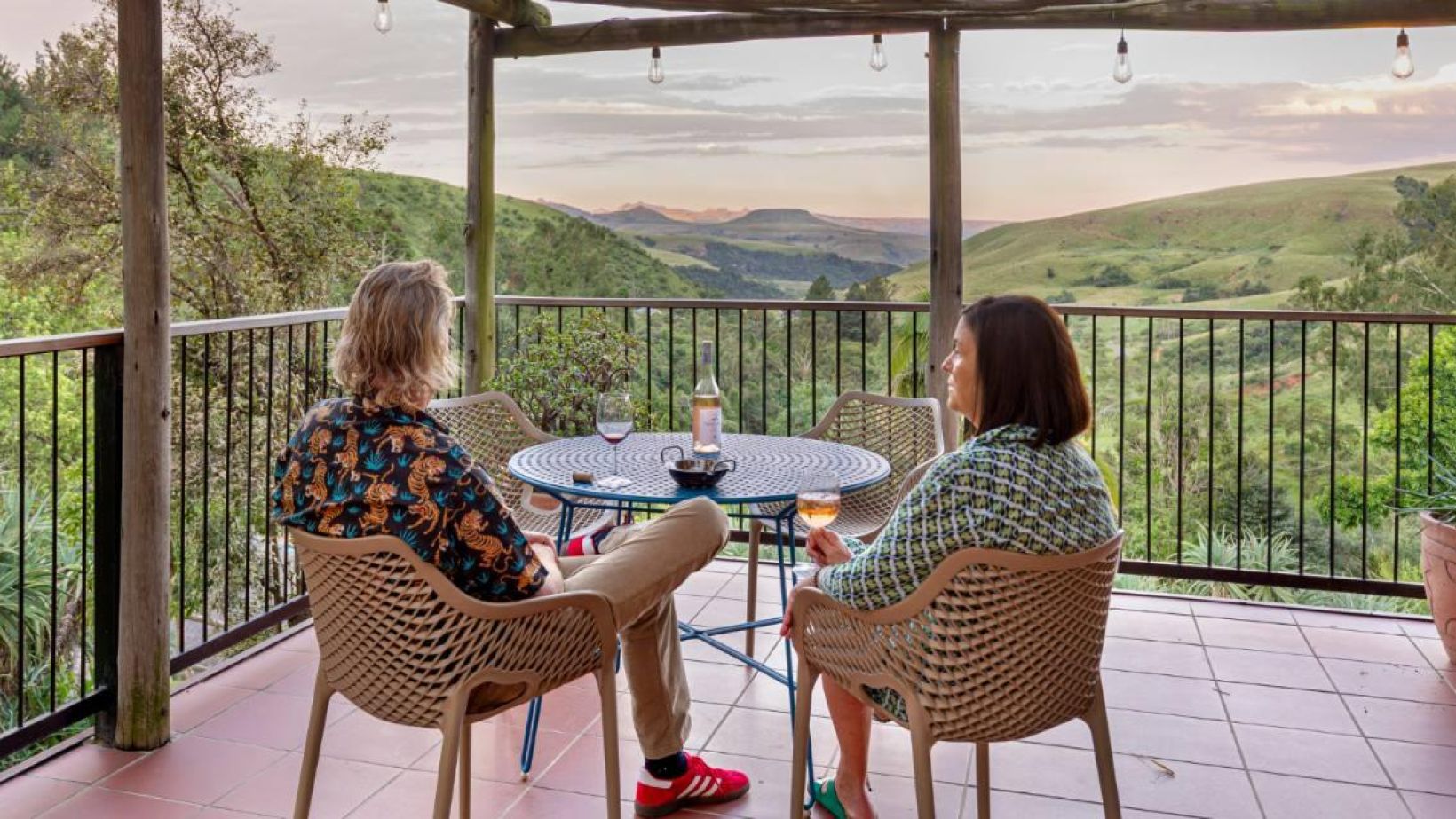
For a wine industry that’s increasingly leaning into tourism, the question is no longer whether to offer experiences, but what those experiences sustain. In rural South Africa, tourism has the potential to do more than drive revenue. It can protect landscapes, support communities and build something that lasts well beyond a single season. Which is why The Cavern’s story matters. While not a wine farm, it offers a blueprint for what wine tourism could be at its best.
The Cavern’s story started more than 80 years ago and remains grounded in the philosophy of its founder. “Our work is to create beauty, to make the land more fertile, to make our living, to leave the world better than when we first came into it,” Bill Carte said. Drawn by the towering sandstone cliffs of the Northern Drakensberg, Bill and wife Ruth established The Cavern guest farm in 1941. In those early years, guests stayed in simple thatched rondavels, explored the mountains on foot, and gathered for sundowners and conversation. After Bill’s passing in 1954, Ruth continued to build what they’d started, raising their four children while nurturing The Cavern from a modest homestead to a much-loved family resort.
Today, more than eight decades later, The Cavern is still a family-run business. It has grown and evolved, but the essence remains unchanged. It’s a place families return to, where people reconnect and the experience is grounded in something deeper than hospitality alone. It’s what guests have come to call “The resort of many happy returns”.
It’s also, perhaps unexpectedly, a story that’s relevant to wine.
For Megan Bedingham, a third-generation custodian of The Cavern, it has never been about chasing sustainability as a concept, but rather about continuing something that was already set in motion long before the concept of sustainability existed. “Commitment is key,” she says. “In the very early days, our grandmother, Ruth, made the decision to stop using the land for grazing and to rather conserve the grasslands. Her commitment was a financial loss, but it was most definitely an environmental gain.”
Ruth’s decision still influences everything that happens on the property today. And it’s perhaps where the most relevant lesson for wine begins, not in what is added, but in what is chosen to protect, even if it comes at a cost.
At The Cavern, conservation is a rhythm. “Conservation needs to be lived every day,” Megan says. “It’s about assessing what we do and how we do it, and making continual changes.” That means clearing invasive species year after year, knowing that seeds can lie dormant for decades. It also means repairing trails after storms or investing in land restoration without an immediate return. It’s repetitive, often unseen work. “But if left undone, the consequences are devastating,” she says, referring to the invasive silver wattle. “The impact on the water table, the erosion . . . we have to commit to controlling it wholeheartedly.”
For wine estates, this feels familiar. The relationship with land is never static. It demands attention, consistency and a long-term view that stretches beyond a single vintage. But stewardship alone doesn’t sustain a business. At The Cavern, tourism makes that work possible. “Tourism is what drives our business,” Megan says.
It’s this interplay between commercial viability and environmental care that sits at the centre of the model. Tourism generates income that supports conservation investment, from clearing alien vegetation to maintaining infrastructure. And when done thoughtfully, development doesn’t compete with conservation, it enables it. For a wine industry increasingly leaning into tourism as a revenue stream, this is where the conversation becomes more nuanced. It’s not simply about adding experiences, but about asking what those experiences sustain.
At The Cavern, that answer extends beyond the land into the surrounding community. “Rural communities rely on tourism for jobs and opportunity,” Megan says. “The link can be powerful when it comes to giving a community hope.”
Through the Royal Drakensberg Education Trust, the family has invested in early childhood development, teacher training and caregiver support, creating pathways that extend far beyond the property itself. What stands out is the scale of the work and its deep integration into the business. “It forms part of our purpose,” she says. “It’s why we get up each day. It’s very much intertwined with our day-to-day business, so it’s authentic, not just an add-on.” This is where many tourism strategies falter. When community or conservation becomes a layer rather than a foundation, guests notice it. Teams notice it. And over time, the story loses its weight. At The Cavern, the story is not manufactured. It’s lived and then shared. “We have a book in each room that tells the family story. We share stories in conversation, on menus, in small ways. Storytelling builds an emotional connection . . . and people take that story home.”
For wine, where storytelling has become central to the visitor experience, The Cavern presents a subtle but important distinction. The story is not something you create. It’s something you uncover, protect and tell honestly, even when it includes hardship. And perhaps most importantly, it’s something your people believe in. “It’s about creating something bigger than an individual,” Megan says. “Everyone needs to know they’re part of it and contributing to it. That sense of shared purpose is what guests ultimately experience. It’s in the way a place feels, not just what it offers.”
Megan sees the opportunity for South African tourism, and by extension wine tourism, in exactly this space. “Investing in people and communities has been a great source of motivation for us,” she says. “Visitors notice. They know they’re contributing to something meaningful.” The Cavern is a reminder that the future of tourism is not only about attracting visitors, but about what those visits enable, she says. This presents a challenge and an opportunity to move beyond experience as a product and towards experience as participation in something bigger.
At The Cavern, they call it “the gift of experience”. It’s a simple phrase, but one that carries weight. “When done well, an experience does more than create a memory,” Megan says. “It connects labour with land, visitors with place and business with legacy. And with that connection, something lasting is built.”
To read more articles in our August issue themed “Champions of Change,” buy a copy here.

More from
People, community and tourism

South African wineries shortlisted for Golden Vines award
South Africa continues to make its mark on the global stage, taking two of the three World’s Best Rising Star spots, with Mullineux and Alheit Vineyards shortlisted alongside Spain’s Comando G. The Sadie Family Wines, Rising Star winner in 2023 and 2024, has also progressed to the Best Fine Wine Producer in the Rest of the World shortlist. The shortlist is voted for by an Academy of nearly 1,300 senior wine and spirits professionals, whose insights directly inform the full report (released during the awards weekend).

Wine Tourism South Africa announces partnership
Wine Tourism South Africa has announced Air France-KLM as the official airline partner to the 2027 Wine Tourism Conference.
Brookdale Estate launches Wine Club
Brookdale Estate has announced the launch of its Wine Club, inviting wine lovers to become part of the estate’s ongoing evolution to discover new and exclusive wines from its Paarl cellar.