
Profit-saving in drought conditions

· 2 min read

One doesn’t need to be an avid reader, social media nut or academic to acknowledge the impact of the current drought the Western Cape is facing. Unfortunately, water restrictions in rural environments have a deeper impact than those in the cities; something that isn’t necessarily factored into these decisions. Suburban lawns and swimming pools cannot really be weighed up against food security, yet farmers are challenged more than ever to operate more efficiently.
For resilient entrepreneurs, this means some hard decisions will have to be made to ensure sustainable income levels in this season. A clinical view should be taken to ensure we aim towards a return on water (ROW) rather than return on ego (ROE). One way of determining this is by calculating the gross and net profit per block. This is the potential gross margin (Rand/ton x yield per block) and net farm income (gross margin minus total production cost) of the production unit.
The following case study will justify the impact of removing unprofitable blocks. Beware of chasing turnover, as it is profit that keeps you in business. Producer A had 155.36 ha of wine grapes with a total turnover of close to R5.5M and total nett farm income of R1.2M in 2012.
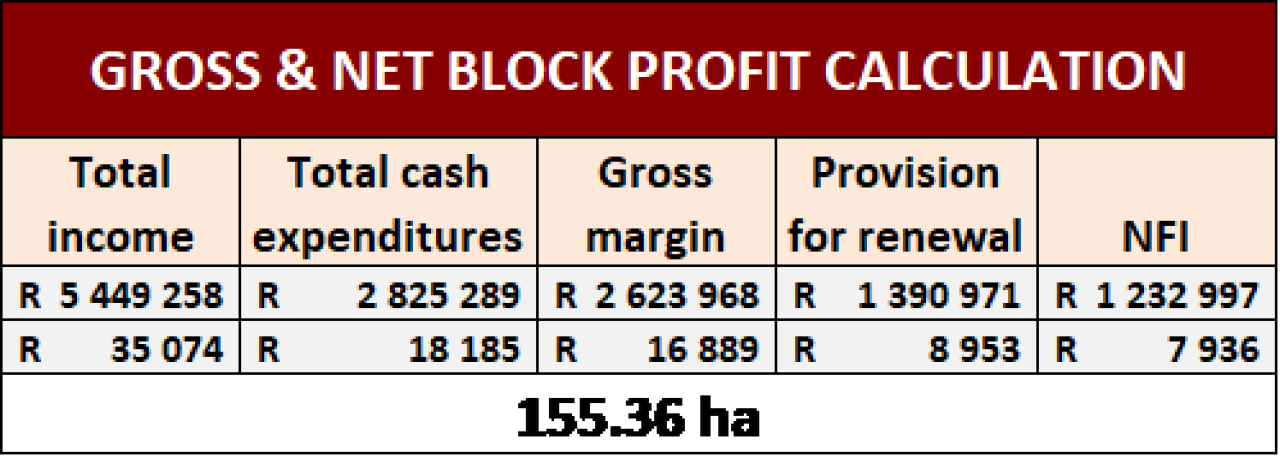
Step 1: Determine the profit per block

Step 2: Remove unprofitable blocks in consultation with the cellar and viticulturist

By removing 46 ha unprofitable hectares, turnover decreased by close to R1M but the net farm income increased by R350k. This may seem like a no-brainer, but it is concerning how common inefficient hectares still are in our industry. Guided by sound financial principles, water can be allocated according to profitability. Consider removing the less profitable and loss-making blocks and allocate resources accordingly, thereby ensuring the survival of the income generators. If a block doesn’t cover its direct production cost, cull it.
As the saying goes: turnover is vanity, profit is sanity and cash-flow is reality.

More from
Markets, business and trade

Does Government know what it’s costing you?
A decision made in Pretoria can change the way a wine business operates. But who makes sure the people making those decisions understand what happens on the ground? South Africa Wine’s Jordyn Goeieman takes us inside the often unseen work of influencing the policies that affect the industry.

All roads lead to Wine Paris
With professionals from more than 169 countries attending Wine Paris in 2026, the exhibition has become an increasingly important meeting point for the global wine trade. Nicolas Cuissard, Director of Wine Paris, speaks to WineLand about the exhibition’s growing international influence, opportunities for South African producers and what it takes to turn participation into business.
Before you bottle it, can you sell it?
A good wine and an attractive label are not enough to build a sustainable business. South Africa Wine’s Phil Bowes explains why finding customers, testing assumptions and understanding the numbers should come before committing to a new wine brand.