
Esca in SA vineyards
· 5 min read
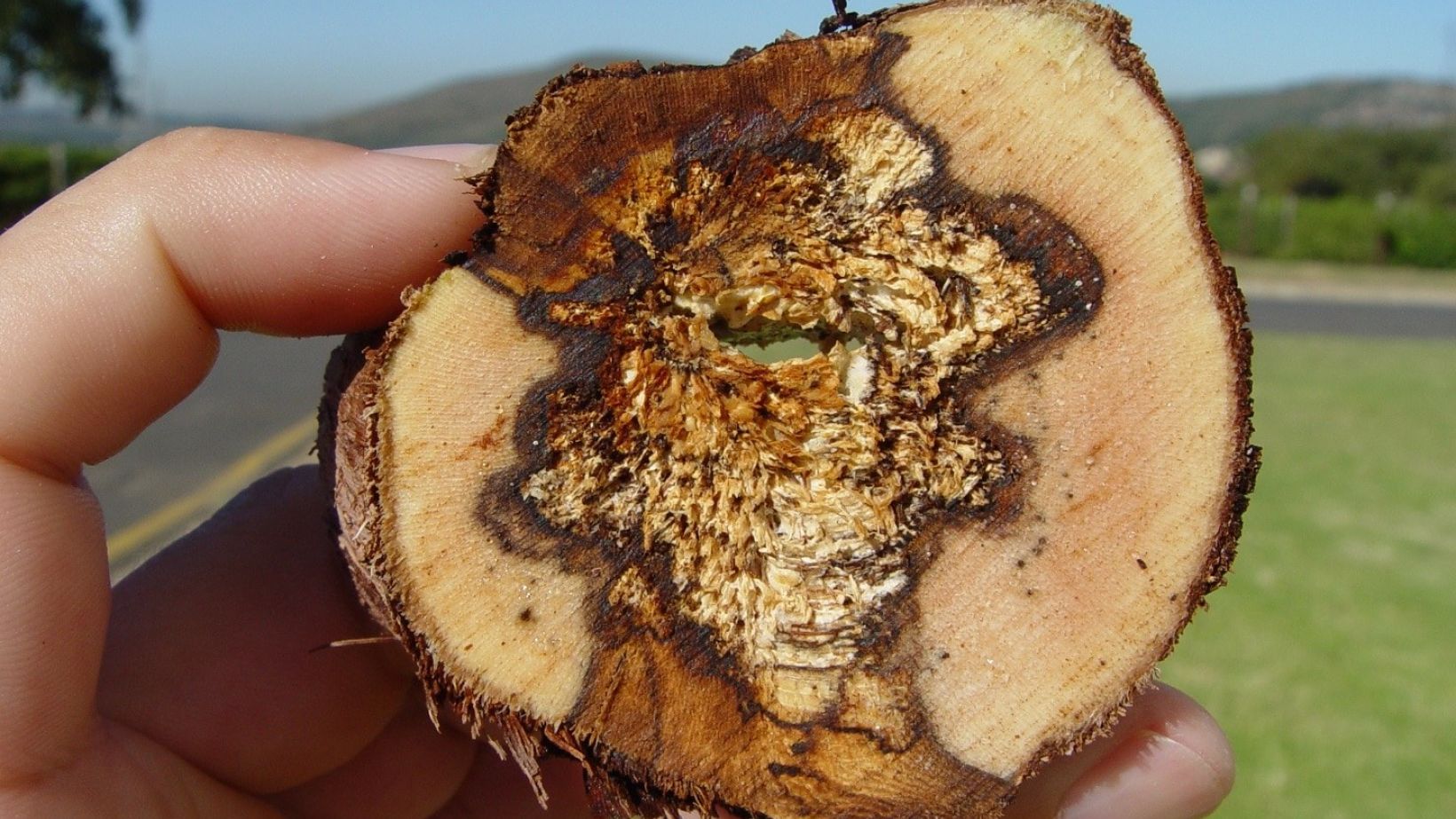
Esca is a fairly unknown grapevine disease in South Africa, although the disease has probably existed locally for decades. This article discusses the causative organisms, the symptoms by which the disease may be recognised and basic control strategies.In Europe esca is currently one of the biggest causes of grapevines’ dying, which lead to loss of income. In certain regions it is known as the ‘second phylloxera’.What exactly is esca? The definition of esca has changed regularly over the past few years. Certain researchers have suggested that the disease is caused by a succession of different fungi, while others consider it a complex of various diseases, inter alia a vascular and a wood rot disease. The vascular disease is linked to Phaeomoniella chlamydospora and Phaeoacremonium spp. which cause Petri disease, and wood rot with Basidiomycete fungi.What do the symptoms look like?A cross section of a trunk or arm of a grapevine with esca displays sections with soft yellow rot (Photo 1). The soft yellowing may be accompanied by a black or dark brown margin, while V-shaped browning and black or brown spots are also regularly observed. Leaves sometimes display characteristic tiger stripe symptoms (Photo 2). These symptoms start out as yellow spots between the veins (Photo 3). When the spots become larger, they coalesce and later appear as necrotic sections between the veins, hence the tiger stripe appearance. Leaf symptoms do not necessarily appear each year and the reasons for this are unknown. These characteristic symptoms are not very common in South African vineyards and may partially explain why the disease is not well known. In South Africa the disease usually goes hand in hand with a general decline of the plant. Berries may display characteristic purplish brown spots, although these symptoms have only been observed in isolated instances in South Africa (Photo 4). However, these symptoms are very common in California where it is known as black measles. Apoplexy, or the sudden wilting and dying of grapevines, is known as the acute form of esca (Photo 5). Symptoms are more common in older grapevines, although symptoms have been observed on seven to 10-year-old grapevines in South Africa. |
Economic importance of the disease
Esca considerably shortens the productive lifetime of a grapevine. Must and wine quality are also compromised. Spots on berries may render it impossible to market table grapes. The loss of income as a result of smaller crops and inferior quality grapes, together with the cost of new plantings, undoubtedly contribute to the economic impact of the disease. Large-scale monitoring and surveys in French vineyards have found esca to be currently responsible for an annual loss of 1 to 1.5 billion euros. (The total income of the French wine industry is 7 billion euros.) This figure only reflects the loss due to unproductivity and does not include the costs associated with re-establishment. Recent surveys in South Africa have shown that the disease occurs in all the wine-growing regions of the Western and Northern Cape, while it has also been observed in grapevines in Limpopo and Mpumalanga. Producers are mostly unaware of the disease and are under the impression that the deterioration in the plants’ performance is due to the age of the grapevines.
Control measures
The best advice is to prevent the disease. There is no remedy to heal the rotten and dead tissue. Producers are encouraged to buy certified nursery plants. Such grapevines have the best chance during establishment to develop into healthy, balanced grapevines with the ability to handle stress. Phaeomoniella chlamydospora and Phaeoacremonium spp. are able to infect plants at a very early stage. Wounds, in particular pruning wounds, are the most important infection portals in established grapevines and therefore pruning wound protection is of cardinal importance. A registered biological control agent, based on Trichoderma, is highly recommended. The Trichoderma fungus has the ability to colonise pruning wounds and to form a long lasting biological protective layer inside the pruning wound to fight pathogen infections. Basidiomycete fungi most probably infect plants through wounds, although this occurs at a later stage than pathogens of Petri disease. If symptoms of esca are observed, the affected section or arm can be sawn off and an extension made. This treatment will only be successful, however, if the symptomatic tissue is removed completely. It is good practice also to remove 10 to 15 cm of the ‘visually healthy’ wood, because the pathogens usually colonise the healthy wood before symptoms become visible. This wound then has to be treated with a wound sealer or biological product, because it is usually large and there is a reasonable chance that it may be reinfected.
– For further information, contact Francois Halleen at [email protected].
This article emanates from a research project that was financially supported by Winetech, WW06/37 (“Epidemiology and etiology of fungi associated with the grapevine disease esca”).

More from
Innovation and insights

Packaging under pressure: What wine businesses should be watching
From lighter bottles to automated packing lines, packaging decisions are becoming increasingly important to the cost and competitiveness of South African wine.

How vine water stress shapes grape and wine quality
This study formed part of the South Africa Wine programme “Grapevine production with limited water resources”, and aimed to evaluate how spatial and temporal water stress affects vine physiology, fruit composition and wine quality.

Drought tolerance of different scion cultivars (Part 4): Vegetative growth and yield
The study aimed to assess grapevine vegetative and yield responses in an almost worst-case scenario, i.e. grapevines growing under dryland conditions in sandy loam soil in the Swartland region.