
Hyperspectral - the answer to water stress? (Part 1)
Kyle Loggenberg, Albert Strever and Nitesh Poona
· 8 min read
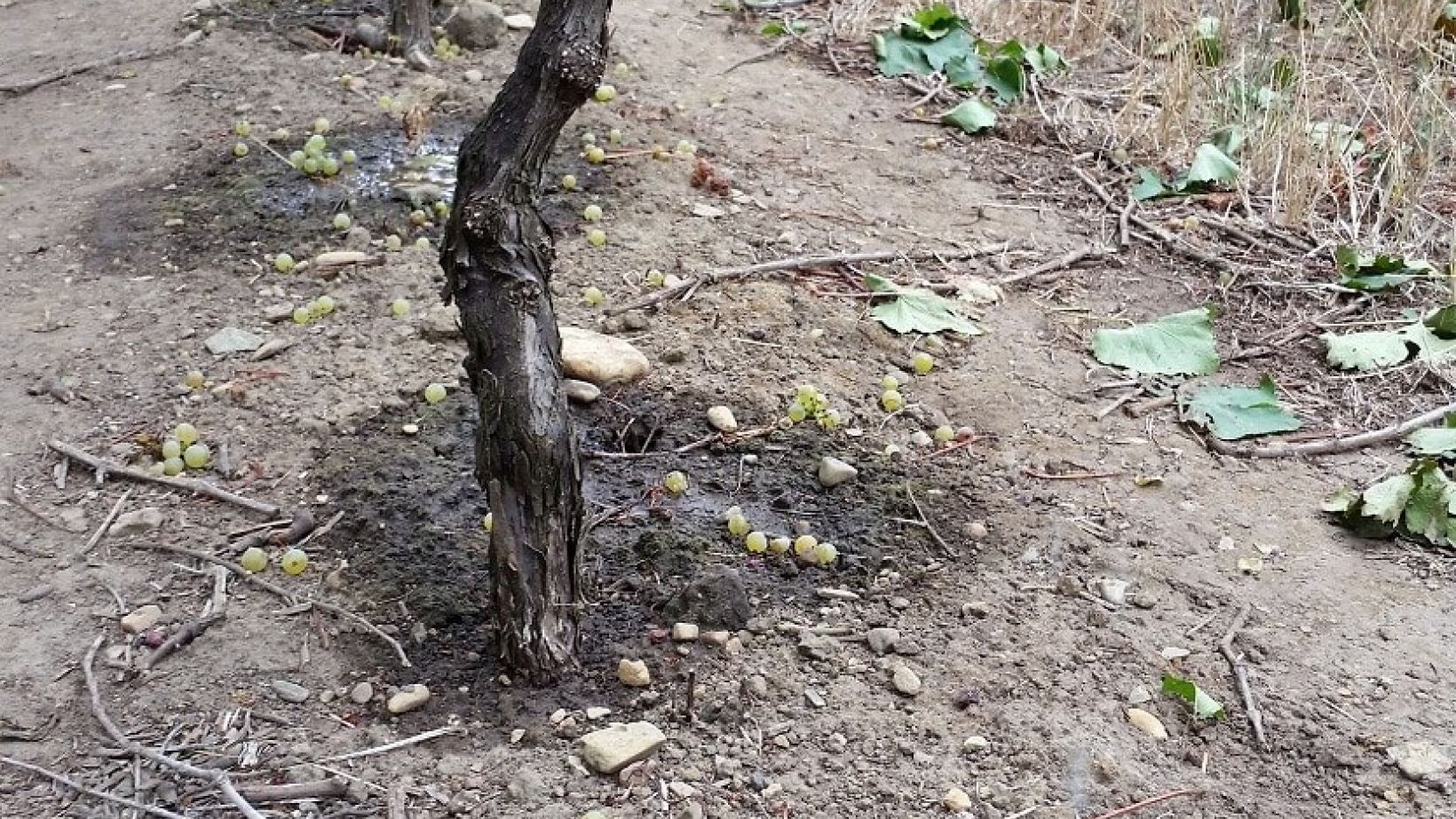
This study presents a novel hyperspectral-machine learning methodology for the non-destructive identification of water-stressed vines in a Shiraz vineyard.
Background
Water is a limited natural resource and a major environmental constraint for vineyard crop production. The unpredictability of rainfall patterns, combined with the potentially catastrophic effects of climate change, could present dire future scenarios of water shortages for grape farming. Furthermore, major water shortages would negatively affect vegetative growth and grape quality, potentially leading to devastating losses in grape production.1,2 Losses in crop production would have disastrous effects on job security and national income. It is therefore important to develop management schemes and farming practices that can improve water usage.
Developing methods capable of detecting water-stressed vines can help prevent these devastating crop losses and improve the management of water resources. Hyperspectral remote sensing (also known as imaging spectroscopy) could provide a potential solution for the monitoring of vineyard water status. Hyperspectral data collection captures a wide range of electromagnetic radiation (typically 350 - 2 500 nm) at narrow spectral intervals (typically 10 nm). The more detailed spectral information can better detect the biochemical and physiological differences of vegetation and therefore lead to more accurate detection of water-stressed vines.3,4 Hyperspectral data, analysed using machine learning algorithms, may prove to be the most accurate approach for the non-destructive detection of vineyard water stress.
Materials and methods
- Ground-based hyperspectral images were captured for a Shiraz vineyard on the Welgevallen experimental farm in Stellenbosch. The SIMERA HX MkII hyperspectral camera (SIMERA Technology Group, South Africa) was used to capture the hyperspectral images. Images comprised 176 spectral wavebands (p).
- Spectra samples were collected for both water-stressed and non-stressed vines. Vine water status was confirmed using in-field stem water potential measurements. These samples were used as input to classification.
- The Random Forest (RF)5 and Extreme Gradient Boosting (XGBoost)6 algorithms were used to discriminate between water-stressed and non-stressed vines. Classification models were developed using both default and optimised hyperparameter values for the RF and XGBoost algorithms.
- Three feature selection methods were employed to reduce processing complexity and to identify the wavebands most important for the detection of vineyard water stress. The Kruskal-Wallis (KW) filter,7 Sequential Floating Forward Selection (SFFS) wrapper,8 and a Filter-Wrapper (FW)9 feature selection methods were tested.
- The effectiveness of RF and XGBoost to identify water-stressed vines was assessed using an independent test dataset, confusion matrix and KHAT statistic.
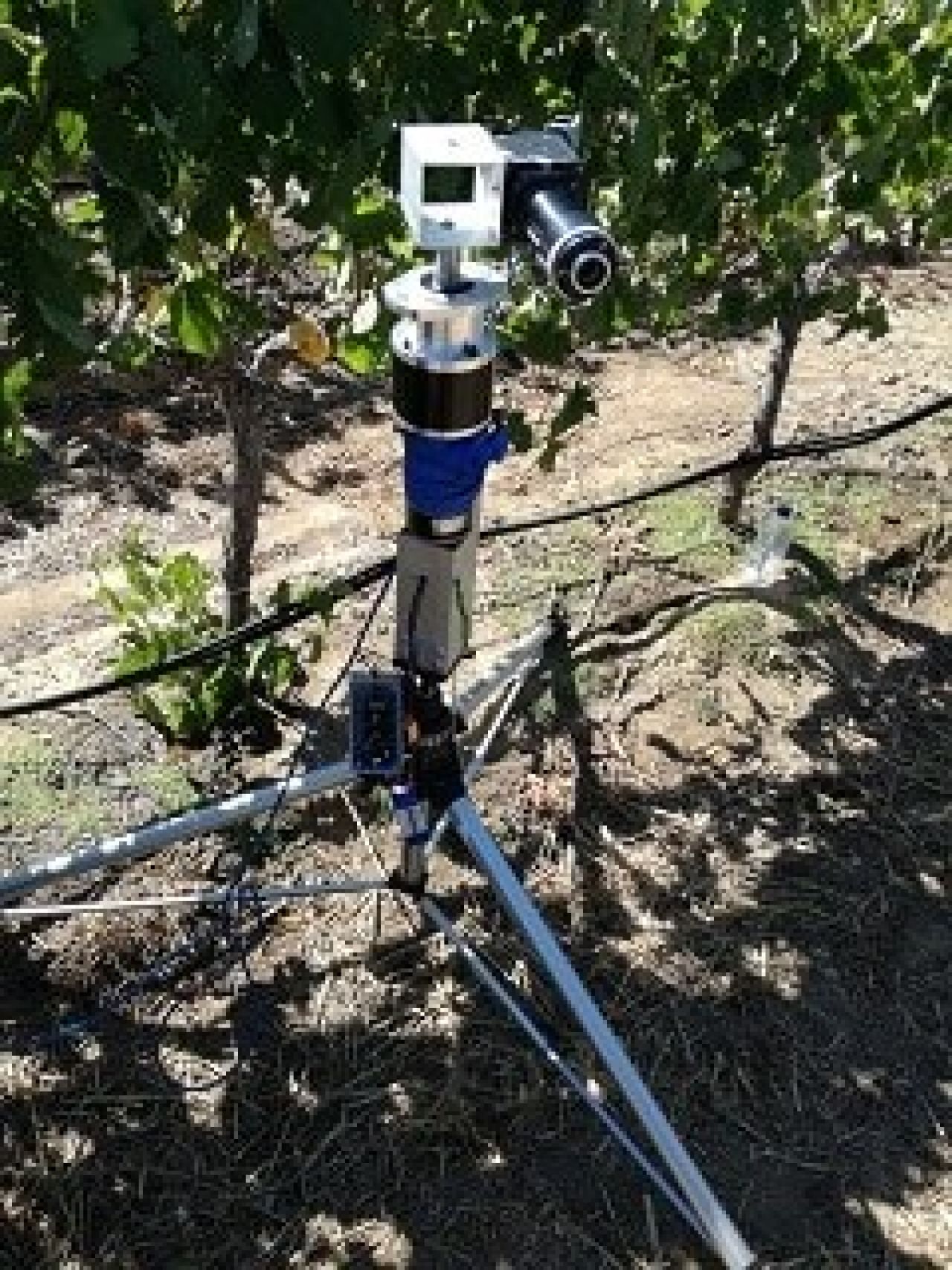
Articles10,11 provides a detailed account of the study area, data collection and processing methods.
Results
The results (see Figure 1) showed that both the RF and XGBoost algorithms could effectively identify water-stressed vines. When using all wavebands (p = 176) and optimised hyperparameter values, RF marginally outperformed XGBoost. RF yielded a test accuracy of 83.3% (KHAT = 0.67), whereas XGBoost yielded a test accuracy of 81.7% (KHAT = 0.63). Optimising hyperparameter values lead to an increase in accuracy for both the RF and XGBoost classifiers, with the increase in accuracy ranging from 0.8% - 5.0%. However, the marginal increases in accuracy may not always warrant the added processing time, therefore careful consideration must be given when optimising hyperparameter values.
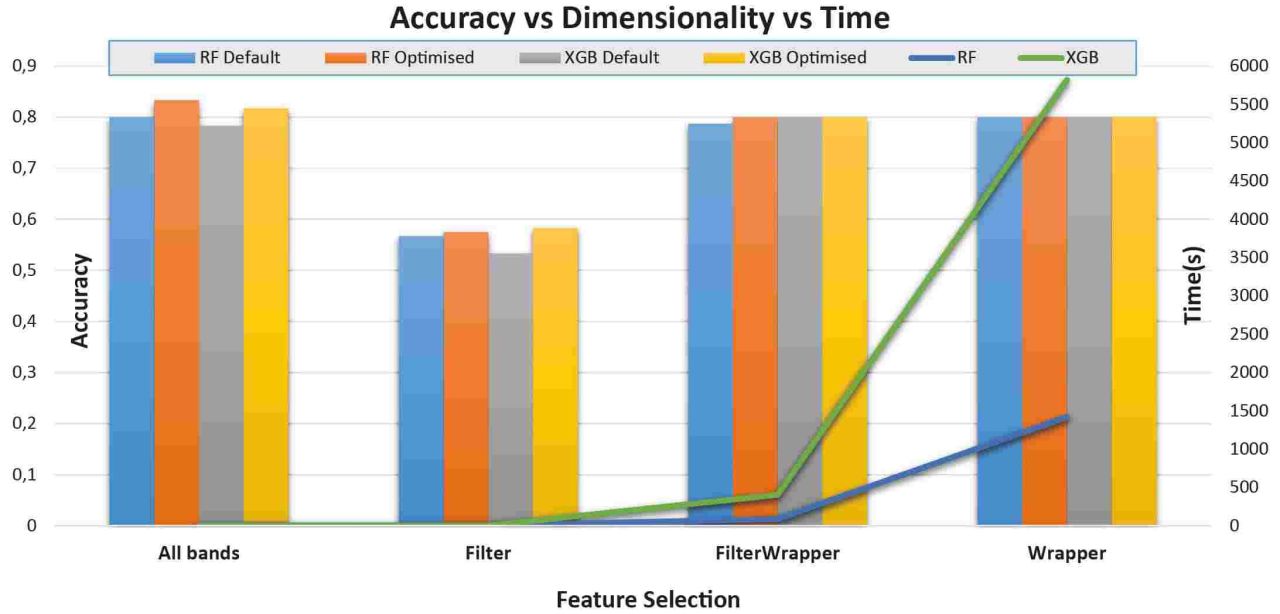
The KW filter, the SFFS wrapper and the FW feature subsets did not produce an increase in classification accuracy. However, all three feature selection methods did greatly reduce the number of features (i.e., wavebands) needed for classification, thereby reducing processing time and complexity. Of the three feature selection methods, the KW filter yielded the lowest accuracies. The SFFS wrapper and FW approach obtained similar accuracies, with both subsets producing an accuracy of 80.0% (KHAT = 0.60) for both RF and XGBoost. The SFFS wrapper (p = 4 for RF; p = 3 for XGBoost) and FW approach (p = 35 for RF; p = 18 for XGBoost) were able to obtain these results using only 2 - 20% of the original waveband dataset (approximately 80 - 98% reduction in features).
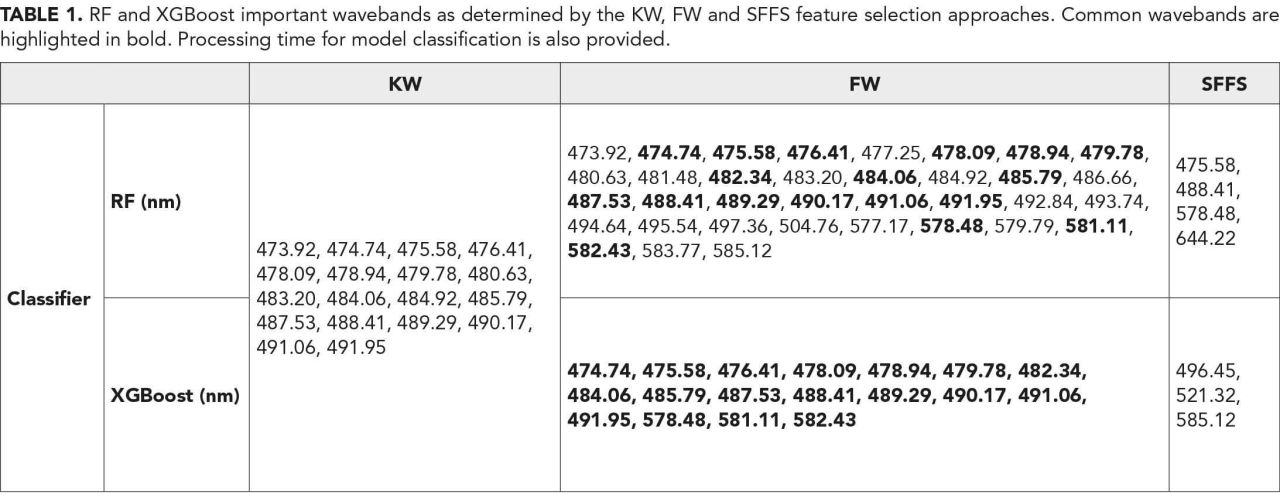
Table 1 shows that the FW approach selected wavebands across the visible regions of the electromagnetic spectrum (VIS) for both RF (473.92 - 585.12 nm) and XGBoost (474.74 - 582.43 nm). FW approach also selected wavebands common to both RF and XGBoost. These common wavebands (p = 18) were located across the blue (474.74 - 491.95 nm) and green (578.48 - 582.43 nm) regions of the electromagnetic spectrum. These findings suggest that these 18 common wavebands may be the most important for water stress detection in a Shiraz vineyard. However, this requires further investigation. Furthermore, these selected wavebands highlight the potential of using narrow wavebands in the VIS to identify water-stressed vines.
Conclusion
The study provides a point of departure for the operationalisation of future machine learning-remote sensing frameworks for water stress monitoring. The results illustrate the potential of narrow VIS wavebands to detect water-stressed Shiraz vines. The study also demonstrated the competency of tree-based machine learning algorithms, such as RF and XGBoost, for modelling water stress. RF marginally outperformed XGBoost in both classification accuracy and processing complexity. The use of RF is, therefore, recommended for future studies.
A limiting factor for operationalisation is the availability of hyperspectral cameras. Hyperspectral cameras are still very costly. However, with the advancement of technology in the last decade, hyperspectral sensors are becoming more readily available. Hyperspectral technologies are also receiving growing endorsement from major public and private agencies, with approximately 15 new hyperspectral satellite missions identified for launch in the next decade. Additionally, the hyperspectral inventory available for unmanned aerial vehicles (UAV) is also rapidly expanding.12 For now, hyperspectral technologies, practically, only serve as a research tool.
Finally, the procedure developed for selecting important wavebands lends itself to:
- The development of customised cameras that are less expensive than hyperspectral cameras and optimised to detect vineyard water stress; and
- The development of vegetation indices that are designed for a specific application, such as vineyard water stress detection.
The latter will be discussed in Part 2 of our “Hyperspectral – the answer to water stress?” series.
Abstract
Vineyard water stress threatens the quality and sustainability of grape production. It is therefore imperative to develop frameworks that can detect water-stressed vines. These frameworks can potentially prevent devastating crop losses and help better manage water resources. The study employed hyperspectral imaging and machine learning approaches to model water stress in a Shiraz vineyard. Water-stressed vines were discriminated from non-stressed vines by building classification models using leaf spectra samples and tree-based ensemble learners. The accuracy and robustness of the classification models were evaluated on independent datasets. Additionally, feature selection methods were employed to identify wavebands most relevant for water stress detection in a Shiraz vineyard. The results show that the Random Forest (RF) classifier marginally outperformed Extreme Gradient Boosting (XGBoost), producing a test accuracy of 83.3% (KHAT = 0.67). The results further indicate that optimising hyperparameter values does lead to an overall increase in accuracy. Furthermore, using the Sequential Floating Forward Selection (SFFS) and Filter-Wrapper (FW) feature selection methods yielded a test accuracy of 80.0% (KHAT = 0.6) for both RF and XGBoost.
References
- Bellvert, J.; Zarco-Tejada, P.J.; Girona, J.; Fereres, E. Mapping crop water stress index in a Pinot-noir vineyard: Comparing ground measurements with thermal remote sensing imagery from an unmanned aerial vehicle. Precis. Agric. 2014, 15, 361–376.
- Costa, J.M.; Vaz, M.; Escalona, J.; Egipto, R.; Lopes, C.; Medrano, H.; Chaves, M.M. Modern viticulture in southern Europe: Vulnerabilities and strategies for adaptation to water scarcity. Agric. Water Manag. 2016, 164, 5–18.
- Mulla, D.J. Twenty five years of remote sensing in precision agriculture: Key advances and remaining knowledge gaps. Biosyst. Eng. 2013, 114, 358–371.
- Poona, N.; van Niekerk, A.; Ismail, R. Investigating the utility of oblique tree-based ensembles for the classification of hyperspectral data. Sensors 2016, 16, 1–16.
- Breiman, L. Random forests. Mach. Learn. 2001, 45, 5–32.
- Chen, T.; Guestrin, C. XGBoost: A Scalable Tree Boosting System. In Proceedings of the Proceedings of the 22nd acm sigkdd international conference on knowledge discovery and data mining; ACM: San Francisco,CA, USA, 2016; pp. 785–794.
- Kruskal, W.H.; Wallis, W.A. Use of ranks in one-criterion variance analysis. J. Am. Stat. Assoc. 1952, 47, 583–621.
- Pudil, P.; Novovičová, J.; Kittler, J. Floating search methods in feature selection. Pattern Recognit. Lett. 1994, 15, 1119–1125.
- Bischl, B.; Lang, M.; Kotthoff, L.; Schiffner, J.; Richter, J.; Studerus, E.; Casalicchio, G.; Jones, Z. mlr: Machine Learning in R. J. Mach. Learn. Res. 2016, 17, 1–5.
- Loggenberg, K.; Strever, A.; Greyling, B.; Poona, N. Modelling water stress in a Shiraz vineyard using hyperspectral imaging and machine learning. Remote Sens. 2018, 10.
- Loggenberg, K.; Poona, N. A Feature Selection Approach for Terrestrial Hyperspectral Image Analysis. South African J. Geomatics 2020, 9, 302–320.
- Adão, T.; Hruška, J.; Pádua, L.; Bessa, J.; Peres, E.; Morais, R.; Sousa, J.J. Hyperspectral imaging: A review on UAV-based sensors, data processing and applications for agriculture and forestry. Remote Sens. 2017, 9.
– For more information, contact Kyle Loggenberg at [email protected].
Click here to get your copy of WineLand Magazine and here to subscribe to our newsletter.

More from
Innovation and insights

Packaging under pressure: What wine businesses should be watching
From lighter bottles to automated packing lines, packaging decisions are becoming increasingly important to the cost and competitiveness of South African wine.
How vine water stress shapes grape and wine quality
This study formed part of the South Africa Wine programme “Grapevine production with limited water resources”, and aimed to evaluate how spatial and temporal water stress affects vine physiology, fruit composition and wine quality.
Drought tolerance of different scion cultivars (Part 4): Vegetative growth and yield
The study aimed to assess grapevine vegetative and yield responses in an almost worst-case scenario, i.e. grapevines growing under dryland conditions in sandy loam soil in the Swartland region.