
Irrigation strategy and trellis system (Part 3): Juice and wine characteristics
The primary objectives of the study were to determine during what stage(s) Pinotage per se is sensitive to water deficits, the most suitable irrigation strategy when water restrictions are imposed during periodic droughts, and if more grapes can be produced with the same volume of irrigation water…
· 19 min read
Abstract
Rainfall in the Breede River Valley region is low, so grapevines in this region require irrigation. Therefore, the sensitivity of Pinotage/99R to water deficits was studied in a field trial from 1998/99 until 2000/01. Irrigation strategies entailed combinations of 50% readily available water (RAW) depletion, 75% RAW depletion and no irrigation between various phenological stages, viz. budbreak, flowering, pea size berries, véraison, 17°B and harvest. Irrigation applied at 50% RAW depletion from budbreak in September until harvest in February was considered to be the control. The possibility of producing more grapes with the same volume of irrigation water was also investigated, and each experimental plot was split into a six-strand vertical hedge and a two-tier vertical trellis. The experimental layout was a split-plot, randomised block design. Water deficits did not have any detrimental effects on juice TTA and pH. The trellis system did not affect the overall wine quality of Pinotage. Water deficits after véraison or irrigation throughout the season at 75% RAW depletion enhanced colour and cultivar aroma in Pinotage. Results showed that irrigation of Pinotage can be terminated at véraison to improve wine quality if irrigation water is limited or during drought. Grapevine yield will be reduced to a certain extent, so such an irrigation strategy can only be recommended as a short-term response to drought or if higher grape prices will compensate for subsequent yield losses.
Introduction
Limited water resources must be used by wine grape growers as effectively as possible.1 In this regard, adjustments to a vineyard’s irrigation system can result in water savings without compromising yield.1,2,3 More grapes can also be grown on bigger trellis systems with the same amount of irrigation water.4,5,6 Vertical trellis systems, such as a two-tier trellis, which has a bigger bearing capacity per running metre, do not necessarily increase water use6 or plant water stress. These trellis systems may therefore be considered for more effective use of irrigation water.
Previous research in the Breede River Valley showed that Chenin blanc wine quality was better from grapevines growing as bush vines compared to those trained onto a slanting trellis.7 However, these differences were due to the incidence of Botrytis cinerea. The same wine quality was obtained when Chenin blanc grapevines were converted to a vertical (extended) or lyre system.8 Although the wine aroma compounds of Chenin blanc were not affected by six different trellis systems,9 wine quality was negatively affected by a Santorinni trellis system.10 For Shiraz, wines containing the highest fruity attributes were produced on a sprawling system whereas wines with high vegetative character were produced by grapevines growing on a vertical shoot position (VSP) system.11
Although there has been a lot of research investigating the response of red wine grape cultivars to irrigation, none of it focussed on the effects of water deficits during different phenological stages on Pinotage wine sensorial and quality characteristics. This was to be expected given that Pinotage is a South African red wine grape cultivar. For red cultivars in South Africa, local research showed that less frequent irrigation improved the wine berry aroma character and overall quality.1,12,13,14,15 None of the previous research done locally addressed the question of water shortages in different phenological stages. In drought, water restrictions could be imposed during the growing season. In order for growers to make informed decisions regarding the irrigation of their vineyards to obtain the optimum balance between yield and final wine quality, scientific information is needed on the effect of water shortages during the different phenological stages of the grapevine.
Taking the above-mentioned into consideration, the primary objectives of the study were to determine (i) during what stage(s) Pinotage per se is sensitive to water deficits, (ii) the most suitable irrigation strategy when water restrictions are imposed during periodic droughts, and (iii) if more grapes can be produced with the same volume of irrigation water when the bearing capacity of grapevines is increased.
Methods
Experimental vineyard
The field trial was carried out over three seasons, i.e. from 1998/99 until 2000/01, in a three-year-old Pinotage/99Richter vineyard on the Agricultural Research Council (ARC) Research Farm near Robertson in the Breede River Valley of South Africa. Details have been given previously.6
Experimental layout
To determine the effect of water deficits at various stages, different irrigation strategies were applied. These irrigation strategies consisted of eight different combinations of 50% readily available water (RAW) depletion, 75% RAW depletion and no irrigation between various phenological stages, viz. budbreak, flowering, pea size berries, véraison, 17°B and harvest. Irrigation applied at 50% RAW depletion from budbreak in September until harvest in February was regarded as the control (S1). For the purpose of this study, RAW was defined as the water available between -5 kPa and -100 kPa soil matric potential. Tensiometers installed at 30 cm, 60 cm and 90 cm depths were used to measure the soil water matric potential weekly, as well as before and after irrigations. The experimental layout was a split plot, randomised block design. Each experimental plot was split into a six-strand vertical trellis and a two-tier vertical trellis to give a total of 16 irrigation strategy/trellis system combinations, or treatments. Each strategy/trellis system combination was replicated three times.
Juice characteristics
The objective was to harvest grapes when the total soluble solids (TSS) in the juice reached 24°B. The TSS, total titratable acidity (TTA) and pH in the juice were determined according to the standard procedures of Infruitec-Nietvoorbij which is the Fruit, Vine and Wine Research Institute of the Agricultural Research Council (ARC) near Stellenbosch.
Wine colour analyses
The wines were analysed according to the methods described previously.16 The wine colour density (WCD) was calculated according to the formula therein.
Wine quality characteristics
Grapes were harvested when they reached the target sugar content of 24°B for Pinotage. Wines were made from the grapes (40 kg) of each experimental plot according to the standard procedure for making red wine used by the experimental winery at ARC Infruitec-Nietvoorbij.14 After six months, the wines were evaluated sensorially by a panel of at least 12 industry experts. Pinotage wines were evaluated on an unscaled line that was 100 mm long for cultivar character, fullness, bitterness and overall quality.
Statistical analyses
Raw data was captured and sorted in Microsoft® Excel. The data were subjected to an analysis of variance (ANOVA) by using Statgraphics®. Least significant difference (LSD) values were calculated to facilitate comparison between treatment means. Means which differed at p ≤ 0.05 were considered significantly different.
Results
It must be noted that some of the results of S1 and S7 on the two trellis systems have been summarised previously.1 The results obtained with both the trellis systems and all the irrigation strategies will be discussed in detail below.
Juice characteristics
Effect of trellis system
Grapes were harvested as close as possible to 24°B so there were no meaningful differences in TSS of the different treatments. The sugar content at harvest varied between 23.5°B and 24.2°B (data not shown). However, the increase in sugar content of the grapes on the two-tier trellis was slower than that on the six-strand hedge. Depending on the season, grapes on the two-tier trellis were harvested one to two weeks after those on the six-strand hedge. Similarly, it was previously reported that there was slower sugar accumulation in grapes as the yield increased.17,18
On average, the juice TTA produced by grapevines of all irrigation strategy/trellis system combinations were within the typical range of 5 to 8 g/L for grapes (Figure 1A).19 The TTA was lower on the two-tier trellis compared to the six-strand hedge (Figure 1A) and was probably caused by slightly cooler grapes due to less exposure to solar radiation on the six-strand hedge than those on the two-tier trellis.20,21 However, more exposed leaves on the six-strand trellis could also have contributed towards higher juice TTA.21
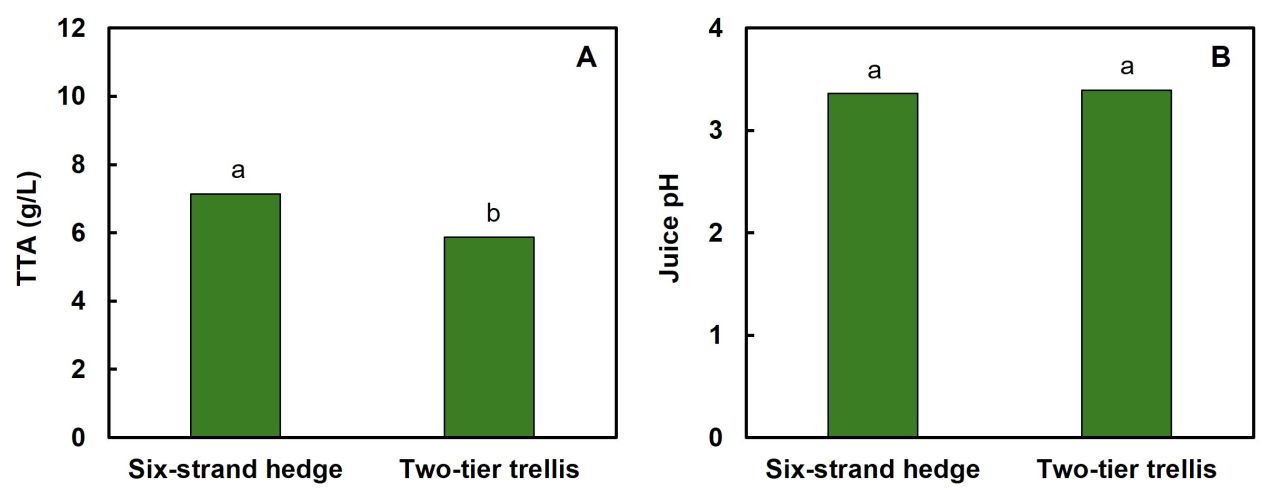
FIGURE 1. Effect of two trellis systems on mean (A) total titratable acidity and (B) juice pH of Pinotage/99R over three seasons near Robertson. Columns designated by the same letters do not differ (p ≤ 0.05).
On average, juice pH was similar for grapevines growing on the six-strand hedge to those on the two-tier trellis (Figure 1B). Juice pH for both the trellis systems was in the optimum range of 3.0 to 3.5 for winemaking.22,23
Effect of irrigation strategies
On average, juice TTA was within the typical range of 5 to 8 g/L for grapes (Figure 2A).19 Irrigation at 50% RAW depletion from budbreak until harvest (S1) had no effect on juice TTA compared to irrigation at 75% depletion (S7) (Figure 2A). This insensitivity of titratable acidity to water constraints agrees with previous findings.24,25,26 Irrigation of grapevines at 50% RAW depletion before véraison followed by water deficits during berry ripening (S5 & S6) tended to produce higher levels of juice TTA (Figure 2A). A previous study also showed that post-véraison water constraints can increase juice TTA.27
On average, irrigation strategy had no effect on juice pH, except that grapevines where the irrigation at 75% RAW depletion was changed to 50% from flowering to véraison (S6) had lower pH compared to all of the other strategies (Figure 2B). The foregoing agrees with previous studies which showed that irrigation strategies do not have major effects on juice pH.14,17,27,28
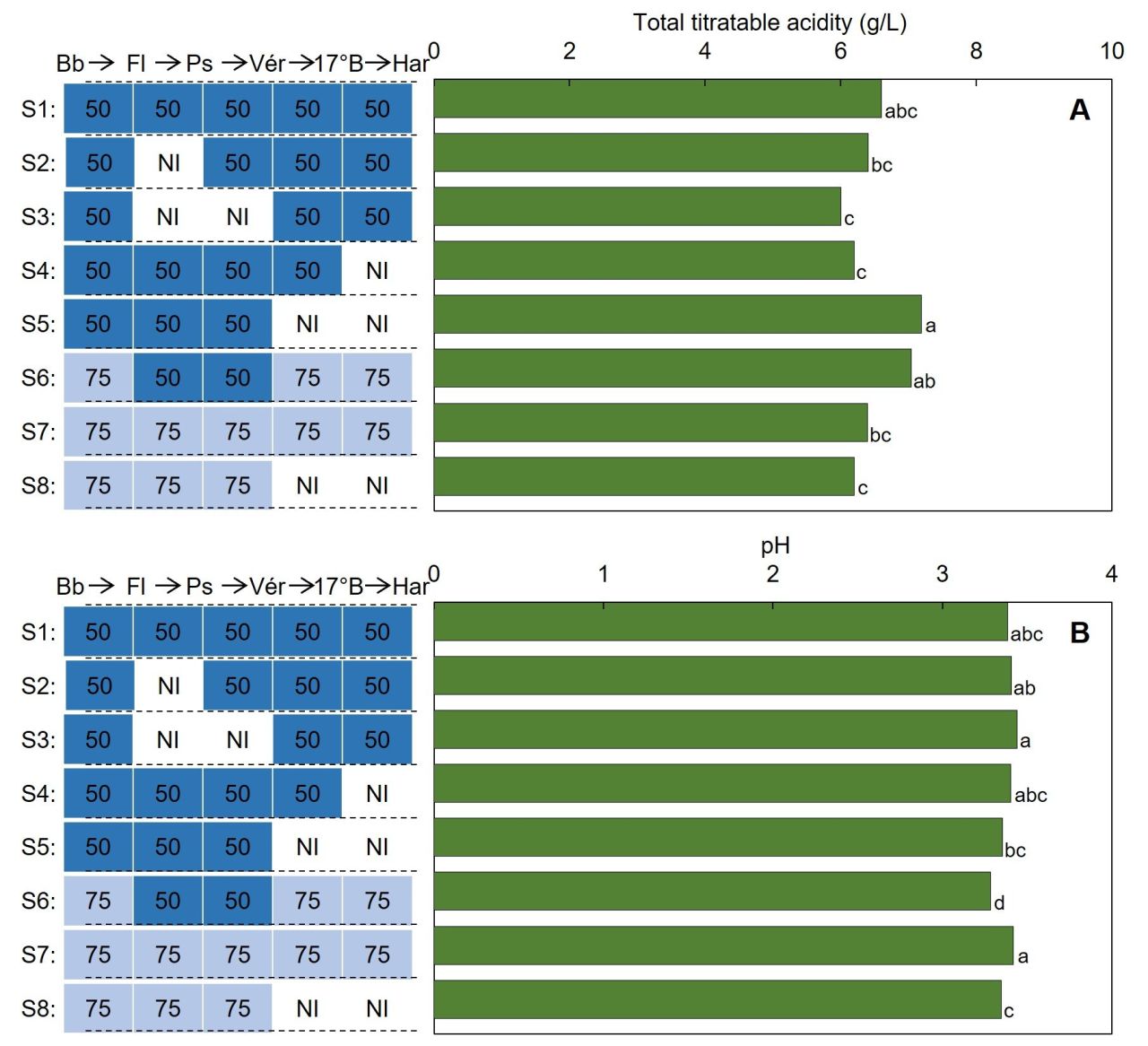
Figure 2. Effect of different irrigation strategies (S), i.e. combinations of 50% readily available water depletion (50), 75% readily available water depletion (75) and no irrigation (NI) between various phenological stages, namely budbreak (Bb), flowering (Fl), pea size berries (Ps), véraison (Vér), 17°B and harvest (Har) on juice (A) total titratable acidity (TTA) and (B) pH of Pinotage/99R near Robertson in the Breede River Valley. Data are means for three years. Columns designated by the same letters do not differ (p ≤ 0.05).
Wine characteristics
Effect of trellis system
The mean WCD of the Pinotage wines was higher for the six-strand hedge compared to the two-tier trellis (data not shown). This was to be expected as the two-tier trellis produced substantially more grapes than the six-strand hedge.6 On average, there were no differences in wine sensorial characteristics of the Pinotage wines over three years (data not shown). This indicated that the two-tier trellis could allow for more efficient use of irrigation water than the six-strand hedge without compromising the overall wine quality of Pinotage.
Effect of irrigation strategies
On average, irrigation at 75% RAW depletion from budbreak until harvest (S7) increased the WCD of Pinotage compared to irrigation applied at 50% RAW depletion over the period (S1) (Figure 3). Similarly, Shiraz grapevines that were irrigated at 30 - 40% plant available water (PAW) depletion also produced lower sensorial wine colour compared to those irrigated at 75% depletion.13 Sensorial wine colour of suckered VSP Shiraz grapevines increased with an increase in the level of PAW depletion.15 Regulated deficit irrigation and prolonged deficit irrigation also increased WCD compared to a control.29 The WCD was substantially higher where grapevines were irrigated at 50% RAW depletion until véraison (S5) compared to irrigation applied at 50% RAW depletion from bud break to harvest (S1) (Figure 3). In contrast, other studies reported that pre-veraison water deficits enhanced wine colour.30,31 Irrigation applied at 75% RAW depletion until véraison (S8) increased WCD compared to irrigation applied at 75% RAW depletion throughout the season (S7) (Figure 3).
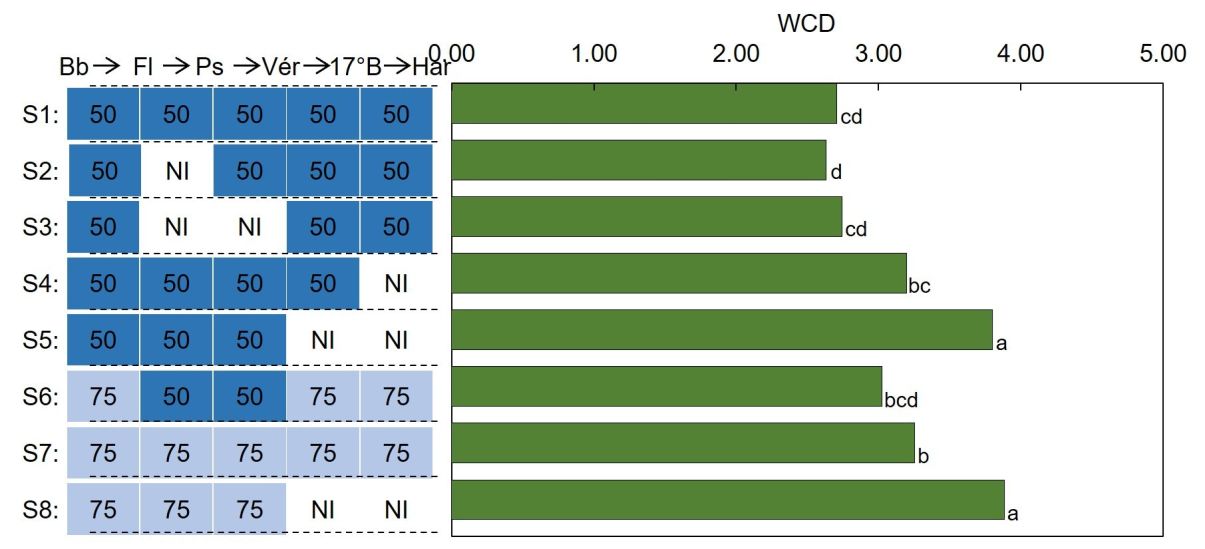
FIGURE 3. Effect of irrigation strategies (S) consisting of different levels of soil water depletion and no irrigation (NI) on the wine colour density (WCD) of Pinotage (Bb = bud break; FI = flowering; Ps = pea size; Vér = véraison and Har = harvest). Data are means for three years. Columns designated by the same letters do not differ (p ≤ 0.05).
On average, irrigation of Pinotage grapevines at 75% RAW depletion from budbreak until harvest (S7) tended to increase the cultivar character of the wine compared to irrigation applied at 50% RAW depletion (Figure 4A). Cabernet Sauvignon grapevines that received minimal irrigation also produced wines that rated higher in fruity attributes compared to standard irrigation and double irrigation.32 The mean wine cultivar character was higher where grapevines were irrigated at 50% RAW depletion until véraison (S5) compared to irrigation applied at 50% RAW depletion throughout the season (S1) (Figure 4A). Furthermore, the cultivar character of the wines for the three wettest treatments, i.e. S1 to S3, was generally lower compared to the drier treatments, i.e. S4 to S8.
Irrigation at 75% RAW depletion from budbreak until harvest (S7) increased the fullness of the Pinotage wine compared to irrigation applied at 50% RAW depletion from bud break to harvest (S1) (Figure 4B). Where irrigation at 50% RAW depletion was terminated at either 17°B (S4) or véraison (S5), fullness of the wine was higher compared to irrigation applied at 50% RAW depletion from bud break to harvest (S1) (Figure 4B). The fullness of the wines for the three wettest treatments, i.e. S1 to S3, was generally lower compared to the drier treatments, i.e. S4 to S8.
On average over the three years of the study, irrigation at 75% RAW depletion from budbreak until harvest (S7) increased the overall wine quality of Pinotage compared to irrigation applied at 50% RAW depletion from bud break to harvest (S1) (Figure 4C). Similarly, Shiraz grapevines irrigated at 30 - 40% PAW depletion also produced lower wine quality compared to those irrigated at 75% depletion.13 Wine quality of suckered VSP Shiraz grapevines increased with an increase in the level of PAW depletion.15 Reducing irrigation has also improved the sensory score of Cabernet wines in other studies, and it has been reported that wine quality is negatively correlated with the amount of irrigation water applied.33,34 Where irrigation at 50% RAW depletion was terminated at either 17°B (S4) or véraison (S5), overall quality of the wine was higher compared to irrigation applied at 50% RAW depletion from bud break to harvest (S1) (Figure 4C). Irrigation applied at 75% RAW depletion until véraison (S8) tended to have lower overall wine quality compared to irrigation applied at 75% RAW depletion throughout the season (S7). Overall, applying irrigation from flowering to véraison (S6) rather than at 75% RAW throughout the season reduced Pinotage wine quality. The overall quality of the wines for the three wettest treatments, i.e. S1 to S3, was generally lower compared to most of the drier treatments, i.e. S4 to S8.
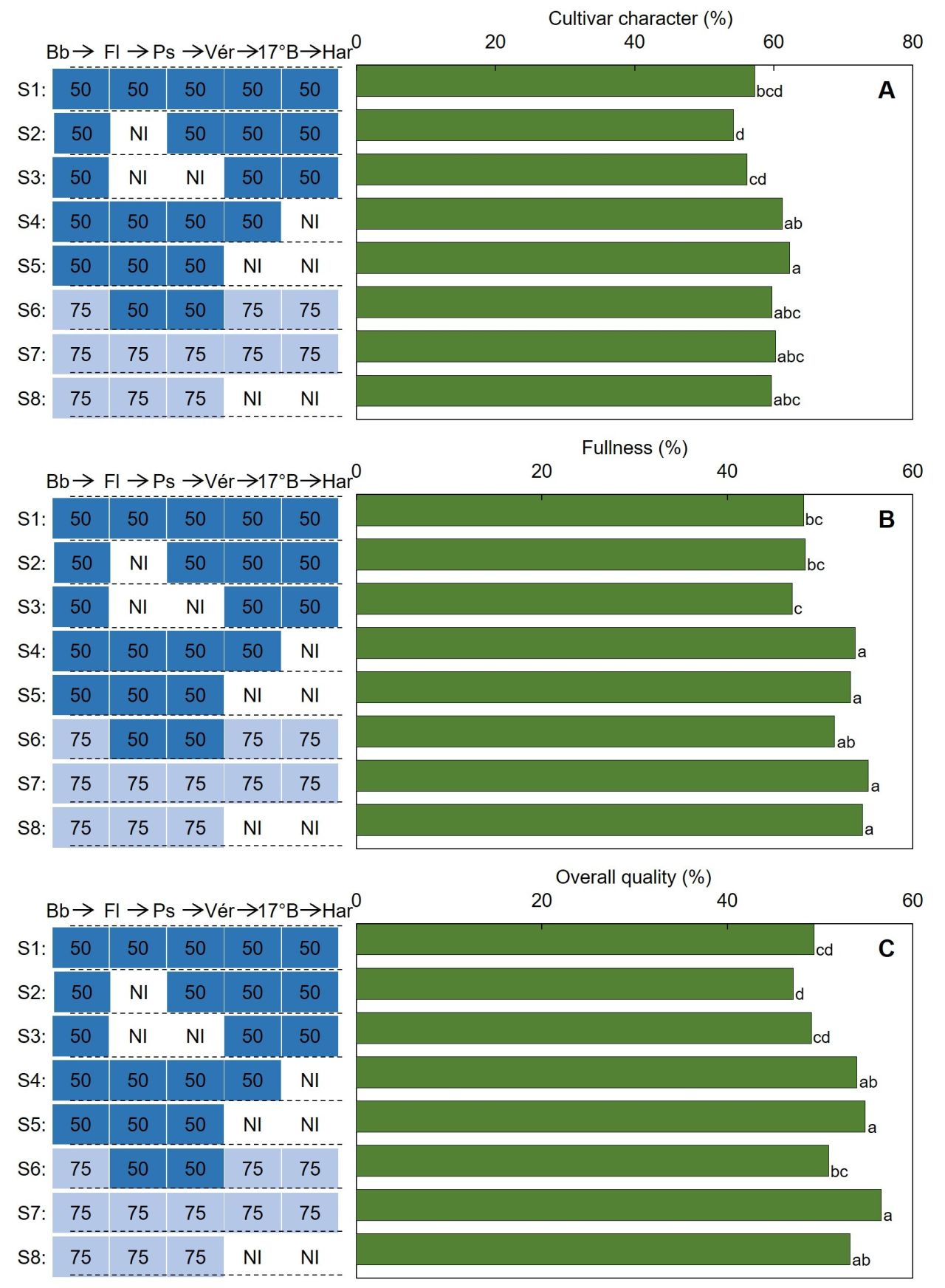
FIGURE 4. Effect of irrigation strategies (S) consisting of different levels of soil water depletion and no irrigation (NI) on wine (A) cultivar character, (B) fullness, and (C) overall quality of Pinotage (Bb = bud break; FI = flowering; Ps = pea size; Vér = véraison and Har = harvest). Data are means for three years. Columns designated by the same letters do not differ (p ≤ 0.05).
Conclusions
This was the first study in South Africa to determine the responses of Pinotage juice and wine to water deficits across different phenological stages and trellis systems. Water deficits did not have any detrimental effects on juice TTA and pH. Results showed that trellis systems did not affect overall wine quality of Pinotage. Therefore, adapting trellis systems can allow for more efficient use of irrigation water without reducing wine quality and should be considered where the soil potential is high and sufficient irrigation water is available. Although water deficits applied throughout the season or from véraison will reduce yield, the potential for colour and cultivar character development in Pinotage is increased and culminates in superior wines. This is probably why Pinotage is one of the preferred cultivars for rain fed viticulture in the coastal region of the Western Cape. Results showed that irrigation of Pinotage can be terminated at véraison to improve wine quality if irrigation water is limited or during drought. Grapevine yield will be reduced to a certain extent, so such an irrigation strategy can only be recommended as a short-term response to drought or if higher grape prices will compensate for subsequent yield losses.
Acknowledgements
- The Agricultural Research Council (ARC) and Winetech for funding the project.
- ARC for infrastructure and resources.
- Staff of the Soil and Water Science division at ARC Infruitec-Nietvoorbij for their assistance, and in particular Mr. T. Harris for his dedicated technical support.
- Staff at ARC Robertson Research Farm.
References
- Myburgh, P.A., 2018. Handbook for irrigation of wine grapes in South Africa. Agricultural Research Council, Pretoria, South Africa.
- Myburgh, P.A., 2003. Possible flood irrigation technologies to reduce water use of Sultanina grapevines in a hot, arid climate. S. Afr. J. Plant Soil 20, 180-187.
- Myburgh, P.A., 2007a. An investigation into possible water savings with sub-surface irrigation (Part II) – Plant water stress, growth, yield and quality. Wineland, Technical Yearbook, 2007/08, 38-42.-62.
- Van Zyl, J.L. & Van Huyssteen, L., 1980a. Comparative studies on wine grapes on different trellis systems: I. Consumptive water use. S. Afr. J. Enol. Vitic. 1, 7-14.
- Swanepoel, J.J., Hunter, J.J. & Archer, E., 1990. The effect of trellis systems on the performance of Vitis vinifera cvs Sultanina and Chenel in the Lower Orange River region. S. Afr. J. Enol. Vitic. 11, 59-66.
- Howell, C.L. & Myburgh, P.A., 2024. Response of Vitis viniferacv. Pinotage to irrigation strategy and trellis system in the Breede River Valley Region: Vegetative growth, yield and juice characteristics. S. Afr. J. Enol. Vitic. 45, 92-106.
- Van Zyl, J.L. & Van Huyssteen, L., 1980b. Comparative studies on wine grapes on different trellis systems: II. Micro-climatic studies, grape composition and wine quality. S. Afr. J. Enol. Vitic. 1, 15-25.
- Volschenk, C.G. & Hunter, J.J., 2001. Effect of trellis conversion on the performance of Chenin blanc/99 Richter grapevines. S. Afr. J. Enol. Vitic. 22, 31-35.
- Iipinge, H.N., 2019. Oenological evaluation of Chenin Blanc wines elaborated from different trellising systems. Thesis, Stellenbosch University, Private Bag X1, 7602 Matieland (Stellenbosch), South Africa.
- Panzeri, V., Ipinge, H.N. & Buica, A., 2020. Evaluation of South African Chenin blanc wines made from six different trellising systems using a chemical and sensorial approach. S. Afr. J. Enol. Vitic. 41, 133-150.
- Davel, A., 2015. Optimising productivity in vineyards and potential effects on grape and wine composition for a specific production goal. Thesis, Stellenbosch University, Private Bag X1, 7602 Matieland (Stellenbosch), South Africa.
- Bruwer, R.J., 2010. The edaphic and climatic effects on production and wine quality of Cabernet Sauvignon in the Lower Olifants River region. Thesis, Stellenbosch University, Private Bag X1, Matieland 7602, South Africa.
- Lategan, E.L., 2011. Determining of optimum irrigation schedules for drip irrigated Shiraz vineyards in the Breede River Valley. Thesis, Stellenbosch University, Private Bag X1, 7602 Matieland (Stellenbosch), South Africa.
- Myburgh, P.A., 2011. Response of Vitis viniferacv. Merlot to low frequency irrigation and partial root zone drying in the Western Cape Coastal Region - Part II. Vegetative growth, yield and quality. S. Afr. J. Enol. Vitic. 32, 104-116.
- Lategan, E.L. & Howell, C.L., 2016. Deficit irrigation and canopy management practices to improve water use efficiency and profitability of wine grapes. WRC Report No. 2080/1/16. ISBN 978-1-4312-0816-6.
- Iland, P., Ewart, A. & Sitters, J., 1993. Techniques for chemical analysis and stability tests of grape juice and wine.
- Williams, L.E. & Heymann, H., 2017. Effects of applied water amounts and trellis/training system on grapevine water relations, berry characteristics, productivity and wine composition of “Cabernet Sauvignon”. Acta Hortic. 1150, 413-426.
- Myburgh, P.A. & Howell, C.L., 2023. Effects of soil ameliorants produced from recycled glass on the establishment of table grapes. S. Afr. J. Enol. Vitic. 44, 101-111.
- Rajković, M.B., Novaković, I.D. & Petrović, A., 2007. Determination of titratable acidity in white wine. J. Agric. Sci. 52, 169-184.
- Kliewer, W.M., 1971. Effect of day temperature and light intensity on concentration of malic and tartaric acids in Vitis vinifera grapes. J. Amer. Soc. Hort. Sci. 96, 372-377.
- Iland, P., 1989. Grape berry composition - the influence of environmental and viticultural factors. Part 2 - Solar radiation. Aust. Grapegrow. Winemaker, April 1989, 74-76.
- Kodur, S., 2011. Effects of juice pH and potassium on juice and wine quality, and regulation of potassium in grapevines through rootstocks (Vitis): A short review. Vitis 50, 1-6.
- Walker, R.R. & Blackmore, D.H., 2012. Potassium concentration and pH inter-relationships in grapejuice and wine of Chardonnay and Shiraz from a range of rootstocks in different environments. Aust. J. Grape Wine Res. 18, 183-193.
- Medrano, H., Escalona, J., Cifre, J., Bota, J. & Flexas, J., 2003. A ten-year study on the physiology of two Spanish grapevine cultivars under field conditions: effects of water availability from leaf photosynthesis to grape yield and quality. Func. Plant Biol. 30, 607-619.
- Acevedo-Opazo, C., Ortega-Farias, S. & Fuentes, S., 2010. Effects of grapevine (Vitis vinifera) water status on water consumption, vegetative growth and grape quality: An irrigation scheduling application to achieve regulated deficit irrigation. Agric. Wat. Manage. 97, 956-964.
- P´erez-Alvarez, E.P., Intrigliolo Molina, D.S., Vivaldi, G.A., García-Esparza, M.J., Lizama, V. & Alvarez, I., 2021. Effects of the irrigation regimes on grapevine cv. Bobal in a Mediterranean climate: I. Water relations, vine performance and grape composition. Agric. Wat. Manage. 248. https://doi.org/10.1016/j.agwat.2021.106772.
- Hardie, W.J. & Considine, J.A., 1976. Response of grapes to water-deficit stress in particular stages of development. Am. J. Enol. Vitic. 27, 55-61.
- Van Zyl, J.L., 1984b. Response of Colombar grapevines to irrigation as regards quality aspects and growth. S. Afr. J. Enol. Vitic. 5, 19-28.
- Cooley, N.M., Clingeleffer, P.R. & Walker, R.R., 2017. Effect of water deficits and season on berry development and composition of Cabernet Sauvignon (Vitis vinifera) grown in a hot climate. Aust. J. Grape Wine Res. 23, 260-272.
- Intrigliolo, D. & Castel, J.R., 2010. Response of grapevine cv. ‘Tempranillo’ to timing and amount of irrigation; water relations, vine growth, yield and berry and wine composition. Irrig. Sci. 28, 113-125.
- Caruso, G., Palai, G., Gucci, R. & D’onofrio, C., 2023. The effect of regulated deficit irrigation on growth, yield, and berry quality of grapevines (cv. Sangiovese) grafted on rootstocks with different resistance to water deficit. Irri. Sci. 41, 453-467.
- Chapman, D.M., Roby, G., Ebeler, S., Guinard, J-X. & Matthews, M.A., 2005. Sensory attributes of Cabernet Sauvignon wines made from vines with different water status. Aust. J. Grape Wine Res. 339-347.
- Stevens, R.M. Pech, J.M., Taylor, J., Clingeleffer, P. & Walker, R.R., 2016. Effects of irrigation and rootstock on Vitis vinifera (L.) Shiraz berry composition and shrivel, and wine composition and wine score. Aust. J. Grape Wine Res. 22, 124-136.
- Munitz, S., Netzer, Y. & Schwartz, A., 2017. Sustained and regulated deficit irrigation of field-grown Merlot grapevines. Aust. J. Grape Wine Res. 23, 87-93.
For more information, contact Carolyn Howell at [email protected].
Click here to get your copy of WineLand Magazine.

More from
Innovation and insights

Packaging under pressure: What wine businesses should be watching
From lighter bottles to automated packing lines, packaging decisions are becoming increasingly important to the cost and competitiveness of South African wine.
How vine water stress shapes grape and wine quality
This study formed part of the South Africa Wine programme “Grapevine production with limited water resources”, and aimed to evaluate how spatial and temporal water stress affects vine physiology, fruit composition and wine quality.
Drought tolerance of different scion cultivars (Part 4): Vegetative growth and yield
The study aimed to assess grapevine vegetative and yield responses in an almost worst-case scenario, i.e. grapevines growing under dryland conditions in sandy loam soil in the Swartland region.