
Katydid ecology in vineyards
Pia Addison Marce Doubell and Corinna Bazelet
· 4 min read

The aim of this study was to contribute knowledge towards the formulation of an integrated pest management program, as well as an appropriate monitoring system.
Introduction
Katydids (“krompokkels”) are considered minor pests in vineyards of the Western Cape Province, but little is known about their assemblage structure and biology due to their secretive and sporadic nature. We therefore set about investigating what species were involved in causing damage and adapting a generic monitoring system that could practically be used in vineyards as an early warning system before damage occurs. To do this, we surveyed four wine farms in the greater Stellenbosch area from February 2013 to March 2015. We monitored eggs, nymphs and adults, as well as damage (Figure 1).

FIGURE 1. Katydid adult (top), egg (bottom),


nymph (top) and damaged berry (bottom).
Population surveys
Three species were found in vineyards in the greater Stellenbosch region of the Western Cape, namely Plangia graminea, Eurycorypha lesnei and a Phaneroptera species (Table 1). In a taxonomic review of the Plangia complex in 2015, the two species that were originally thought to occur in Western Cape vineyards, P. graminea and P. compressa, were found to be the same species and what we thought was P. compressa, is actually E. lesnei.

A study of the seasonal cycle revealed that both species were found from February to June (Figure 2), while the Phaneroptera species was only present from May/June, therefore not a significant economic threat. It was also found that katydids overwinter as eggs during winter, which are laid on the bark of vines and eggs are present throughout the year.

FIGURE 2. Abundance of two adult katydid species in vineyards of the greater Stellenbosch area from February to June 2013.
Monitoring
Eggs were found to be a good early predictor for katydid abundance later in the season and are therefore recommended as a monitoring tool. The monitoring system of De Villiers and Pringle (2008) was adapted as follows: Five evenly spaced rows were selected in each vineyard block and in each row, four evenly spaced plots, consisting of five vines between two trellis posts, giving a total of 20 plots were used. Eggs were sampled by searching the bark on the main stem (Figure 3) and two main cordons, 15 cm on either side of the main stem. This was done on one vine/plot.
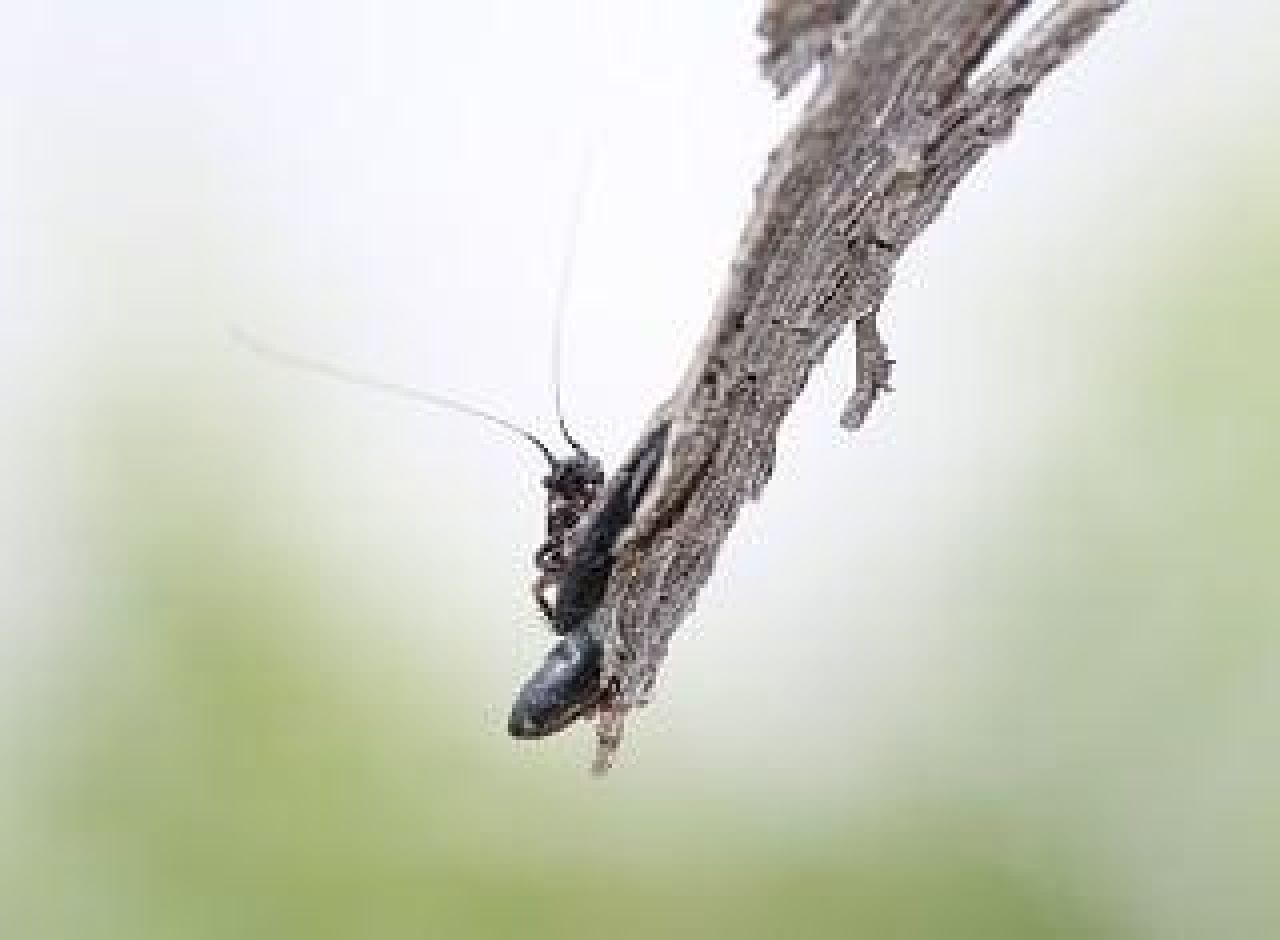
FIGURE 3. Katydid nymph and egg inserted into lower tip of vine bark.
Plangia eggs measure 2.3 x 4.3 mm and are therefore relatively easy to spot, whilst the adults and nymphs are cryptic and tend to hide behind foliage when they detect any disturbances. Egg counts were positively and significantly correlated with adult counts, with a lag time of 10 weeks, which can be used to estimate if population outbreaks of either species will occur. Monitoring for eggs should occur from June to August and can therefore be incorporated into the winter monitoring protocols for vine mealybug.
Biological control
Parasitic wasps were found to contribute to parasitism rates of 22% in Western Cape vineyards, with two wasp species being recorded during our survey, namely Anastatus and Baryconus spp. Their populations peaked during January 2014 in our study and were reared from field collected katydid eggs. It was found that the wasps were well synchronised with egg laying of the katydids and could therefore have a significant impact on naturally-occurring biological control, if chemical inputs are kept to a minimum during this time period.
An entomopathogenic fungus, Metarhizium anisopliae, was isolated from a P. graminea individual collected in a Stellenbosch vineyard. This isolate was accessioned as PPRI 12353 at the National Collection of Fungi (ARC-Plant Protection Research Institute, Pretoria) and indicates that P. graminea is indeed susceptible to pathogenic fungi. With further testing, this biocontrol option could also be incorporated into an IPM strategy.
Conclusion
Katydids are sporadic pests and we do not yet fully understand the factors influencing their occurrence. It is therefore critical to monitor at all times, as this can present larger-scale outbreaks from occurring.
– For more information, contact Pia Addison at [email protected].

More from
Innovation and insights

Packaging under pressure: What wine businesses should be watching
From lighter bottles to automated packing lines, packaging decisions are becoming increasingly important to the cost and competitiveness of South African wine.
How vine water stress shapes grape and wine quality
This study formed part of the South Africa Wine programme “Grapevine production with limited water resources”, and aimed to evaluate how spatial and temporal water stress affects vine physiology, fruit composition and wine quality.

Drought tolerance of different scion cultivars (Part 4): Vegetative growth and yield
The study aimed to assess grapevine vegetative and yield responses in an almost worst-case scenario, i.e. grapevines growing under dryland conditions in sandy loam soil in the Swartland region.