
Late pruning of the vine
By destroying young shoots, spring frosts can impact the following season’s production, by reducing the number of canes available for pruning. Late pruning is one method to combat spring frosts.
Alain Deloire and Anne Pellegrino
· 7 min read
Republished with permission from IVES Technical Reviews, September 2022.
DOI: https://doi.org/10.20870/IVES-TR.2022.7167.
Take note, this research was done in France (Northern Hemisphere), hence the seasons will differ from ours in South Africa (Southern Hemisphere).
In the current climatic context, with milder winters leading to earlier budburst in most wine regions, vines are exposed to the risk of spring frosts for a longer period. Depending on the year, frost can lead to yield losses of between 20 and 100%, jeopardising the economic survival of wine estates. In addition, by destroying young shoots, spring frosts can impact the following season’s production, by reducing the number of canes available for pruning, for example. Late pruning is one method to combat spring frosts.1,2
Why prune late?
- To delay budburst and thus limit the impact of spring frosts in April (especially for early grape varieties) in temperate regions with mild winters.
- To delay (in addition to budburst) the other phenological stages, namely flowering, veraison and ripening, and hence the harvest date.
What basic workings of the vine need to be known for effective late pruning?
We shall distinguish between pre- and post-budburst pruning.
Pre-budburst pruning
Pre-budburst pruning should be considered in relation to two key stages of the vine’s winter resting period: endodormancy (linked to physiological limitations) and ecodormancy (linked to climatic limitations). Ecodormancy is divided into two physiological sub-stages: before and during bleeding of the vine.3,4 Pruning before bleeding has no impact on the phenological stages. Only pruning as from the time of bleeding can delay budburst, but without impact on the subsequent phenological stages. According to our results with Syrah (Mediterranean climate), the delay in budburst is approximately six days (to be adjusted for other grape varieties and climates).
Post-budburst pruning
To practice post-budburst pruning, i.e. beyond mid-budburst (when 30 - 50% of the latent buds have burst on winter canes not yet pruned, stage EL-4 on the Eichhorn & Lorenz scale), it is important to understand certain concepts related to the development and functioning of the vine, such as acrotony and the dynamics of changes in the carbon reserves of the canes, trunk and roots.3
- Acrotony: on a vertically positioned winter cane, the top buds will develop first, inhibiting the development of latent buds at the base. Acrotony thus permits post-budburst pruning of the vine. It is recommended to leave at least eight to 10 latent buds on a cane in case of pre-pruning, so that acrotony can do its work effectively.
- Vine reserves: the carbon reserves (starch, soluble sugars) and nitrogen reserves (amino acids, proteins) stored in the perennial organs (roots, trunk, canes) are called on at budburst to allow the growth of the young shoots (Figure 1). According to Bates and other authors (2002),5 up to 80% of the reserves are called on before the flowering stage. The reserves are then gradually built up again during the growth cycle, when the leaves become mostly autotrophic (at around the time of flowering). Justification of post-budburst pruning should be based on the pool of carbon reserves established the previous year and the quantity of carbon allocated to new shoots.6 In this respect, the phyllochron (thermal time between the sequential emergence of leaves) can be used as an indicator of the post-budburst level of depletion of carbon reserves.
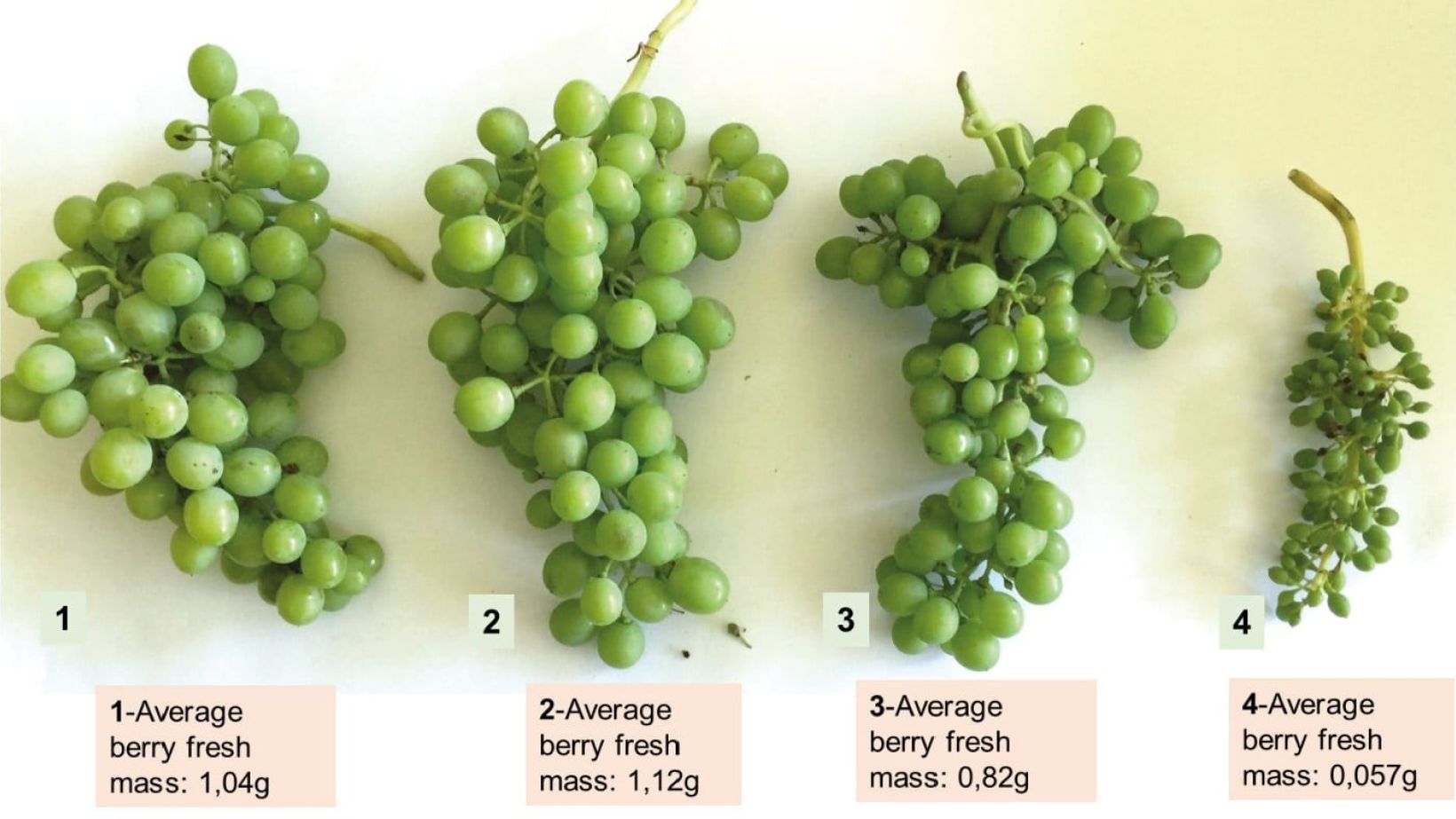
Trials carried out on the Syrah cultivar have shown that herbaceous growth of berries (Figure 2) and the onset of veraison (softening and colouring of the berries) (Figure 3) are all the more delayed when pruning is carried out at advanced growth stages, i.e. from the bleeding stage (pre-budburst) to the three to five leaves separated stage (post-budburst). To complete the legend for Figure 3, it is interesting to note that mid-veraison was around 31 July 2021 for the first two pruning dates and approximately 10 days later for pruning on 21 April 2021. The notable effect of the grape variety × climate × soil interaction on the shift in phenological stages should again be emphasised here.
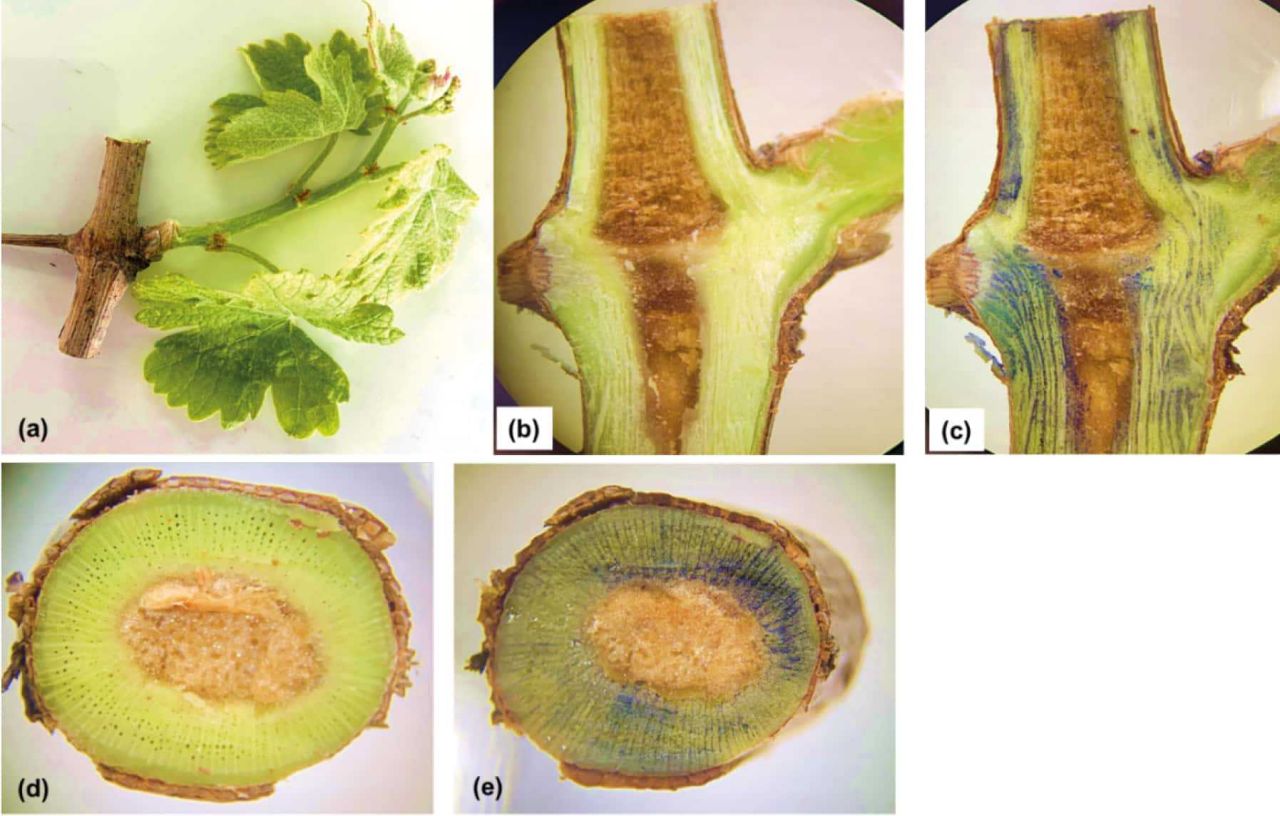
FIGURE 1. (a) Post-budburst late pruning at the three to five leaves separated stage for the two or three latent buds at the top of the cane. (b) Longitudinal section of a node and (c) visualisation of starch in the ligneous parenchyma of the secondary xylem by Lugol’s Iodine staining. (d) and (e) Cross-sections of the cane showing the tissues before and after Lugol’s Iodine staining. The presence of starch in the ray parenchyma of the secondary xylem is visible 15 days after the normal date of budburst.
FIGURE 2. Syrah bunches observed on 8 July 2020 and average berry weight as a function of pruning date (50% budburst on the control observed on 1 April 2020). 1) Pruning on 5 February 2020 at the ecodormancy stage and before bleeding. 2) Pruning on 13 March 2020 at the time of vine bleeding. 3) Post-budburst pruning on 9 April 2020. 4) Post-budburst pruning on 7 May 2020.
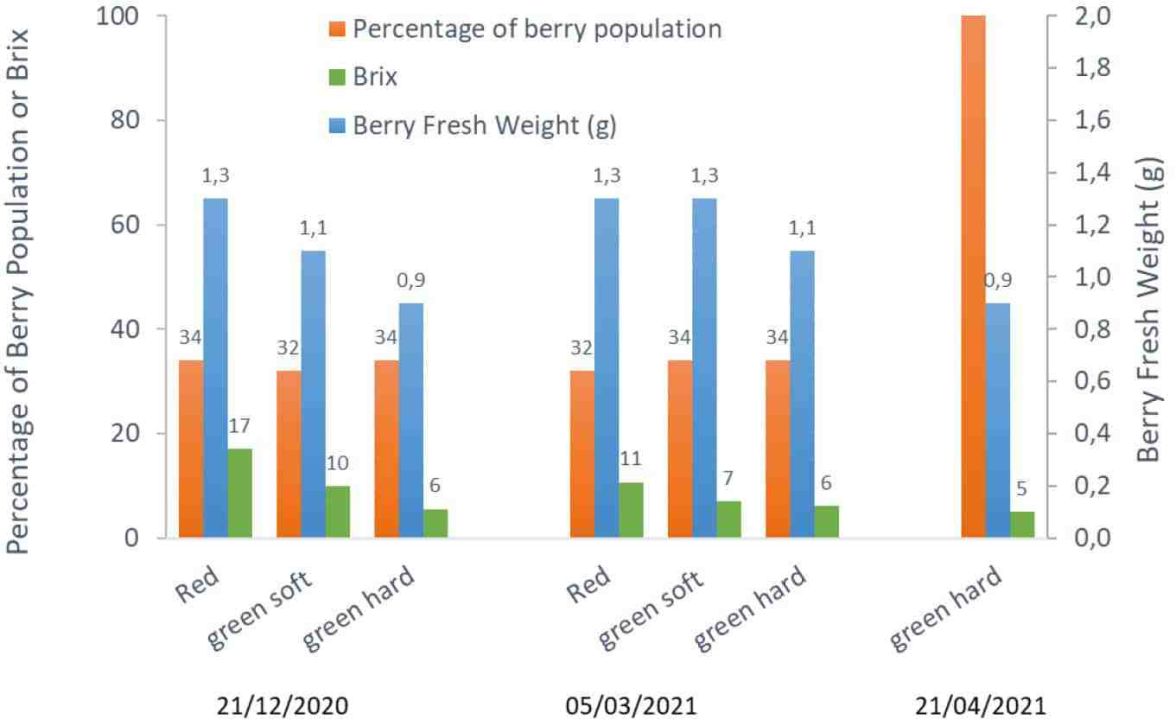
FIGURE 3. Example of the effect of pruning dates on percentage veraison (colour of a population of 60 berries), the sugar concentration (°Brix) and the average fresh weight of the berries (g); the measurements were made on 21 July 2021. Three pruning dates are compared: pre-budburst in the endodormancy phase (21 December 2020); during bleeding (5 March 2021) and post-budburst on 21 April 2021, when the un-pruned canes have developed young shoots at the two to four leaves separated stage (example of the Syrah cultivar, Institut Agro vineyard; study carried out on individual berries).
Adjustment of the post-budburst pruning date according to the “grape variety × environment” situation is therefore necessary to delay budburst (Figure 4), and possibly the other phenological stages, without causing significant yield losses due to exhaustion of the carbon reserves.
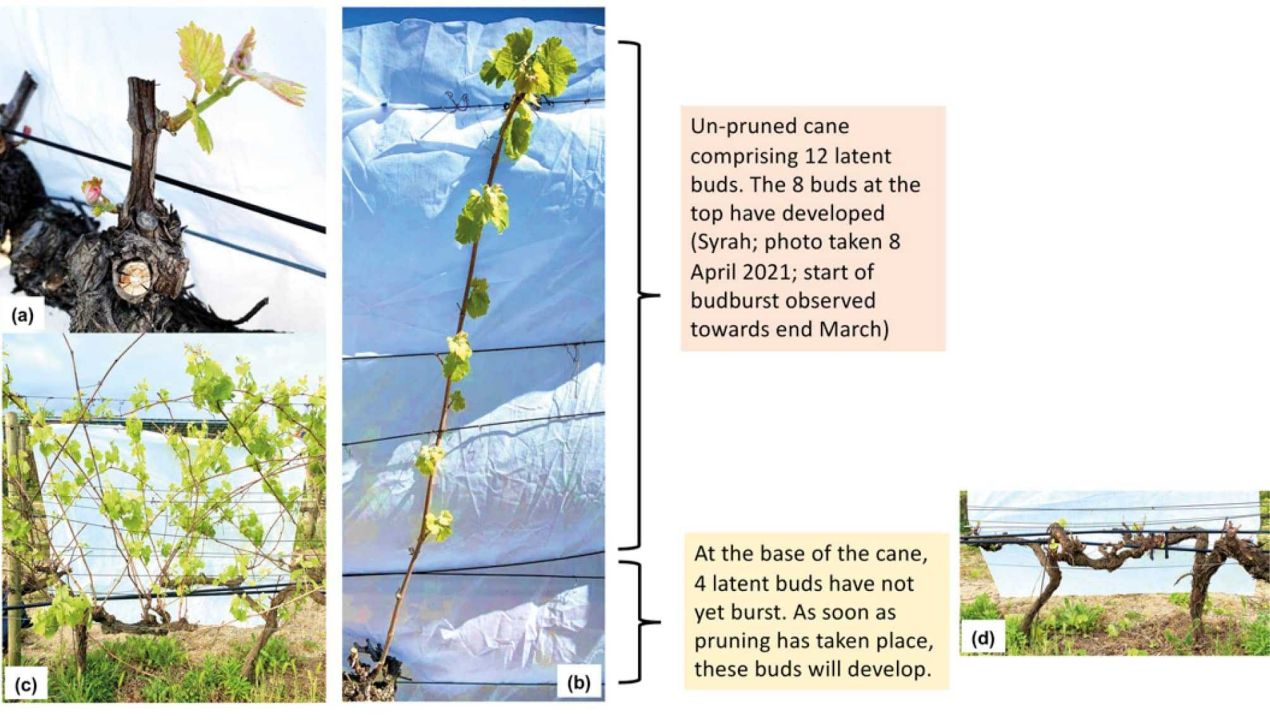
FIGURE 4. (a) Syrah vine pruned during endodormancy. The start of budburst was observed at the end of March 2021 and the photo shows the stage of development of the latent buds of the spur as of 8 April. (b) Example of a cane bearing 12 buds and not pruned on 8 April. The buds at the top of the cane have developed, inhibiting the budburst of at least four buds at the base. (c) On 21 April 2021, for the un-pruned vines, it is observed that only the latent buds at the top of the canes have developed, inhibiting the development of the buds at the base (d), which permits post-budburst late pruning.
What to take away about late pruning of the vine
Pre-budburst
- The most effective period for pruning to delay budburst is during the bleeding phase. Clearly, this raises the question of feasibility related to the size of vineyard to be pruned and the logistics in terms of labour. In this respect, mechanical pruning can be an advantage, with its speedier implementation allowing for late pruning.
- The determination/prediction of the bleeding period of the vine requires more research-experimentation and consideration of the “grape variety/rootstock × temperature × water status of the soil” interaction.
Post-budburst
The pruning period will depend on the “grape variety × climate” interaction versus grape varieties (early or late) and climate (cool or hot) applying the concepts of acrotony, phyllochron and the carbon reserves of the vine.
Adjustment by wine region and by family of grape varieties is necessary, depending on how early budburst occurs for them.7
References
- Ravas, L., 1912. Taille hâtive ou taille tardive, Le Progrès Agricole et Viticole.
- Frioni, T., Pirez, F.J., Diti, I., Ronney, L., Poni, S. & Gatti, M., 2019. Post-budbreak pruning changes intra-spur phenology dynamics, vine productivity and berry ripening parameters in Vitis vinifera cv. ‘Pinot Noir’, https://doi.org/10.1016/j.scienta.2019.108584.
- Pellegrino, A., Rogiers, S. & Deloire, A., 2020. Grapevine latent bud dormancy and shoot development, IVES Technical Reviews. https://doi.org/10.20870/IVES-TR.2020.3420.
- Lang, G.A., Early, J.D., Martin, G.C. & Darnell, R.L., 1987. Endo-, para-, and ecodormancy: Physiological terminology and classification for dormancy research. HortScience 22(3): 371 - 377.
- Bates, T.R., Dunst, R.M. & Joy, P., 2002. Seasonal dry matter, starch, and nutrient distribution in ‘Concord’ grapevine roots, HortScience 37(2): 313316.
- Gatti, M., Pirez, F.J., Chiari, G., Tombesi, S., Palliotti, A., Merli M.C. & Poni, S., 2016. Phenology, canopy aging, and seasonal carbon balance as related to delay winter pruning of Vitis vinifera cv. Sangiovese grapevine. Frontiers in Plant Sciences, Vol. 7, Article 659. https://doi.org/10.3389/fpls.2016.00659.
- Netzer, Y. et al., 2022. Forever young? Late shoot pruning affects phenological development, physiology, yield and wine quality of Vitis vinifera Malbec. Agriculture 12: 605. https://doi.org/10.3390/agriculture12050605.
Click here to get your copy of WineLand Magazine and here to subscribe to our newsletter.

More from
Innovation and insights

Packaging under pressure: What wine businesses should be watching
From lighter bottles to automated packing lines, packaging decisions are becoming increasingly important to the cost and competitiveness of South African wine.
How vine water stress shapes grape and wine quality
This study formed part of the South Africa Wine programme “Grapevine production with limited water resources”, and aimed to evaluate how spatial and temporal water stress affects vine physiology, fruit composition and wine quality.
Drought tolerance of different scion cultivars (Part 4): Vegetative growth and yield
The study aimed to assess grapevine vegetative and yield responses in an almost worst-case scenario, i.e. grapevines growing under dryland conditions in sandy loam soil in the Swartland region.