
Q&A: Tackling calcium crystals in wine
Calcium instability in wine is a complex issue influenced by various factors. Dr Sami Yammine answers the most significant questions related to calcium crystals in wine and provides guidance on how to prevent them.
· 7 min read
By Sami Yammine*
Calcium instability in wine is a complex issue influenced by various factors. Understanding these factors and the tools available to address them is essential for producing stable, high-quality wines. In this article, Dr Sami Yammine answers the most significant questions related to calcium crystals in wine and provides guidance on how to prevent them.
Q: Calcium tartrate (CaT) crystals are showing up more often in bottled wine. Is this a new problem?
A: No, it’s not new. But the frequency has increased. As a result, there’s more discussion, research and innovation around the topic, both in academic circles and among oenological product suppliers.
Q: What’s causing this rise in CaT instability?
A: Climate change appears to play a role.1,2 Warmer conditions and reduced rainfall create stress in the vine, altering the grape composition. Some key changes that contribute to instability include:
- Higher calcium concentrations in juice.
- Higher pH levels.
- Lower malic acid.
- Higher sugar levels, resulting in higher final alcohol.
Q: Are there other sources of calcium in wine, apart from the grapes?
A: Yes, several winemaking practices and materials can add calcium:
- Use of low-purity casein.
- Certain poor-quality calcium-based bentonites at high doses.
- Calcium carbonate for deacidification.
- Wine stored in unsealed cement tanks.
- Vineyard inputs containing calcium or carbonate.
Q: Do LAFFORT® bentonites contribute to calcium concentrations in wine?
A: No, in-house trials revealed that, when used at recommended doses, they do not increase the calcium content of wines.
Q: How exactly does pH affect CaT formation?
A: Tartaric acid exists in three forms in wine: H2T (undissociated tartaric acid), HT⁻ (bitartrate) and T²⁻ (tartrate).1 Their proportions depend on pH. At an average wine pH (around pH 3.6), the bitartrate form typically dominates, and it is this form that binds with potassium to form potassium bitartrate (KHT), also known as potassium hydrogen tartrate. However, tartrate ions (T²⁻) increase in concentration as the pH increases.3 This is the form that typically binds with calcium to form CaT. So, theoretically, at pH 3.2, a wine with 60 mg/L calcium may be stable. However, at pH 3.8, the same concentration could be problematic due to the increased availability of tartrate ions that the calcium can bind to. This is also why one cannot rely solely on the calcium concentration to determine whether a wine will become unstable.
In the same breath, one also cannot assume that a low pH equals a CaT stable wine due to low tartrate concentrations, since CaT instability has been reported in sparkling wines. The problem is multifactorial.
Q: Can CaT stay in solution like KHT?
A: Yes, up to a point. Once the CaT in the wine reaches supersaturation, it can potentially (in the absence of inhibitors) start to nucleate and crystallise. Calcium tartrate is approximately 10 times less soluble than KHT (0.525 g/L4 compared to 5.2 g/L5, in water at 20°C). However, its nucleation is slower and is not significantly influenced by temperature.6 That’s why CaT crystals often only become visible after bottling. Solubility of CaT and KHT is also greatly affected by the alcohol content of the wine – the higher the alcohol, the lower the solubility of these compounds.
Q: Some wines with high calcium content don’t show instability. Why is that?
A: Because wine contains inhibitory compounds that can slow or prevent crystallisation.7 These include:
- Citric and malic acid.
- Polyphenols, proteins and polysaccharides (protective colloids).
The removal of protective colloids with inadequate (or poor) filtration can also be the reason why instability occurs after bottling.
Q: What are the main strategies to prevent CaT instability?
A: Removing excess calcium is the most effective method. This can be done through:
- Cation exchange resins.
- Electrodialysis.
- Racemic tartaric acid (DL form).
- Micronised L-calcium tartrate.
All these methods have advantages and disadvantages. Cellars must choose the method that works best in their environment. Additives like mannoproteins, carboxymethyl cellulose (CMC), or potassium polyaspartate (KPA), although useful for preventing KHT instability, have limited efficacy in preventing CaT instability. There is some emerging evidence that alginic acid, which is approved for use in sparkling wine only, may also have beneficial effects.2
Q: What solutions does LAFFORT® offer to manage calcium concentrations in wine?
A: LAFFORT® offers two products: Ca²⁺Stab (racemic tartaric acid) and CaFinish (micronised calcium tartrate). The differences in their applications are demonstrated in Table 1.
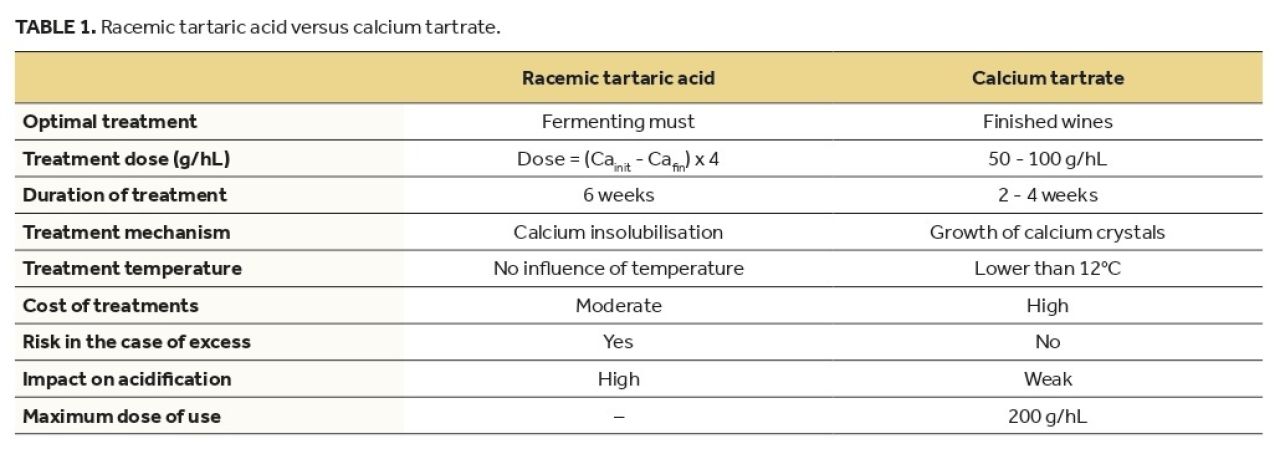
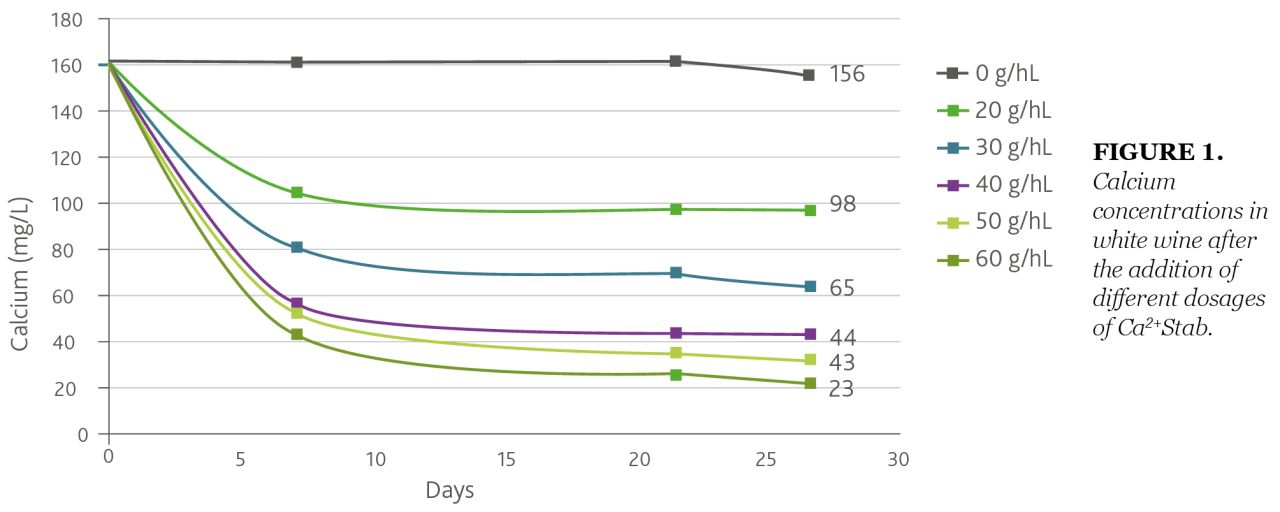
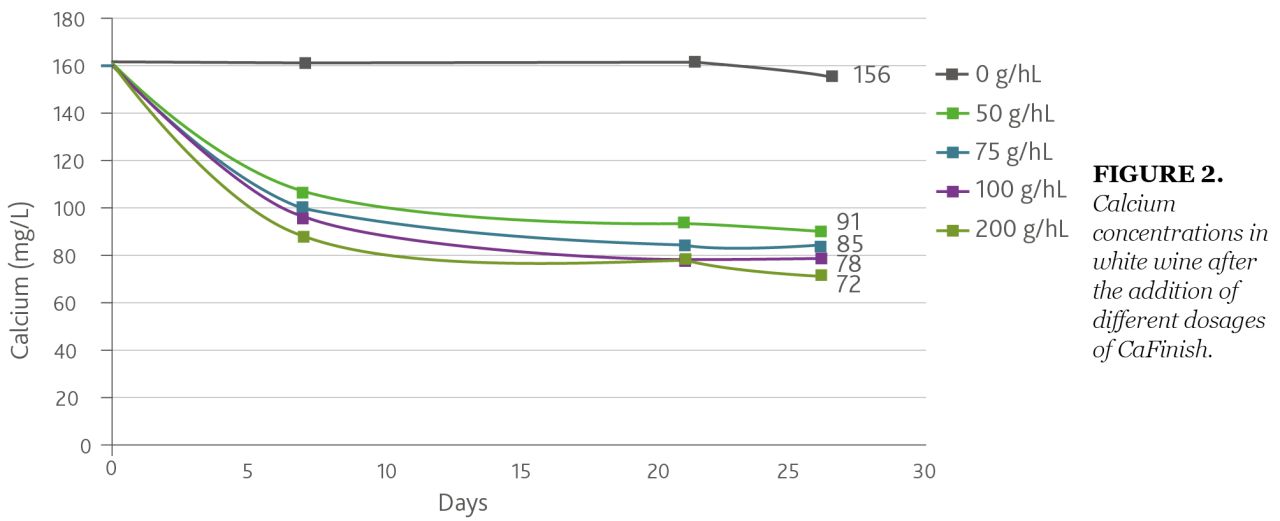
Figures 1 and 2 demonstrate the difference in efficacy of the two products in removing calcium. Ca²⁺Stab reduces calcium levels in must or wine in a stoichiometric and proportional manner. Therefore, dose calculation must be carefully considered to avoid excess product in the wine. The recommended formula is:
Dose (g/hL) = (Ca_initial - Ca_final) x 4
This ensures effective treatment without overdosing. It is recommended to check the final calcium concentration to confirm the treatment’s completion. On the other hand, CaFinish works by following the wine’s natural instability curve.
Q: Does LAFFORT® offer any biological solutions to help alleviate the situation?
A: Yes, indeed.
- ZYMAFLORE™ KLIMA (Saccharomyces cerevisiae) produces malic acid during fermentation that can act as an inhibitor to CaT crystal formation. Additionally, it has a lower alcohol yield than most wine yeast strains, further reducing the chances of instability.
- ZYMAFLORE™ OMEGA (Lachancea thermotolerans) produces lactic acid from glucose, leading to a natural acidification of wine, reducing the need to add exogenous tartaric acid to juice or wine.
- LACTOENOS™ BERRY Direct (Oenococcus oeni) preserves the citric acid content of wines during malolactic fermentation, which can act as an inhibitor to CaT crystal formation.
Q: What are the top five tips to prevent CaT instability in wine?
A:
- Manage hydric stress in the vineyard, as drought and heat from climate change can lead to higher calcium levels in grapes. Consider optimising irrigation, cover crops and soil organic matter to maintain balanced vine nutrition.
- Limit winemaking calcium inputs by avoiding or carefully controlling products such as calcium carbonate, low-purity casein and inferior-quality calcium-based bentonites, and by verifying the condition of cement tanks.
- Maintain pH and acidity balance using biological tools, such as yeast or bacteria that produce or preserve organic acids like malic and citric acid, to reduce free tartrate ions that bind with calcium.
- Preserve protective colloids by avoiding aggressive filtration, and note that common tartrate stabilisers (CMC, KPA and mannoproteins) are ineffective against CaT instability.
- Actively remove excess calcium with targeted treatments: use Ca²⁺Stab in fermenting must or CaFinish in finished wine, applying the correct dose based on calcium analysis.
Final words
With continued research and practical solutions from suppliers, winemakers are better equipped to manage this challenge effectively.
* Dr Sami Yammine holds a PhD in Oenology from the University of Bordeaux. He is currently the Fining and Stabilisation Range Manager at LAFFORT®.
References
- Fioschi, G., Prezioso, I., Sanarica, L., Pagano, R., Bettini, S. & Paradiso, V.M. Carrageenan as possible stabilizer of calcium tartrate in wine. Food Hydrocoll. 2024; 157:110403. doi:10.1016/J.FOODHYD.2024.110403.
- Cosme, F., Filipe-Ribeiro, L., Coixão, A., Bezerra, M. & Nunes, F.M. Efficiency of Alginic Acid, Sodium Carboxymethylcellulose, and Potassium Polyaspartate as Calcium Tartrate Stabilizers in Wines. Foods. 2024; 13(12):1880. doi:10.3390/FOODS13121880/S1.
- McKinnon, A.J., Scollary, G.R., Solomon, D.H. & Williams, P.J. The mechanism of precipitation of calcium L(+)-tartrate in a model wine solution. Colloids Surf A Physicochem Eng Asp. 1994; 82(3):225-235. doi:10.1016/0927-7757(93)02636-S.
- Calcium tartrate | OIV. Accessed June 30, 2025. https://www.oiv.int/standards/international-oenological-codex/part-i-monographs/monographs/calcium-tartrate?utm_source=chatgpt.com.
- Potassium hydrogen tartrate | OIV. Accessed June 30, 2025. https://www.oiv.int/standards/international-oenological-codex/part-i-monographs/monographs/potassium-hydrogen-tartrate.
- Calcium Instability - The Australian Wine Research Institute. Accessed June 30, 2025. https://www.awri.com.au/industry_support/winemaking_resources/fining-stabilities/hazes_and_deposits/calcium_instability/.
- McKinnon, A.J., Scollary, G.R., Solomon, D.H. & Williams, P.J. The Influence of Wine Components on the Spontaneous Precipitation of Calcium L(+)-Tartrate in a Model Wine Solution. Am J Enol Vitic. 1995; 46(4):509-517. doi:10.5344/AJEV.1995.46.4.509.
For more information, contact Morné Kemp at [email protected].
Click here to get your copy of WineLand Magazine.

More from
Innovation and insights

Packaging under pressure: What wine businesses should be watching
From lighter bottles to automated packing lines, packaging decisions are becoming increasingly important to the cost and competitiveness of South African wine.
How vine water stress shapes grape and wine quality
This study formed part of the South Africa Wine programme “Grapevine production with limited water resources”, and aimed to evaluate how spatial and temporal water stress affects vine physiology, fruit composition and wine quality.
Drought tolerance of different scion cultivars (Part 4): Vegetative growth and yield
The study aimed to assess grapevine vegetative and yield responses in an almost worst-case scenario, i.e. grapevines growing under dryland conditions in sandy loam soil in the Swartland region.