
Responding to climate change
· 2 min read

Climate change, increased seasonal variability and limitation of available water resources, have increased pressure on the production of table wines, and could continue without effective adaptive strategies.
The question is how exactly is climate in the Western Cape changing, how do grapevines respond and how can producers adapt? To shed light on these questions, Winetech funded a PhD study by Dr Tara Southey which integrated remote sensing, climate and grapevine responses over six localities and four years.
The study included extreme climatic conditions by selecting sites over a climatic band, and multiple factor analysis was used to evaluate the interaction of climate with grapevine expression to isolate possible driving factors that can be used in future climatic modelling.
Results from the study indicated that the grapevine is responding to climate change through altered phenology, growth and ripening responses. Despite differences on vineyard and site level, the grapevine’s performance is affected by environmental parameters.
Integrating these multiple environmental factors into site selection models in the near future for the Western Cape study area, would allow for informed decision making regarding site suitability within the context of climate change.
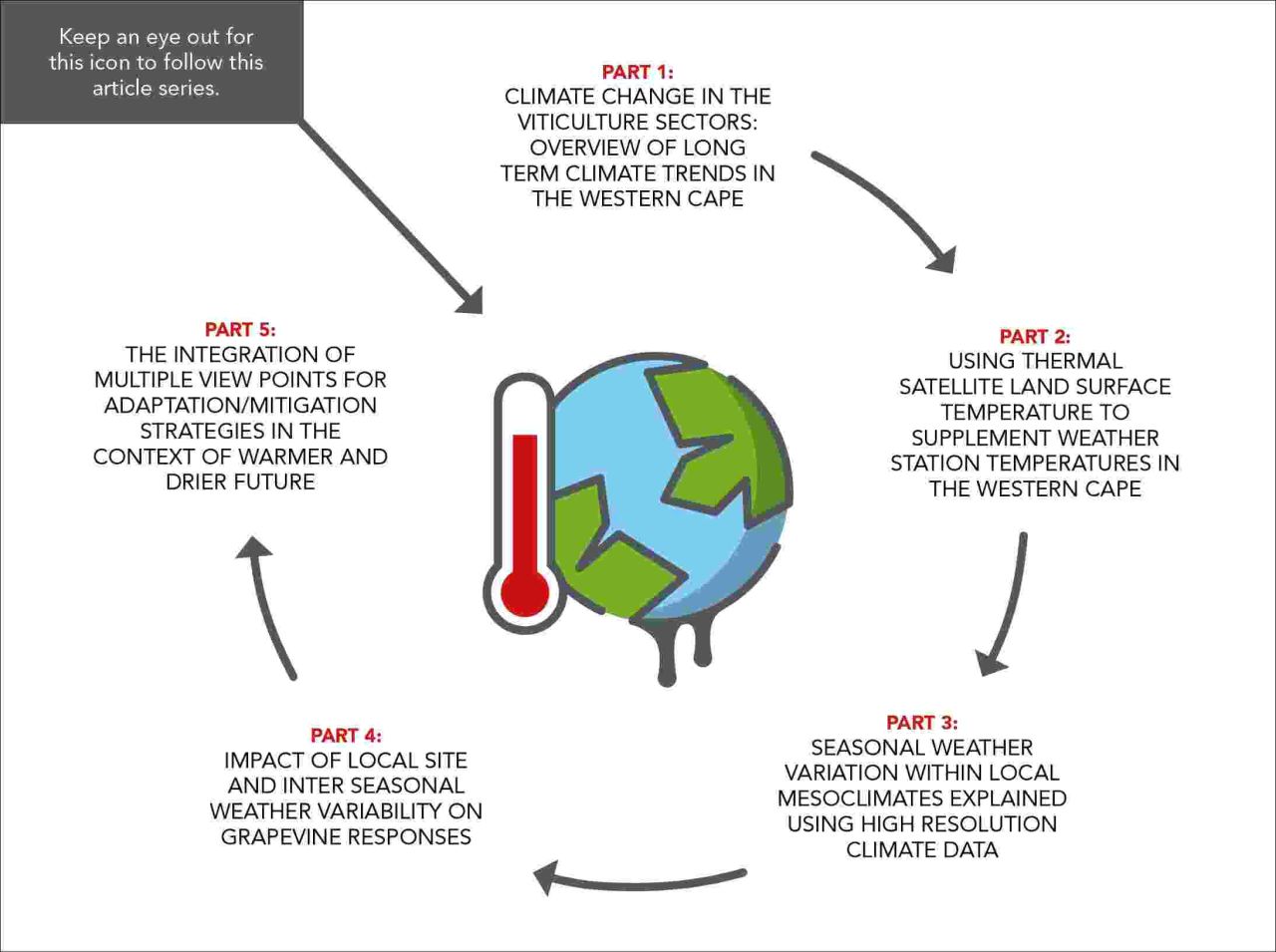
More details about this PhD study and the results from the study will be published in a five part article series over the next few months in the Winetech Technical. Above indicates the topics that will be discussed in each article in this series.
Terraclim
This PhD study was undertaken to integrate remote sensing, climate and phenological data. The results highlighted the reality of climate change and that grapevines respond to a changing climate. Another outcome of the project was the realisation that access to climate data is extremely limited. Based on this, Winetech commissioned a survey among industry members to identify what they need to aid decision making in the context of climate change. The feedback from the industry was that having a user-friendly platform where climate data and GIS information can be integrated, would be of immense value to aid short and long term decision making and to help producers adapt to climate change. This led to the development of the Terraclim platform.
– For more information about Terraclim, visit www.terraclim.co.za or you can also watch this video:

More from
Innovation and insights

Packaging under pressure: What wine businesses should be watching
From lighter bottles to automated packing lines, packaging decisions are becoming increasingly important to the cost and competitiveness of South African wine.
How vine water stress shapes grape and wine quality
This study formed part of the South Africa Wine programme “Grapevine production with limited water resources”, and aimed to evaluate how spatial and temporal water stress affects vine physiology, fruit composition and wine quality.
Drought tolerance of different scion cultivars (Part 4): Vegetative growth and yield
The study aimed to assess grapevine vegetative and yield responses in an almost worst-case scenario, i.e. grapevines growing under dryland conditions in sandy loam soil in the Swartland region.