
Crack down on counterfeiting
With its innovative products Guala Closures South Africa is leading the way when it comes to curbing counterfeiting.

· 4 min read
| With its innovative products Guala Closures South Africa is leading the way when it comes to curbing counterfeiting.Global counterfeiting has risen and today there are billions of dollars of counterfeit goods sold around the world. Statistics also show that the estimated global increase of counterfeit goods has resulted in hundreds of thousands of jobs lost.Methods of counterfeiting vary, from the simple substitution of the contents of a bottle with an inferior product to the production of completely fake packaging and contents copying well-known brands. These counterfeit products also contain ingredients which may be harmful to consumers’ health.Refilling or the replacement of the authentic product in the original bottle with an inferior product is the easiest and most common form of counterfeiting because it can be done by independent bar and restaurant owners for instance. Other forms of counterfeiting include reconstruction, reconstruction of the packaging using its original elements, removal and reuse of closures, reassembly of closures using components from various closures, applying a new label or duty stamp, and reuse of bottles or outer packaging and fake packaging, which includes the complete manufacturing of new packaging, production of certain or all closure components, assembly and decoration of the closure, and the production of new bottles. |
VISUAL PROTECTION FOR YOUR BRAND
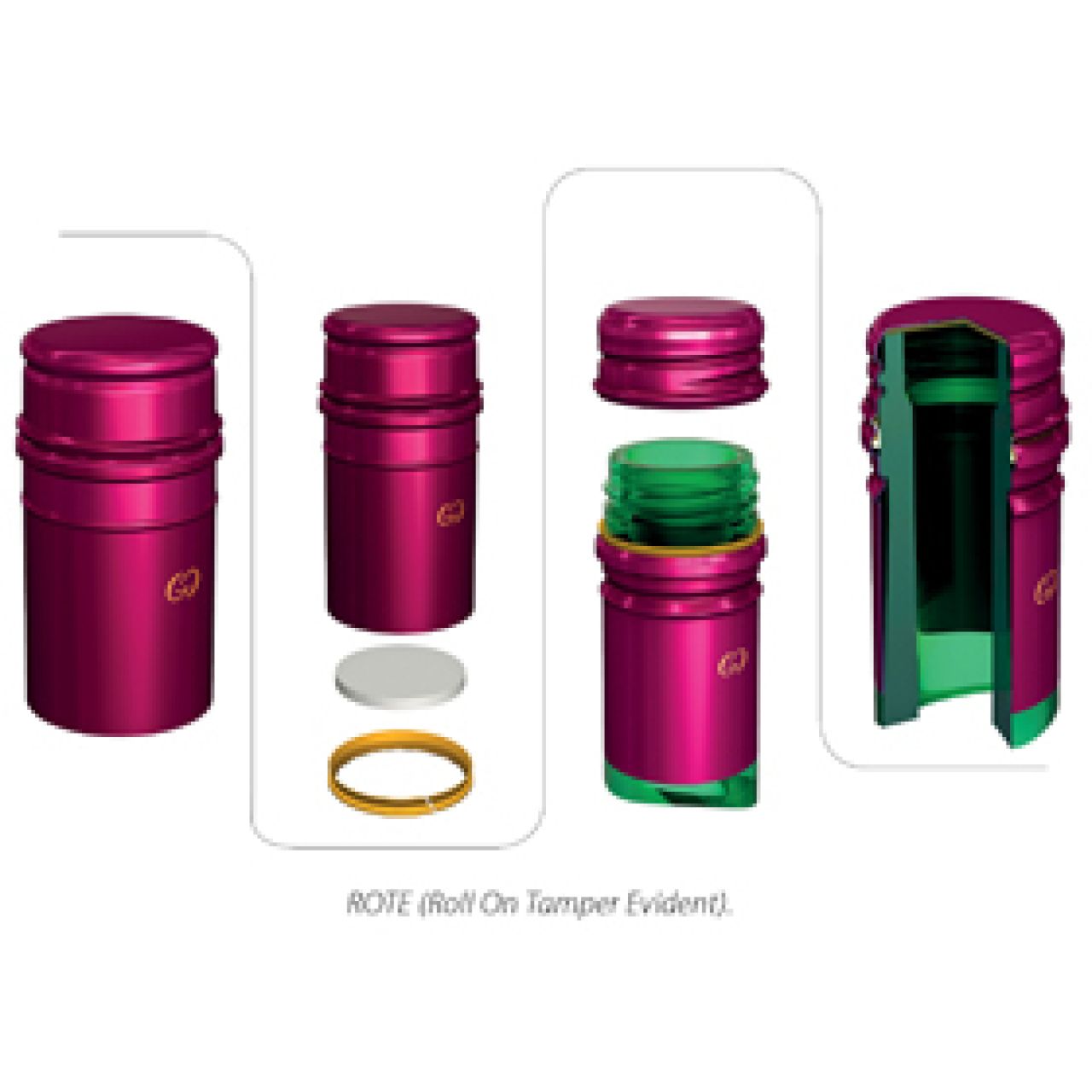
With these facts in mind, Guala Closures South Africa came up with innovative solutions to prevent counterfeiting, one of these being the Role On Tamper Evident (ROTE) closure, a dual tamper evident system specifically dedicated to standard aluminium closures.
With this simple, economic and safe solution a coloured plastic ring appears after the first opening and closing. The coloured plastic ring can be seen at a glance and can’t be removed and doesn’t damage the closure. This technology is available for aluminium ROPP closures on 30x35, 30x44, 30x50 and 30x60 standard neck finishes for both wine and spirits.
“ROTE is the perfect choice to protect your brand’s image and integrity, whether for spirits or wine,” says Guala Closures SA CEO Giuseppe Carosini. “Other counterfeiting solutions include Taggant security ink and UV ink.”
Another innovation from Guala Closures is the SAVIN Premium & Premium Spirits, a closure with a strong, double-layered design and internal thread.
“Not only do the two layers offer a stronger seal, but the lack of threading on the outside gives a completely smooth surface area to allow branding such as foiling and embossing,” says Carosini. This closure is available in 30x60, 30x50, 30x44 and 30x35 with liner options of Tin, SARANEX, TRI-OX or EPE.
A NEW RANGE OF LINERS BY OENOSEAL
Over the past 15 years the wine market’s quality requirements have changed due to cork taint, leakage and oxidation. The wine closure market has changed dramatically over this period with 30% of the still wine market using screw caps, according to Guala Closures South Africa.
Due to changes in the market Guala Closures and MGJ have shared their expertise to provide a new range of oxygen-management liners. Oenoseal Coral High Permeability, Oenoseal Ivory Medium Permeability and Oenoseal Onyx Low Permeability offer winemakers and wine consumers traceability and allow control and monitoring of consistent high-performance oxygen ingress (OTR). By using proven wine preservation materials, no wine contact changes can happen and no capping heads and bottling line setting changes are needed.
The liners are made of aluminium as opposed to tin and fully certified in-house plastic films recycled by MGJ, making them environmentally friendly. The Oenoseal liners have also been approved by the FDA and EU, so comply with all food safety regulations.
HANDY APP FOR WINEMAKERS
The Oenoseal app is a decisionmaking support tool with a questionnaire that follows a bottle of wine from its conception and includes questions about your wine’s identity, winemaking guidelines, bottling conditions and commercialisation.
This App provides support to the winemaker to choose the most appropriate liner, according to the oxygen ingress (OTR), the type of wine and the winemaker’s intention and/or consumer’s expectation.
The app is based on the following 20 criteria ranked according to priority level: wine colour, varietal, oak-barrel aging, micro-ox, TPO, free sulphur dioxide, storage conditions, pH, head space (HS) inerting, screwsap inerting, wine profile, carbon dioxide, grape soundness, copper, ascorbic acid, glutathione, bottling temperature, rotation, stabilisation before bottling and retail price.

More from
Markets, business and trade

Does Government know what it’s costing you?
A decision made in Pretoria can change the way a wine business operates. But who makes sure the people making those decisions understand what happens on the ground? South Africa Wine’s Jordyn Goeieman takes us inside the often unseen work of influencing the policies that affect the industry.

All roads lead to Wine Paris
With professionals from more than 169 countries attending Wine Paris in 2026, the exhibition has become an increasingly important meeting point for the global wine trade. Nicolas Cuissard, Director of Wine Paris, speaks to WineLand about the exhibition’s growing international influence, opportunities for South African producers and what it takes to turn participation into business.
Before you bottle it, can you sell it?
A good wine and an attractive label are not enough to build a sustainable business. South Africa Wine’s Phil Bowes explains why finding customers, testing assumptions and understanding the numbers should come before committing to a new wine brand.