
Drought tolerance of different scion cultivars (Part 3): Grapevine water status
the objective of the study was to assess the grapevine water status of selected reference and alternative scion cultivars under dryland conditions in the Swartland region. It must be noted that the study aimed to assess grapevine responses in an almost worst-case scenario, i.e. grapevines growing…
Carolyn Howell, Karen Freitag and Reckson Mulidzi
· 10 min read
Abstract
Drought-tolerant scion cultivars can reduce the risk of yield losses for viticulture. Therefore, a field trial was conducted in the Swartland region, South Africa, to determine the vegetative growth, yield and quality of alternative scion cultivars to make recommendations to the wine industry. In this regard, nine red and eight white alternative and reference scion cultivars were planted in an experimental vineyard near Malmesbury in July 2018. Grapevine water status was measured in this experimental vineyard using the pressure chamber technique on selected dates from 2019 to 2022. As expected, the grapevine water status of scion cultivars behaved differently under the dryland conditions. In particular, Grenache noir and Pinotage exhibited isohydric behaviour, whereas Shiraz responded in a more anisohydric way. For white scion cultivars, Verdelho showed more isohydric characteristics compared to most of the other white cultivars.
Introduction
Drought-tolerant wine grape scion cultivars can reduce the risk of yield losses for viticulture, particularly under dryland or drought conditions. However, there is no scientifically based information regarding the growth, yield and quality of alternative scion cultivars in South Africa. Consequently, the study was conducted to generate this knowledge to make recommendations to the wine industry. In this regard, nine red and eight white alternative and reference cultivars were planted in an experimental vineyard near Malmesbury in the Swartland region in July 2018.1
The effect of soil, rootstock and scion cultivar on drought tolerance of plants is difficult to differentiate and depends on complex mechanisms.2 However, grapevines are considered to be drought-tolerant plants and have diverse hydraulic and photosynthetic behaviour depending on the cultivar.3 Plants are frequently classed as isohydric or anisohydric.4 In this regard, isohydric means that the leaf water potential (ΨL) of the grapevine is kept steady whereas when cultivars are anisohydric, ΨL lowers as the soil becomes drier.3 Therefore, isohydric plants have a tighter regulation of stomatal conductance (gs) and anisohydric plants have higher gs. For grapevines, the most classic examples are Grenache, which is considered to be isohydric and Shiraz, which exhibits anisohydric behaviour.
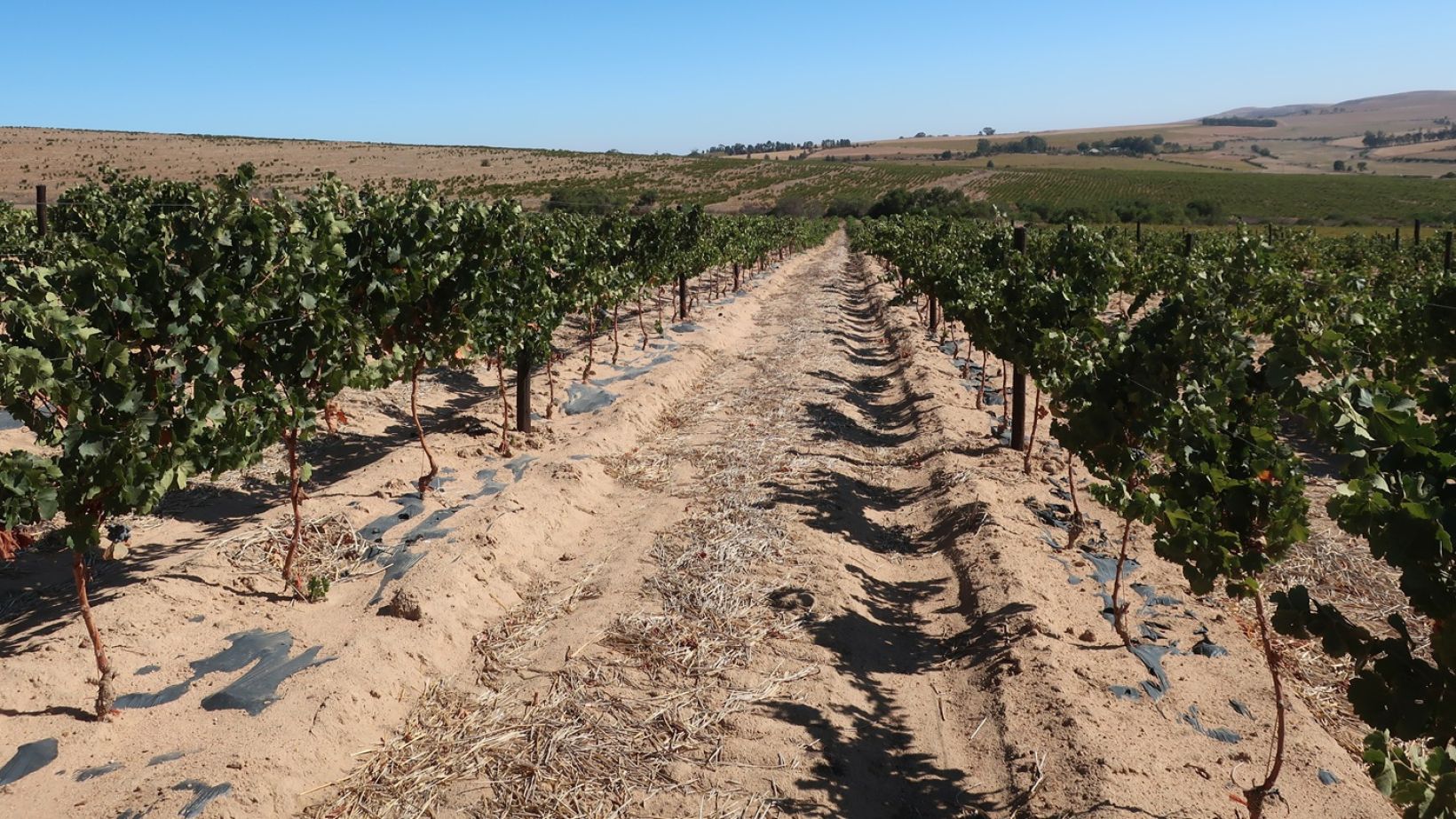
Taking the above-mentioned into consideration, the selection of drought-tolerant scion cultivars could be an important tool in developing adaptation strategies for drought to increase the sustainability of the wine industry. In South Africa, 18.4%, 9.6%, 7.6% and 7.6% of the total area of wine grapes are Chenin blanc, Shiraz, Chardonnay and Pinotage, respectively.5 Furthermore, there is no scientifically based information regarding grapevine water status for alternative scion cultivars in South Africa. Therefore, the objective of the study was to assess the grapevine water status of selected reference and alternative scion cultivars under dryland conditions in the Swartland region. It must be noted that the study aimed to assess grapevine responses in an almost worst-case scenario, i.e. grapevines growing under dryland conditions in a sandy loam soil in the Swartland region.
Materials and methods
Grapevine water status in the experimental vineyard with the nine red and eight white scion cultivars was quantified by measuring grapevine water potential using the pressure chamber technique.6,7 Midday ΨL and stem (ΨS) water potential were measured in one mature, unscathed leaf on a primary shoot per plot. For ΨS measurements, leaves were covered in aluminium bags7,8 for at least one hour before measurements commenced. Midday ΨL and ΨS were measured on selected dates from 2019 to 2022.
Statistical analysis
The average of October to December (pre-véraison) and January to February (post-véraison) midday ΨL, ΨS, as well as the difference between ΨL and ΨS (ΔΨ) were calculated and analysed statistically for the red and white scion cultivars. Analyses of Variance (Anovas) were performed using SAS software. Student’s least significant differences were calculated at the 5% significance level to facilitate comparison between treatment means.
Results and discussion
Red cultivars
Midday ΨL of the red scion cultivars in the pre-véraison period, i.e. October to December, fell into the no to low water constraint classes9 (Figure 1A). Grenache noir and Pinotage had higher midday ΨL than all the other red cultivars except Malbec. Midday ΨL was substantially lower for all the red cultivars in the post-véraison period, i.e. January to February, and fell mainly into the moderate to high-water constraint classes.9 Grenache noir and Pinotage still had the highest midday ΨL whereas Durif, Shiraz and Tempranillo had the lowest (Figure 1A). The fact that Grenache noir and Pinotage had the highest midday ΨL in the pre- and post-véraison periods suggested that they lost less water due to transpiration compared to the other red cultivars. This likely induced lower levels of water deficits for Grenache noir and Pinotage. It was previously reported that Grenache shows isohydric behaviour whereas Shiraz grapevines exhibit near-anisohydric behaviour.3,10,11,12 Therefore, it would be expected that ΨL of Shiraz would be substantially lower than Grenache noir under the same prevailing conditions.
Midday ΨS was substantially lower later in the growing season compared to earlier on (Figure 1B). According to thresholds for water constraint classes for ΨS,13 values later in the season fell mainly into the high-water constraint class (Figure 1B). Similar reductions in ΨS in the progression of the growing season were previously reported for Cabernet Sauvignon.14 Grenache noir had higher midday ΨS than Arinarnoa, Durif, Marselan, Shiraz, Tempranillo and Touriga in the pre-véraison period (Figure 1B).
From October to December, ΔΨ was highest for Marselan and Shiraz (Figure 1C). The lowest ΔΨ was obtained for Pinotage. Differences in midday ΨL seemed to have contributed more to the difference between ΨS and ΨL, i.e. ΔΨ. If ΔΨ is large, it implies that the grapevines lose more water through transpiration compared to grapevines where ΔΨ is smaller. Consequently, grapevines with a smaller ΔΨ will probably be better adapted when the soil water content becomes limited.
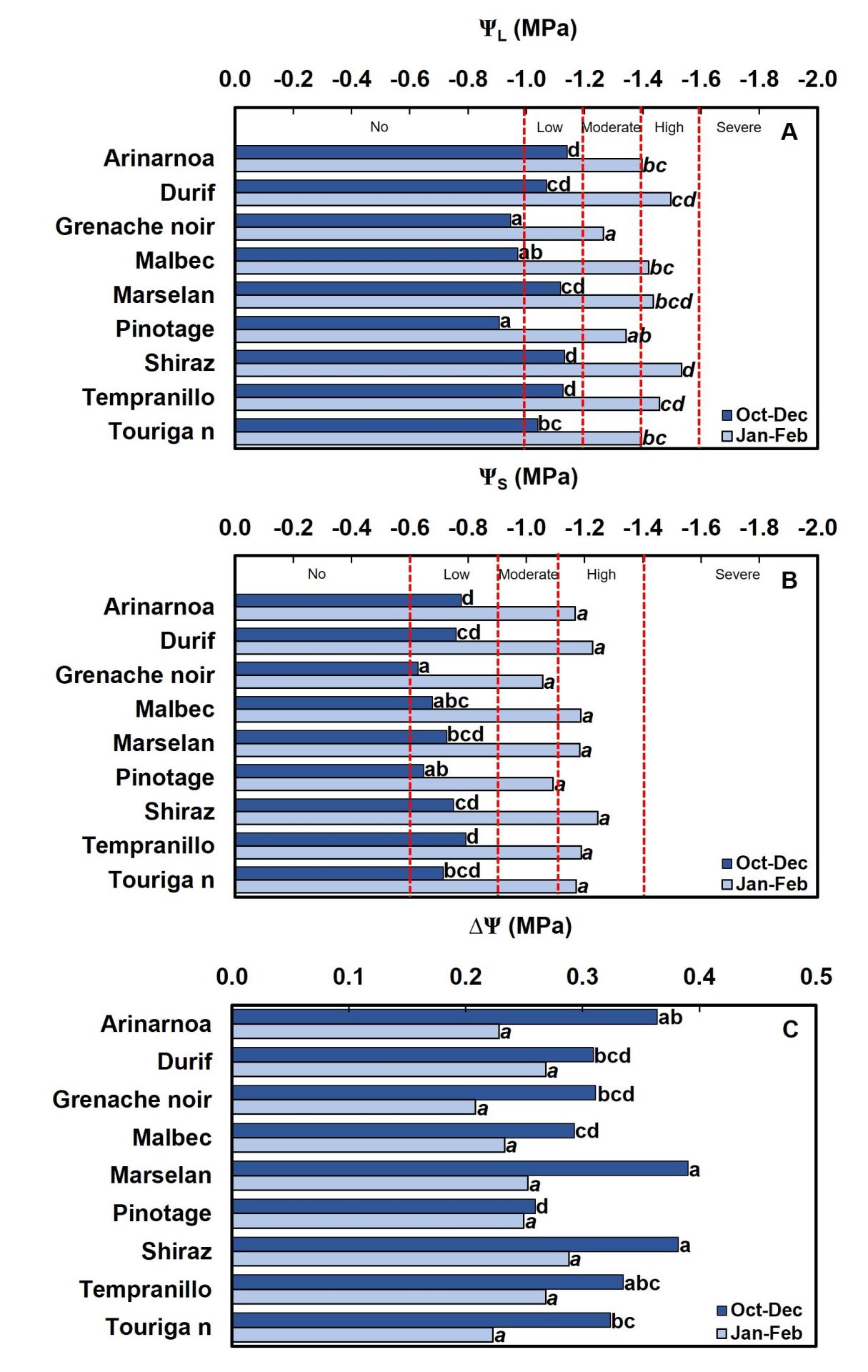
FIGURE 1. The mean pre-December and post-December midday (A) leaf (ΨL) and (B) stem water potential (ΨS), as well as (C) the difference between ΨL and ΨS (ΔΨ) in red scion cultivars grown under dryland conditions near Malmesbury in the Swartland region of South Africa. Bars designated by the same letter for each time period do not differ significantly (p ≤ 0.05).
White cultivars
In the case of the white scion cultivars, midday ΨL in the pre-véraison period, i.e. October to December, fell into the low to moderate water constraint classes9 (Figure 2A). Verdelho had higher ΨL than most of the other cultivars. This suggested that Verdelho showed isohydric behaviour under the prevailing conditions. In addition, ΨL of Verdelho did not go below -1.5 MPa.15 In contrast, Chenin blanc and Vermentino had the lowest ΨL. Midday ΨL was substantially lower for all white cultivars in the post-véraison period compared to pre-véraison (Figure 2A) and fell mostly into the high-water constraint class.9 On average, Verdelho had the highest midday ΨL, whereas Chenin blanc had the lowest.
Verdelho had the highest midday ΨS in the pre-véraison period compared to all the other cultivars except for Piquepoul blanc (Figure 2B). Midday ΨS was substantially lower later in the season compared to earlier on. The reduction in midday ΨS over the course of the growing season was similar to that reported for dryland Sauvignon blanc grapevine14 and was expected under the prevailing conditions. The ΔΨ was highest for Chardonnay and Vermentino in the pre-véraison period, but lowest for Macabeo (Figure 2C).
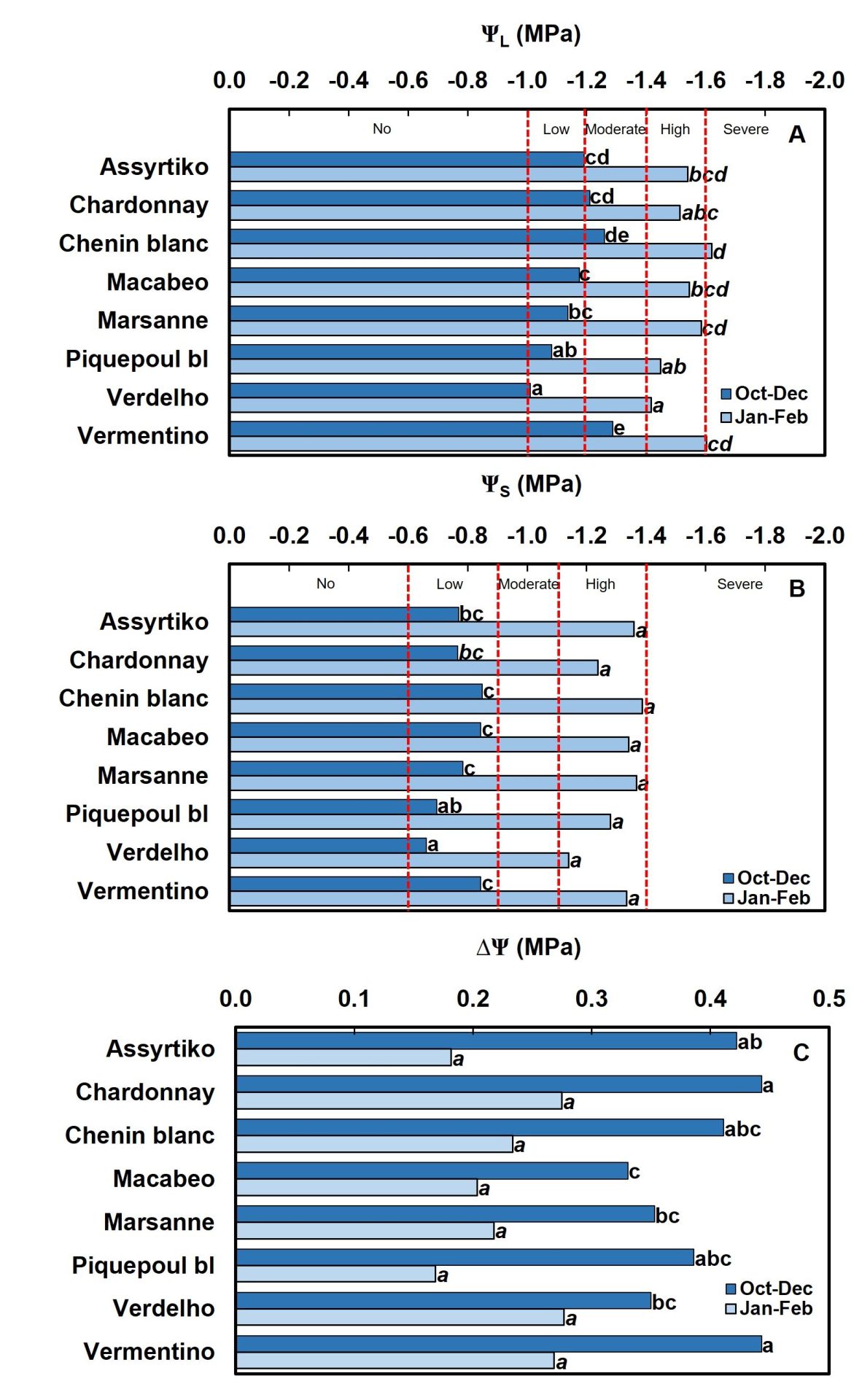
FIGURE 2. The mean pre-December and post-December midday (A) leaf (ΨL) and (B) stem water potential (ΨS), as well as (C) the difference between ΨL and ΨS (ΔΨ) in white scion cultivars grown under dryland conditions near Malmesbury in the Swartland region of South Africa. Bars designated by the same letter for each time period do not differ significantly (p ≤ 0.05).
Conclusions
The study was the first in South Africa to assess grapevine water status of selected wine grape scion cultivars in an almost worst-case scenario, i.e. under dryland conditions in a sandy loam soil in the Swartland region. As expected, the grapevine water status of the scion cultivars behaved differently under the dryland conditions. In particular, Grenache noir and Pinotage exhibited isohydric behaviour whereas Shiraz responded in a more anisohydric way. For white scion cultivars, Verdelho showed more isohydric characteristics compared to most of the other cultivars.
Vegetative growth and yield will be presented in the next article.
Acknowledgements
- South Africa Wine and the Agricultural Research Council (ARC) for funding Project P04000207 entitled “Assessing the drought tolerance of selected grapevine scion cultivars under dryland conditions in the Swartland region”.
- ARC for infrastructure and resources.
- Staff of the Soil and Water Science division at ARC Infruitec-Nietvoorbij for technical support, in particular J. Adams, F. Baron and T. Harris for their dedicated, enthusiastic work and support.
- Rossouw of Fairview Farm, Malmesbury, for allowing us to have the project on his farm and for his interest in the study and viticultural inputs. His staff for their inputs in the experimental vineyard.
- van Breda, C. Paulsen and other colleagues in the PHAT division at ARC Infruitec-Nietvoorbij for the analyses of the juice samples and the making of the experimental wines for the project.
- van der Rijst of ARC for statistical analyses of the data.
- South Africa Wine for funding for C.L. Howell to attend the 19th AWITC in Adelaide, Australia in July 2025.
References
- Howell, C., Freitag, K & Mulidzi, R., 2025. Drought tolerance of different scion cultivars (Part 1): Introduction. Wineland July. 75-79.
- Lovisolo, C., Lavoie-Lamoureux, A., Tramontini, S. & Ferrandino, A., 2016. Grapevine adaptations to water stress: new perspectives about soil/plant interactions. Theor. Exp. Plant Physiol. 28, 53-66.
- Hochberg, U., Degu, A., Fait, A. & Rachmilevitch, S., 2013. Near isohydric grapevine cultivar displays higher photosynthetic efficiency and photorespiration rates under drought stress as compared with near anisohydric grapevine cultivar. Physiol. Plant. 147, 443-452.
- Hochberg, U., Rockwell, F.E., Holbrooke, N.M. & Corchard, H., 2018. Iso/anisohydry: A plant-environment interaction rather than a simple hydraulic trait. Trends in Plant Sci. 23, 112-120.
- SAWIS, 2024. South Africa wine industry statistics, www.wosa.co.za.
- Scholander, P.F., Hammel, H.T., Bradstreet, E.D. & Hemmingsen, E.A., 1965. Sap pressure in vascular plants. Science 148, 339-346.
- Myburgh, P.A., 2010. Practical guidelines for the measurement of water potential in grapevine leaves. Wynboer Technical Yearbook 2010, 11-13.
- Choné, X., Van Leeuwen, C., Durbourdieu, D. & Gaudillére, J.P., 2001. Stem water potential is a sensitive indicator of grapevine water status. Ann. Bot. 87, 477-483.
- Greenspan, M., 2005. Integrated irrigation of California winegrapes. Prac. Vineyard & Winery, March/April 2005, 21-79.
- Schultz, H.R., 2003. Differences in hydraulic architecture account for near-isohydric and anisohydric behaviour of two field-grown Vitis vinifera cultivars during drought. Plant Cell Environ. 26, 1393-1405.
- Soar, C.J., Speirs, J., Maffei, S.M, Penrose, A.B., McCarthy, M.G. & Loveys, B.R., 2006. Grape vine varieties Shiraz and Grenache differ in their stomatal response to VPD: apparent links with ABA physiology and gene expression in leaf tissue. Aust. J. Grape Wine Res. 12, 2-12.
- Gerzon, E., Biton, I., Yaniv, Y., Zemach, H., Netzer, Y., Schwartz, A., Fait, A. & Ben-Ari, G., 2015. Grapevine anatomy as a possible determinant of isohydric or anisohydric behavior. Am. J. Enol. Vitic. 66, 340-347.
- Van Leeuwen, C., Tregoat, O., Choné, X., Bois, B., Pernet, D. & Gaudillère, J.P., 2009. Vine water status is a key factor in grape ripening and vintage quality for red Bordeaux wine. How can it be assessed for vineyard management purposes? J. Int. Sci. Vigne Vin 43, 121-134.
- Hoogendijk, K., 2019. Soil and grapevine responses to irrigation with treated municipal and winery wastewaters. Thesis, Stellenbosch University, Private Bag X1, 7602 Matieland (Stellenbosch), South Africa.
- Lovisolo, C., Perrone, I., Carra, A., Ferrandino, A., Flexas, J., Medrano, H. & Schubert, A., 2010. Drought-induced changes in development and function of grapevine (Vitis spp) organs and their hydraulic and non-hydraulic interactions at the whole-plant level: A physiological and molecular update. Funct. Plant Biol. 37, 98-116.
For more information contact Carolyn Howell at [email protected].
Click here to get your copy of WineLand Magazine.

More from
Innovation and insights

Packaging under pressure: What wine businesses should be watching
From lighter bottles to automated packing lines, packaging decisions are becoming increasingly important to the cost and competitiveness of South African wine.
How vine water stress shapes grape and wine quality
This study formed part of the South Africa Wine programme “Grapevine production with limited water resources”, and aimed to evaluate how spatial and temporal water stress affects vine physiology, fruit composition and wine quality.
Drought tolerance of different scion cultivars (Part 4): Vegetative growth and yield
The study aimed to assess grapevine vegetative and yield responses in an almost worst-case scenario, i.e. grapevines growing under dryland conditions in sandy loam soil in the Swartland region.