
Grape flavan-3-ol evolution (Part 4): Effect of sequential harvesting on the sensory properties of the wines
· 6 min read
The aim of this study was to evaluate wines produced by grapes that were harvested at different ripeness levels using berry sugar accumulation as a physiological indicator.
Introduction
Optimal berry ripeness depends on the wine style goal. The sensory characteristics of the finished wine and thus the quality is strongly dependent on the perception of the primary and secondary metabolites and the alcohol level. Deloire (2011) suggested a sugar loading concept which defines sugar loading as the evolution of the sugar quantity (mg/berry) from véraison onward. The evolution of sugar accumulation per berry gives an indication of the ripening time and could be used as a physiological indicator in direct relation with the potential wine styles. Three sugar loading profiles are distinguished: Continual and rapid loading, slow sugar loading (inhibition of ripening) and sugar loading presenting a plateau phase. Depending on whether the grapes are picked in the early, mid or late stages of the plateau, the wine will be characterised as ‘fresh fruit’, ‘neutral-spicy’ or ‘pre-mature’ and ‘mature fruit’ (Deloire, 2011). The aroma attributes present in the grapes are attributed to the evolution of volatile precursors during berry development, which are dependent on enzyme activity and specificity. Wine phenol composition and thus astringency and bitterness are altered by grape maturity at harvest, winemaking techniques and wine ageing.
Materials and methods
Sequential harvesting and small-scale winemaking
Grapes of the 2010/2011 season were harvested at the fresh fruit period for all four treatments (20 - 25 days after the sugar loading plateau was reached) on the 28th of February 2011. The grapes of all the treatments in 2011/2012 season were harvested at the mature fruit period (45 days after the sugar loading plateau was reached) on the 26th of March 2012. Wine were made from the harvested grapes according to the experimental cellar protocol from the Department of Viticulture and Oenology, Stellenbosch University.
Descriptive sensory analysis (DSA)
The wines were evaluated six months after bottling by a panel of 10 female judges (28 - 65 years old) for the 2010/2011 season during four replicate sessions. The 2011/2012 wines were evaluated by a panel of nine female judges (29 - 65 years old) during six replicate sessions. Prior to testing, the panel members underwent training and assessment of panel performance in six two-hour sessions in both seasons. The samples were evaluated for an array of aroma attributes, as well as taste and mouthfeel attributes, before and after expectoration using 100-point unstructured line scales.
Data analysis
Sensory data were pre-processed and subjected to a test-retest analysis of variance (ANOVA) using SAS. The latter was performed to test for panel reliability. The Shapiro-Wilk test was performed to test for normality (Shapiro & Wilk, 1965). Students’ t-test least significant difference was calculated at the 5% level to compare treatment means (Ott, 1998). A probability level of p≤0.05 was considered significant for all the significance tests.
Results and discussion
Sensory profile of the wines
The wines made from the different treatments differed significantly for 11 of the 22 sensory attributes in 2010/2011. These include the aromas vegetative green (p≤0.001) and green plum (p≤0.001) and the in mouth palate attributes: Acidity (p≤0.001), fullness (p≤0.001), drying (p≤0.05), satin (p≤0.05) and coarse emery (p≤0.05), as well as the attributes experienced after expectoration, drying (p≤0.001), adhesive (p≤0.001), hotness (≤0.001) and fruit flavour persistence (p≤0.001) (Table 1). Wines made from STD and STD-UV-B treatment grapes scored significantly higher for green plum (Table 1). Wines made from the STD treatment grapes were rated significantly higher in satin in the mouth compared to the other treatment wines (Table 1). This finding coincides with that of Ristic et al. (2007) who found shaded berries to be less coarse and grainy. After expectoration, “drying” and “adhesive’ was rated the highest for the STD-UV-B treatment, indicating a higher perception of astringency. Numerous authors attribute the increase in astringency perception to greater concentration of tannins, polymerised phenols and the variation in tannin structures (Vidal et al., 2003; Kennedy et al., 2006, Mercurio & Smith, 2008; Oberholster et al., 2009).
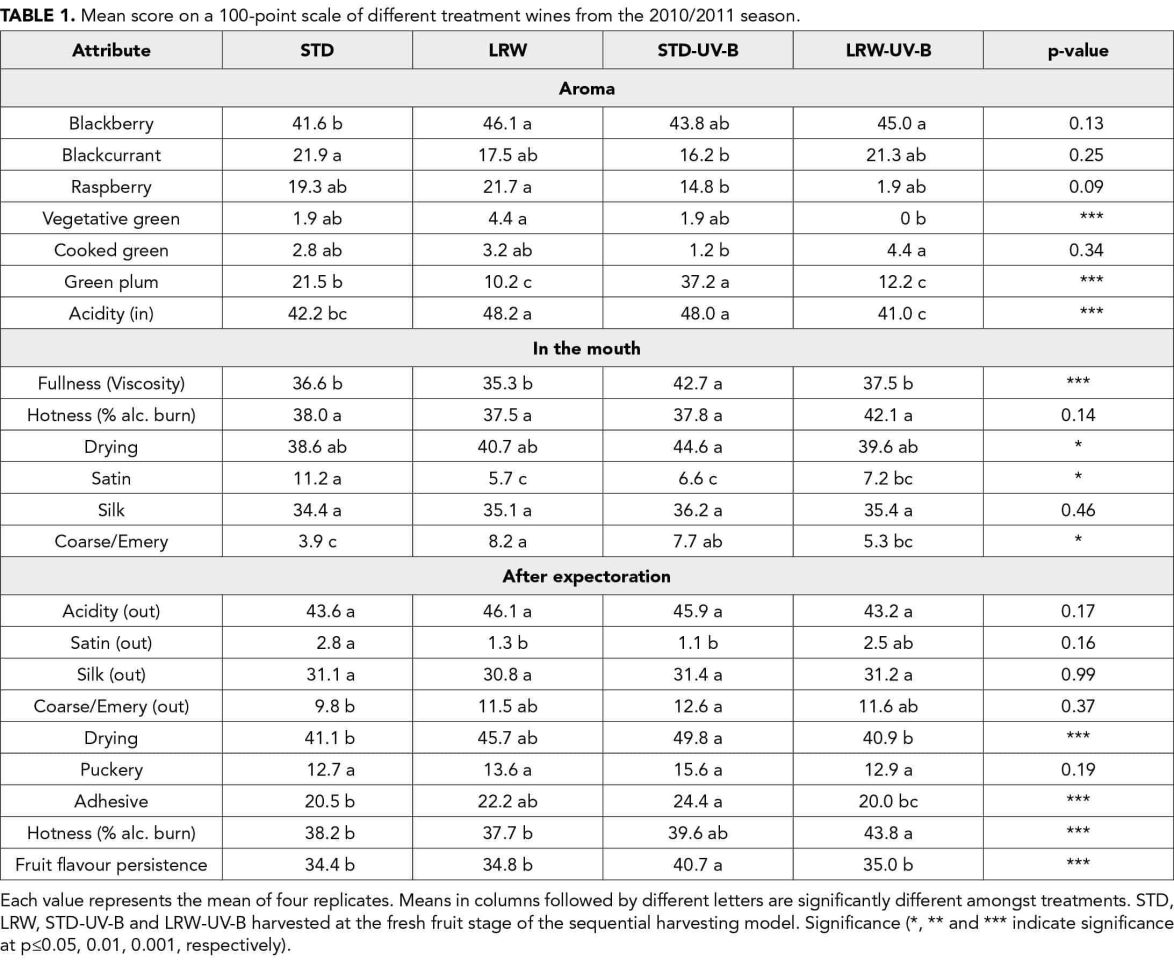
Wines made from the 2011/2012 season differed significantly among treatments in both aroma and mouthfeel attributes for 20 of the 27 attributes investigated (Table 2). These include the aromas prune (p≤0.001), raisin (p≤0.001), spice (p≤0.001), earthy (p≤0.05) and cooked vegetable (p≤0.001). In the palate acidity (p≤0.001), satin (p≤0.05), silk (p≤0.05), coarse emery (p≤0.001), drying (p≤0.001), hotness (p≤0.001) and puckery (p≤0.001) and after expectoration, acidity (p≤0.05), satin (p≤0.05), silk (p≤0.05), coarse/emery (p≤0.001), drying (p≤0.001), hotness (% alc. burn) (p≤0.001), puckery (p≤0.05), adhesive (p≤0.001) and astringent persistence (p≤0.001) were significantly different among wine treatments (Table 2). The aroma attributes that were perceived by the panel can be associated with over-matured fruit indicating a longer hanging time and corresponds with the sequential harvest model of Deloire (2011). The over-matured fruit and spicy aroma attributes found in this study corresponds with the findings of Nell (2015) in Merlot noir and Cabernet Sauvignon. The LR (-UV-B, 2xUHI) wine scored higher for prune (p≤0.001), raisin (p≤0.001), spice (p≤0.001) and cooked vegetative (p≤0.05) attributes when compared to the other treatments (Table 2).
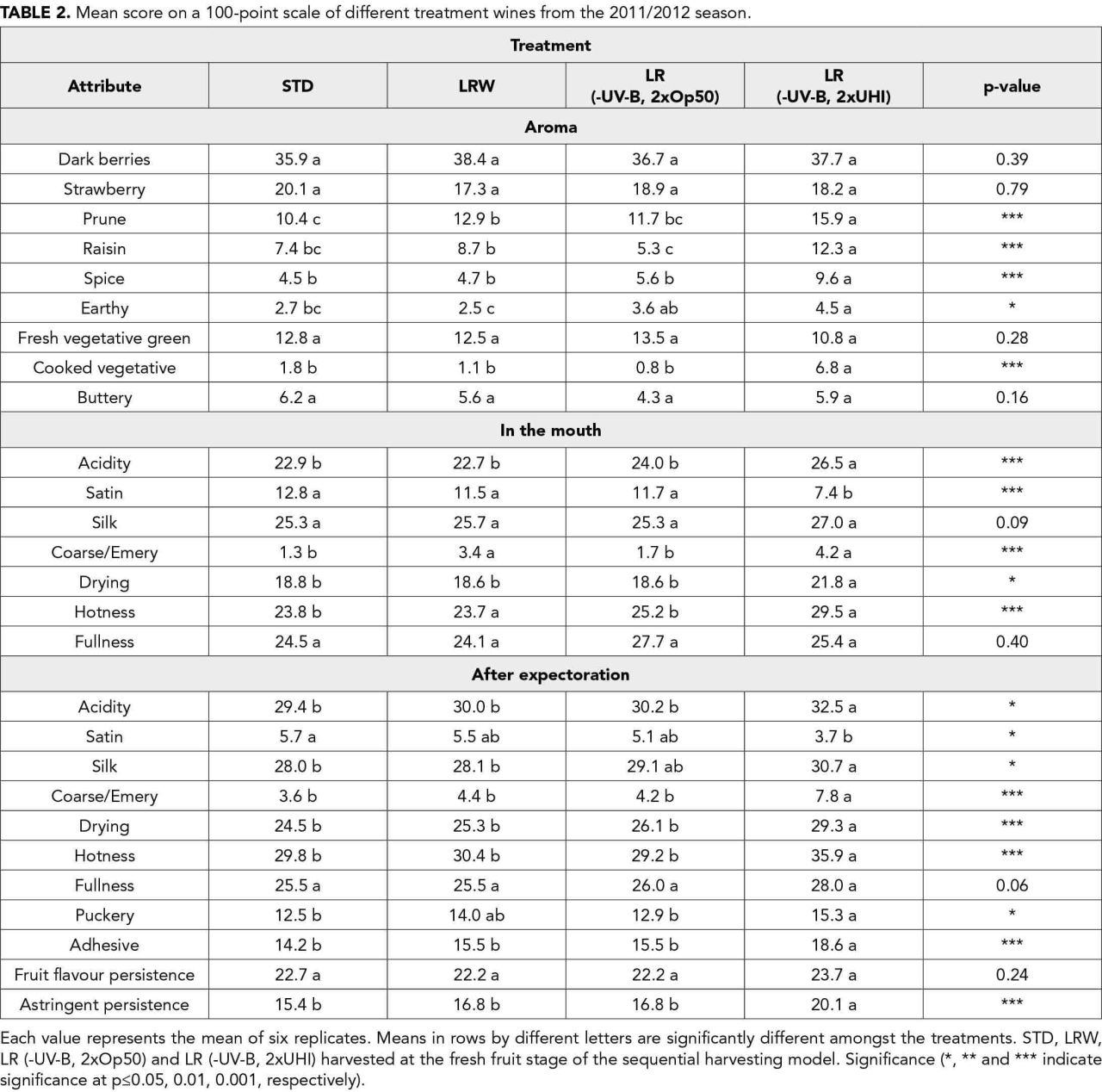
In general, the wine from treatment LR (-UV-B, 2xUHI) was rated significantly higher than the other three treatments [STD, LRW and LR (-UV-B, 2xOP50)] in most of the mouth and after expectoration attributes (Table 2). Gawel et al. (2007) suggested that an increase in ‘puckery’ sensation were characterised by low anthocyanin levels, high acidity and high pigmented polymer and tannin concentrations. The perception of astringency in wines is, however, also influenced by other parameters, such as pH, acidity, ethanol concentration and polysaccharides (Cheynier et al., 2006; Bajec & Pickering, 2008; Ma et al., 2014). From these results, the LR (-UV-B, 2xUHI) treatment had significantly higher (p≤0.001) (data not shown) acidity which could enhance the astringency perception of the phenolic compounds.
Conclusions
Wines in the respective seasons corresponded with sequential harvest using a berry physiological indicator as wines were classified as fresh, green characters in 2010/2011 and prune and raisin characters in 2011/2012. Wines from the STD treatment were consistently rated as having higher satin properties in and after expectoration.
– For more information, contact Erna Blancquaert at [email protected].

More from
Innovation and insights

Packaging under pressure: What wine businesses should be watching
From lighter bottles to automated packing lines, packaging decisions are becoming increasingly important to the cost and competitiveness of South African wine.
How vine water stress shapes grape and wine quality
This study formed part of the South Africa Wine programme “Grapevine production with limited water resources”, and aimed to evaluate how spatial and temporal water stress affects vine physiology, fruit composition and wine quality.
Drought tolerance of different scion cultivars (Part 4): Vegetative growth and yield
The study aimed to assess grapevine vegetative and yield responses in an almost worst-case scenario, i.e. grapevines growing under dryland conditions in sandy loam soil in the Swartland region.