
Harlequin beetle - the Waterloo for South African wines?
· 4 min read
In this study, the seasonal occurrence of the harlequin beetle (Harmonia axyridis) was monitored in four vineyards and the adjacent windbreaks over three growing seasons in the Western Cape Province.
Harlequin beetle, Harmonia axyridis (Pallas) (Coleoptera: Coccinellidae), is an exotic ladybird, first recorded in South Africa in 2004, where it was introduced factitiously. In view of the migration of H. axyridis from the vines in December, they appear not to pose any risk of contaminating grapes during harvest and tainting wine as most wine grapes are harvested from January onwards. No parasitoids were observed attacking H. axyridis.
Introduction
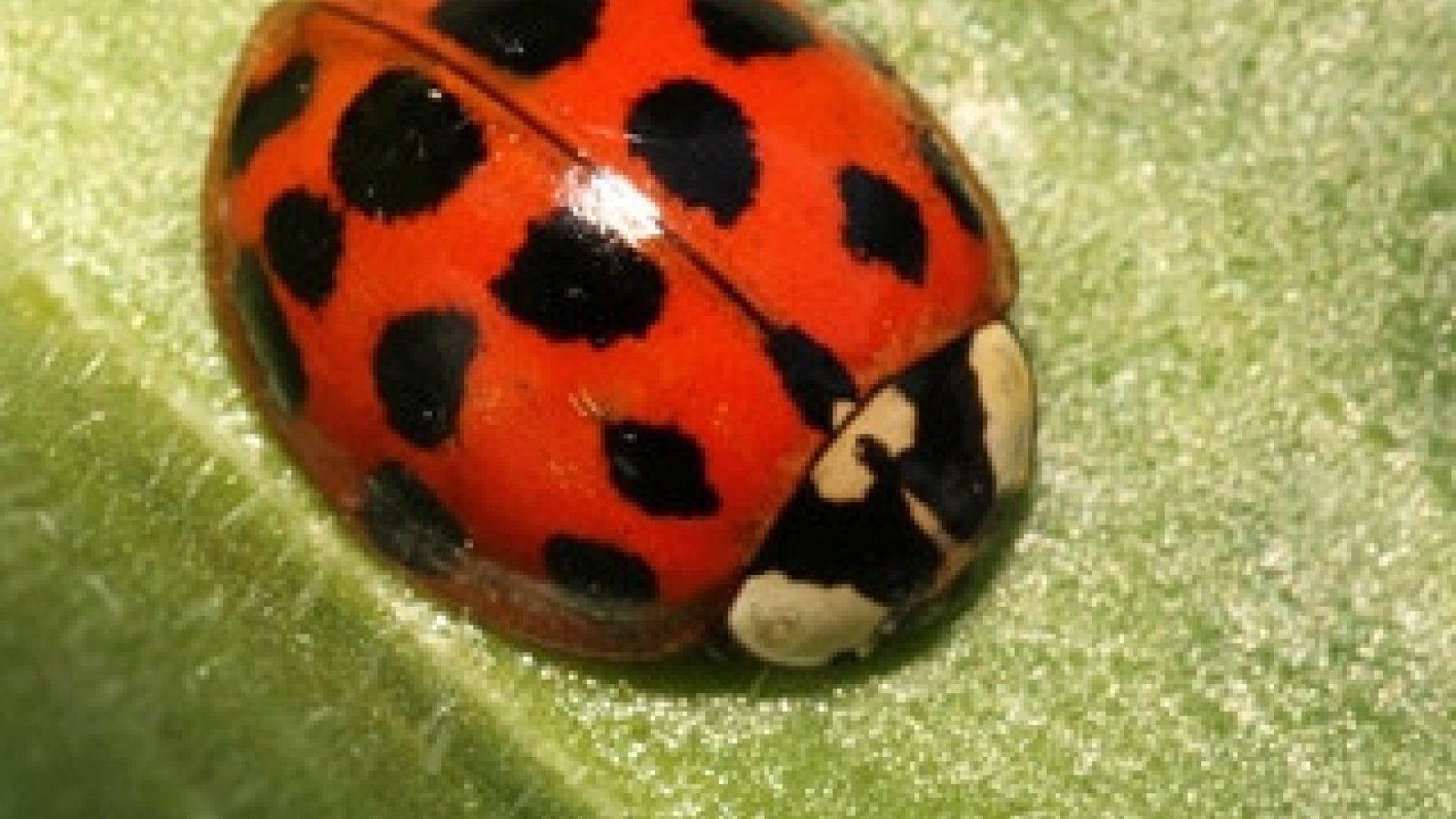
H. axyridis (Figure 1), identified by a black ‘M’/‘W’ on the ‘head’, can have a negative impact on winemaking when it aggregates in clusters of grapes and is processed with the grapes, resulting in an undesirable aroma leading to unmarketable wine or juice. The threshold density for wine contamination could be as little as 0.9 and 1.5 beetles per kg of grapes. The unacceptable flavour associated with H. axyridis, should it occur in South Africa, could cause severe losses to the wine industry in the Western Cape Province, as had happened in Canada and the USA.
FIGURE 1. Harmonia axyridis – W-shaped letter looking from the front; M-shaped from the back.
The presence of H. axyridis was monitored in four vineyards over three seasons. These vineyards were at Nietvoorbij, Glen Helderberg, Backsberg and La Motte. In each vineyard, the number of H. axyridis present on 300 grapevines was recorded every two weeks. The monthly total counts of H. axyridis were averaged over three growing seasons (September 2009 to March 2012) and plotted against mean monthly temperature (°C) (Figure 2). The number of H. axyridis counted in vineyards peaked between October and December and then declined, with one or two minor peaks between May and August, depending on the locality. This pattern suggests that more than one generation of this beetle occurs per year.
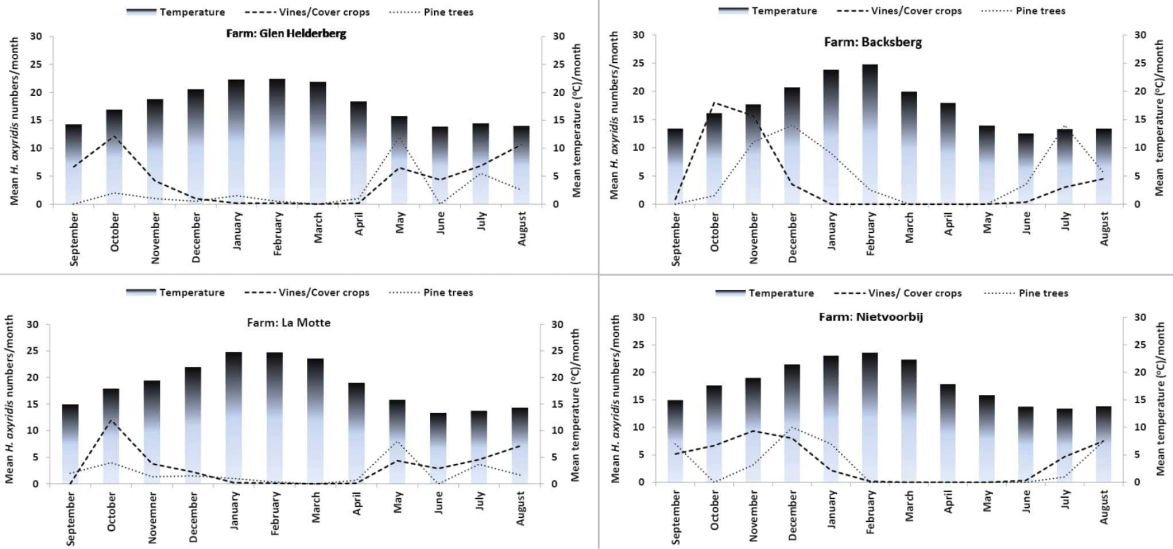
FIGURE 2. Mean number of Harmonia axyridis counted per month in four Western Cape vineyards and the adjacent pine trees plotted against mean monthly temperature (°C) over three seasons (September 2009 to March 2012).
The numbers of H. axyridis collected on the adjacent pine trees also showed an October peak on La Motte, but at Backsberg and Nietvoorbij numbers increased to a peak in December, while those on the vines declined. From June to September aphids, the preferred prey of H. axyridis, were present on the cover crops. H. axyridis started moving out of the vines in mid-October and November when aphid numbers were decreasing as the cover crops were dying off. They returned in May when aphids began to colonise the next season’s cover crops. Applications of chlorpyrifos to dormant grapevines for mealybug control did not appear to have any adverse effect on H. axyridis, since the number of H. axyridis was similar on the farms where no chlorpyrifos was applied. The virtual absence of H. axyridis in vineyards during the harvesting season from January until April indicates that it does not pose any risk of contaminating grapes during harvest and tainting wine. No indigenous parasitoids were found to attack H. axyridis, even though there are several species that attack other ladybird beetles.
Conclusion
In view of the observed decline of H. axyridis numbers in vineyards from December onwards when the cover crops and aphids have disappeared, it appears not to pose any risk of contaminating grapes during harvest and tainting wine, as most wine grapes are harvested from January onwards.
Acknowledgements
This article originates from research project number 230072, funded by Winetech and the Agricultural Research Council. The author wishes to thank L. Maart and L. Williams for assistance with the fieldwork.
– For more information, contact Kwaku Achiano at [email protected].

More from
Innovation and insights
Hairy roots - a biotechnological tool for grapevine improvement
Hairy roots arise when the phytopathogenic bacterium, Rhizobium rhizogenes inserts DNA into a wounded plant’s genome, triggering the formation of rapidly growing root masses. The rapid growth and relatively fast establishment of hairy roots led to their use in laboratories, where they are used to…

To swirl or not to swirl? - that is the question... (Part 2)
This study investigated the sensory suppression effects of H2S on tropical fruit characters and evaluated whether the perceived improvement following swirling is a result of chemical oxidation or physical volatilisation.

Q&A with Jose Luis Aleixandre-Tudo
Jose Luis Aleixandre-Tudo is an Associate Professor in the Department of Food Technology at the Universitat Politècnica de València, Spain, and an Extraordinary Senior Lecturer in the Department of Viticulture and Oenology at Stellenbosch University, South Africa.