
Rooted in research - what science says about regenerative viticulture (Part 2)
· 12 min read
Cover cropping and weed management
This article is based on a recently published scientific review article. In the review article, the question was: ‘What science exists to support the efficacy of practices used in regenerative viticulture systems or approaches?’.
Article reference: O’Brien, F., Nesbitt, A., Sykes, R. & Kemp, B., 2025. Regenerative viticulture and climate change resilience. OENO One 59(1). https://doi.org/10.20870/oeno-one.2025.59.1.8089
Introduction – a scientific look at regenerative practices
This article draws from a recently published scientific review that examined the current evidence supporting practices used in regenerative viticulture (RV). The review explored a range of individual, yet interconnected, vineyard strategies and evaluated how effectively they contribute to the core goals of RV.
In Part 1, we covered the use of organic soil amendments, biostimulants, and biological control agents. This month, we turn our attention to cover cropping and alternative weed management, and the research that underpins these practices.
Practice: Cover crops – greening the gaps for healthier soils and vines
One of the defining features of RV is a commitment to keeping vineyard soils alive and thriving. Instead of the traditional bare soil approach between vine rows – often achieved with herbicides or frequent tillage – RV systems favour the use of cover crops. These are intentionally planted or the maintenance of naturally occurring vegetation in the space between vine rows. Although cover crops aren’t a new concept in agriculture, their use in viticulture is gaining momentum for their benefits to soil health, vine performance and vineyard biodiversity.
Soil health gains
Cover crops bring life to the soil in more ways than one. Physically, deep-rooted species like forage radish help break up compacted soils and enhance structure. Legumes such as vetch and faba beans contribute to natural nitrogen enrichment through biological nitrogen fixation, reducing the need for synthetic fertilisers.
As these plants grow and die back, they add organic matter to the soil via decaying roots and root exudates. This increases soil organic matter (SOM), boosting microbial activity and improving soil aggregation and pore structure. The result? Better water infiltration and retention – critical during both drought and heavy rain. Additionally, by reducing nutrient leaching, cover crops help vineyards retain valuable nitrogen and phosphorus, especially in sloped or erosion-prone landscapes like those found in Mediterranean regions.
Under-vine cover crops – risks and rewards
Even the space directly under the vines – usually kept weed-free – is getting a regenerative rethink. While under-vine cover crops may increase humidity and raise disease concerns, studies have found they can also improve soil porosity, reduce compaction, and increase active carbon and microbial activity. Notably, cooler soil temperatures under cover crops may help protect vines during heat waves. There’s even potential to harness under-vine cover crops as hosts for beneficial arbuscular mycorrhizal fungi (AMF), which can support vine nutrient uptake and resilience.
In low-rainfall regions, careful management of soil moisture is crucial, as cover crops can compete with vines for water and nutrients, potentially causing vine stress.
Managing termination – when and how matters
While RV aims to maintain living roots as long as possible, there are practical reasons for terminating cover crops, especially to control humidity and competition for water. How growers end a cover crop’s lifecycle – mechanically, chemically, or through grazing – has a big influence on soil outcomes, such as weed suppression achieved by a cover crop, as well as its impact on soil health parameters.
Mechanical methods like tillage can boost short-term nitrogen levels by rapidly decomposing plant matter, but they also risk disrupting soil structure, releasing carbon, damaging microbial networks and increasing erosion. Tillage termination of cover crops often results in higher soil water content than roller methods, likely due to more effective crop kill and reduced transpiration. However, it is important to recognise that the effects of cover crop incorporation on soil health are influenced by factors such as soil type, climate, and the specific cover crop species used.
On the other hand, methods like flail mowing are gentler on the soil and have been linked to higher microbial biomass and nutrient cycling. Roller-crimping, which flattens the crop into a mulch, conserves moisture, suppresses weeds, and gradually releases nutrients back into the soil. Mulching also helps cool surface temperatures and reduce evaporation – a bonus for water-scarce regions.
Timing also matters. Letting cover crops grow longer before termination, such as until grapevine budburst, has been shown to significantly increase soil microbial biomass, thanks to the added root exudates and biomass.
Ultimately, the success of cover crops in RV depends on careful selection of species, management of water competition, and thoughtful termination strategies suited to local climates and soil types.
Vine performance, yield and wine quality – does greener soil mean better grapes?
The big question on many growers’ minds when considering cover crops is: ‘Will it be detrimental to my yield or wine quality?’ The good news is research generally says no – at least when cover crops are well-managed.
In fact, cover crops can be a valuable tool in vineyards, especially in fertile or high-rainfall regions where excessive vine growth can be problematic. Too much vigour leads to dense canopies and shaded grape clusters, which reduces airflow and increases the risk of diseases like Botrytis cinerea. By soaking up some of the available water and nutrients, cover crops can help rein in this excess growth, creating a more balanced vine canopy and improved fruit exposure – key factors for ripening and grape quality.
However, the relationship between cover crops and vines isn’t always straightforward. In dry or Mediterranean climates, water can become a limiting factor. One Italian study showed that increased competition from cover crops reduced vine water-use efficiency, meaning the vines had to work harder for each unit of carbon gained through photosynthesis. Without supplementary irrigation, under-vine cover crops in such areas have sometimes led to smaller berries and lower pruning weights – although sugar levels and acidity remained stable. Interestingly, mild water stress can boost concentrations of anthocyanins and phenolic compounds, potentially enhancing wine colour and complexity. But it comes with a trade-off: lower yields.
Some studies report neutral or even positive yield effects from cover crops. For example, in Uruguay, a permanent cover of Festuca arundinaceae didn’t negatively impact grape yield or composition. Similarly, Festuca rubra in another trial helped moderate vigour and resulted in berries with higher sugar (TSS) and anthocyanin levels – though these treatments did rely on extra irrigation. When additional irrigation was not supplied, under-vine cover crops have resulted in lower pruning and berry weights, but TSS and total acidity were unaffected.
Cover crop selection in vineyards must account for local water availability and the crop’s water needs.
In some studies in organic vineyards, spontaneous ground covers and sown cover crops outperformed bare, tilled alleyways in terms of yield, showing that the choice of control treatment can dramatically influence study outcomes.
Boosting vineyard biodiversity – life beneath and beyond the vines
Beyond grapes and yields, cover crops play a critical role in enhancing functional biodiversity – another cornerstone of RV. Flowering species like clover and phacelia attract a rich array of pollinators and beneficial insects. While grapes are self-pollinated, these insects support broader vineyard ecology and pollinate other nearby crops and wild plants.
Cover crops also serve as homes and hunting grounds for natural enemies of common vineyard pests. Research has documented increased populations of predatory beetles, parasitic wasps, and other beneficial arthropods in cover-cropped vineyards. For example, flowering summer covers like buckwheat and sunflower have been shown to reduce leafhopper and thrip populations in Californian vineyards. Similarly, faba bean and vetch mixes in Italian vineyards attracted ground beetles and rove beetles, essential predators of pest insects.
Cover crops may even help fight fungal diseases like B. cinerea by improving airflow and reducing canopy density. Moreover, their presence supports soil fungi like arbuscular mycorrhizal fungi (AMF), which enhance nutrient uptake by vines and contribute to overall soil health.
Greenhouse gas emissions – cover crops in the carbon equation
From a climate perspective, cover crops are both an opportunity and a challenge. On the plus side, they sequester carbon in roots and biomass, contributing to lower net greenhouse gas (GHG) emissions. A seven-year study found that a vineyard using barley cover crops with minimal tillage actually had a negative global warming potential – meaning it stored more carbon than it emitted.
That said, cover crops can also increase emissions of nitrous oxide (N2O), especially in wet conditions or when legumes are used and fertiliser levels aren’t adjusted. Still, these emissions are tiny compared to the massive GHG footprint of synthetic nitrogen fertiliser production and use. And in the case of legumes, the nitrogen released upon decomposition comes from atmospheric N, not synthetic inputs.
Ultimately, cover crops offer a meaningful way for vineyards to lower their environmental impact – especially when paired with thoughtful management practices that minimise disturbance and balance water and nutrient needs.
Practice: Smarter weed management
Weeds might seem like a minor inconvenience in a vineyard, but left unchecked, they can be serious competitors – vying with grapevines for vital water and nutrients, ultimately cutting into yields and fruit quality. Traditional weed control has relied heavily on herbicides, especially glyphosate, or mechanical cultivation. However, as RV gains traction, these conventional methods are being reconsidered due to their environmental drawbacks. RV principles encourage reducing chemical inputs and minimising soil disturbance, posing a challenge when it comes to managing weeds sustainably.
Rethinking herbicides and cultivation
The overuse of herbicides is increasingly under fire, both for environmental reasons and due to mounting herbicide resistance among weed species. Concerns over groundwater contamination, impacts on soil microbes, and the carbon footprint of herbicide production are fuelling a broader shift away from chemical control. Simultaneously, mechanical cultivation – though chemical-free – is no silver bullet. Regular tilling disrupts soil structure, diminishes biodiversity, increases erosion risk, and can reduce drought resilience by disturbing soil microbial communities and depleting organic matter.
This tug-of-war has opened the door for innovative approaches. One such method gaining interest is the use of electric weeders – non-chemical, non-invasive tools that zap weeds at the root. While still in early stages, such technologies reflect the RV spirit of marrying ecological health with practical farming outcomes.
The power of mulch and living barriers
A promising solution lies in mulching, which involves spreading organic (like straw, wood chips, or vine prunings) or inorganic (such as geotextiles) materials under the vines. These mulches create a barrier that blocks light from reaching weed seeds, suppressing their growth while delivering other key benefits: cooler soil temperatures, improved moisture retention and reduced evaporation. Studies in Spain and California have demonstrated that mulched vineyards maintain higher soil water content and better vine hydration than those relying solely on herbicides or tillage.
However, it’s not all upside. In some cases, heavy mulching – especially when combined with no-tillage – can reduce water infiltration by compacting the soil. As with all RV strategies, integrating mulching successfully requires a site-specific approach and ongoing monitoring.
Impacts on vine performance and wine quality
The effectiveness of weed control measures directly influences vine health and grape quality. A vineyard study in Catalonia showed that spontaneous vegetation left to grow under vines could reduce vine nutrient uptake, likely due to competition. Meanwhile, where herbicide-treated weeds were effectively killed, plots showed higher yields and better vine vigour, although they come with trade-offs in terms of soil health.
Mulching, on the other hand, seems to strike a favourable balance. It improves vine water status, suppresses weeds and supports stronger shoot growth, increased canopy area, and even higher grape yields. However, excessive vegetative growth can heighten disease risk and dilute grape concentration, so canopy management remains essential to mitigate these potentially negative effects.
Interestingly, different mulching materials can affect grape composition. For example, black geotextile mulch has been linked to changes in berry acidity and lower anthocyanin levels, as well as musts with lower phenolic content and antioxidant activity – reminding growers that even eco-friendlier practices can subtly influence wine characteristics.
Weed control and vineyard biodiversity
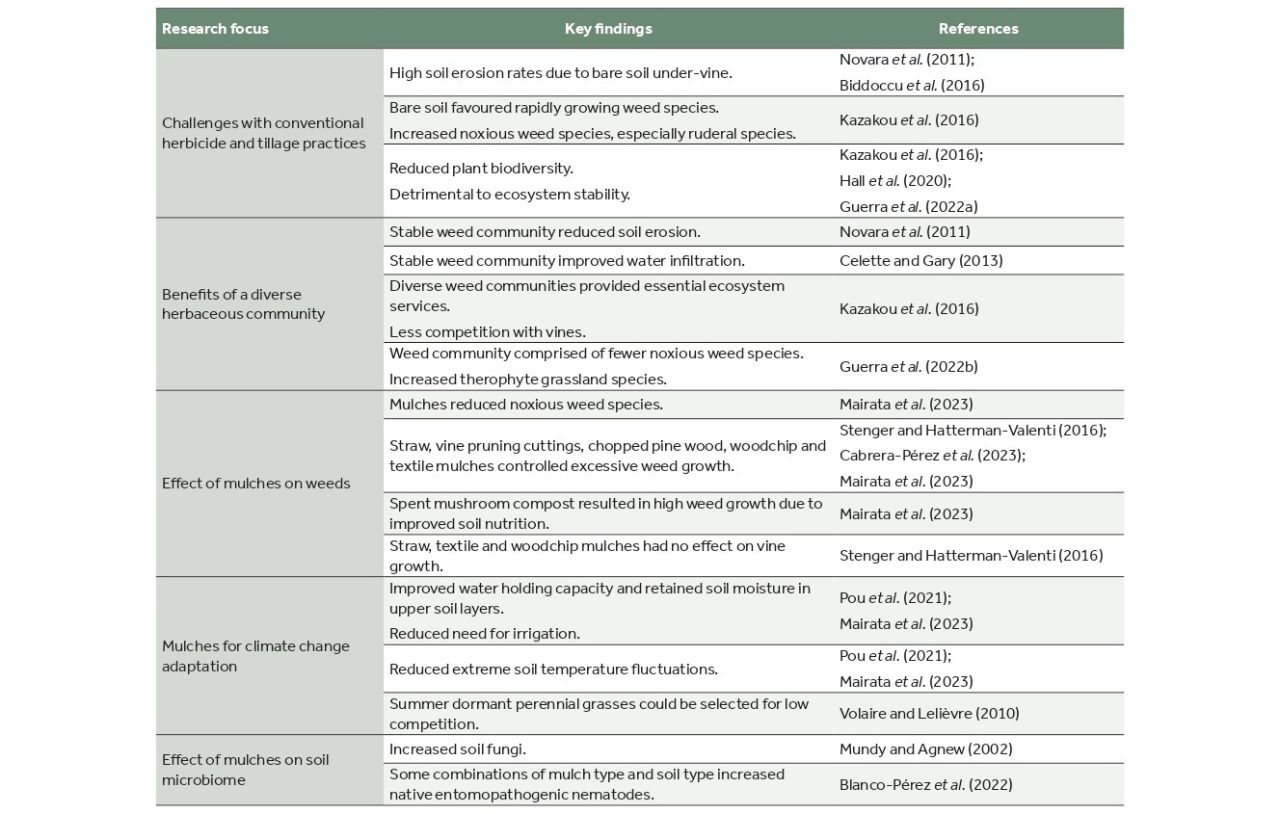
How weeds are managed also shapes vineyard biodiversity. Aggressive tilling may initially boost plant diversity, but typically favours short-lived, fast-growing weeds that thrive in disturbed soils. Conversely, less intensive approaches like mowing or using grazing animals promote slow-growing perennial species that are less competitive, including beneficial legumes like clover, which enrich the soil with nitrogen and reduce leaching. Overreliance on herbicides tends to reduce overall plant richness and can skew ecosystems toward disturbance-tolerant species, undermining long-term soil health. Table 1 summarises the impact of different weed treatments on soil health, biodiversity and vine performance.
In essence, no one-size-fits-all solution exists for weed control in vineyards. But mulching, novel technologies, and thoughtfully managed ground covers all offer promising alternatives to glyphosate and ploughs. Tools that not only suppress weeds, but also build soil health, enhance resilience, and align with the broader ecological goals of regenerative viticulture.
TABLE 1. A summary of select research into the effects of herbicide, tillage and mulches on weed control in vineyards. (Extracted from O’Brien, F., Nesbitt, A., Sykes, R., & Kemp, B., 2025. Regenerative viticulture and climate change resilience. OENO One 59(1), as allowed by the following Creative Commons licence: https://creativecommons.org/licenses/by/4.0/.
What’s next?
While mulches show significant potential, further research into innovative alternatives like flame weeding, hot foam, hot air, electrical weed control or biochar-based treatments is essential. These approaches must be tested in vineyard conditions to determine their effectiveness and compatibility with RV principles. The future of vineyard weed management lies not in reverting to outdated practices, but in refining techniques that serve both the vine and the environment.
To be continued…
Next month, Part 3 will delve into functional biodiversity enhancement, including livestock integration in RV systems.
For more information, contact Anel Andrag at [email protected].
Click here to get your copy of WineLand Magazine.

More from
Innovation and insights

Packaging under pressure: What wine businesses should be watching
From lighter bottles to automated packing lines, packaging decisions are becoming increasingly important to the cost and competitiveness of South African wine.
How vine water stress shapes grape and wine quality
This study formed part of the South Africa Wine programme “Grapevine production with limited water resources”, and aimed to evaluate how spatial and temporal water stress affects vine physiology, fruit composition and wine quality.
Drought tolerance of different scion cultivars (Part 4): Vegetative growth and yield
The study aimed to assess grapevine vegetative and yield responses in an almost worst-case scenario, i.e. grapevines growing under dryland conditions in sandy loam soil in the Swartland region.