
Safeguarding agricultural biosecurity through insect diagnostics
Insect diagnostics are managed through the Plant Disease Clinic (PDC), based at Stellenbosch University, and have emerged as a critical advisory service for South African agriculture. This article outlines the scope of samples analysed by the PDC, the services it provides and the role it will play…
· 10 min read
The Plant Disease Clinic at Stellenbosch University has integrated insect diagnostics with its services for bacteria, fungi and viruses, offering identification, advisory support, training and contract research. It analyses specimens and infested plant material from a wide range of crops, using morphological and molecular methods and rearing; citrus accounted for the largest share of submissions. The article highlights training and collaboration as ways to sustain diagnostic capacity and support agricultural biosecurity and market access.
Summary written by AI from this article. The full article is under “Deep dive”.
Accurate insect identification underpins effective pest management, biosecurity and market access in modern agriculture. Insects and mites represent one of the most diverse groups of organisms on earth, yet only a fraction of this diversity is formally described, and even fewer species are well known in applied agricultural contexts. Insect diagnostics are managed through the Plant Disease Clinic (PDC), based at Stellenbosch University, and have emerged as a critical advisory service for South African agriculture. Established to address a growing gap in local diagnostic capacity for insects and other pathogens, the clinic provides growers, advisors, researchers and industry bodies with reliable identifications, interpretive support and training. This article outlines the scope of samples analysed by the PDC, the services it provides and the role it will play in future.
Rationale for an insect diagnostic service
South Africa faces a well-documented shortage of trained taxonomic and applied entomologists, particularly those with expertise in agricultural pest diagnostics. National staff attrition through retirement and limited replacement has reduced accessibility and increased turnaround times across multiple institutions. For growers and industry stakeholders, delayed or inconclusive identifications can translate in inappropriate control decisions, crop losses and market-access risks.
At the PDC, the service has increasingly demonstrated the value of an integrated diagnostic approach that considers both biotic damage agents and disease symptoms. During the most recent reporting period, the clinic underwent strategic restructuring to improve financial sustainability and operational efficiency, culminating in the decision to merge the previously known insect diagnostic service (Blue Bug Diagnostics) more formally with the Plant Disease Clinic (PDC), where bacteria, fungi, viruses and insect diagnostics now operate under one single roof.
Types of insect samples analysed
The PDC processes a wide range of samples reflecting the diversity of South African agricultural systems, value chains and pathogen/pest insect dynamics. Samples are typically submitted either directly by clients or by national courier services. Received insect samples include both intact specimens and damaged plant material.
Insect and mite specimens
The most common submissions are adult insects and immature stages (larvae, nymphs, or crawlers) collected from crops, storage facilities, processing environments, or natural vegetation adjacent to agricultural systems. These specimens may arrive preserved, alive, or embedded within plant or fruit material.
The PDC routinely handles insect samples from key crop sectors, including:
- Citrus, which accounted for the largest proportion of insect submissions during the reporting period;
- Berries, particularly blueberries, but also strawberries and other small fruit;
- Pome fruit (apples and pears);
- Stone fruit (plums, nectarines and peaches);
- Vineyards, including wine grapes, table grapes and insects associated with wine barrels and cellars;
- Vegetables, spanning root, leafy and fruiting crops;
- Rooibos and other teas, often involving storage pests;
- Nuts such as macadamia and pecan;
- Grains, maize and lucerne;
- Ornamentals and indigenous plants; and
- Miscellaneous samples, including insects from traps, irrigation water, weeds, planting media and laboratory colonies.
This diversity reflects both the broad applicability of the service and the under-recognised need for insect diagnostics beyond traditional orchard crops.
Infested plant material and fruit
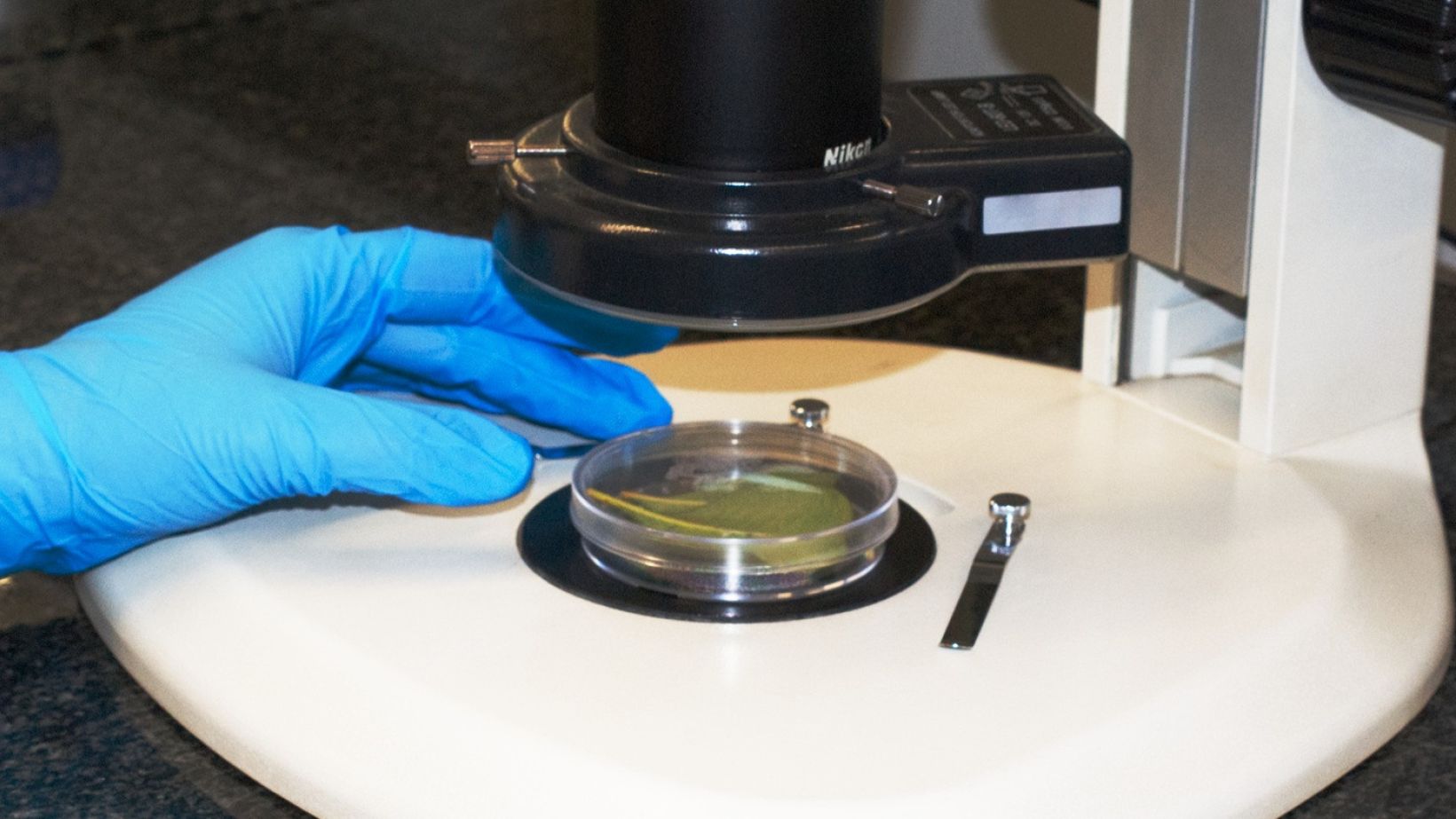
In many cases, clients submit damaged leaves, stems, buds, or fruit rather than intact insects. Such samples require careful examination through dissection and microscopy to characterise the reported and observed damage and link damage symptoms to potential causal agents. When immature insects are present, the clinic may perform morphological or molecular identification. When presence is suspected, the PDC may incubate infested material to rear specimens to adulthood, enabling accurate identification once diagnostic morphological characters are fully developed.
Bud mite analysis
A specialised service offered by the PDC is bud mite analysis, particularly for grapevines and other fruit crops. Growers submit canes or relevant plant material, and buds are dissected and examined for mite infestations. The PDC applies an established threshold (currently 30% infestation in grapevine buds) to guide management recommendations, providing actionable information rather than identification alone.
Nematode and soil-associated samples
The PDC has seen a notable increase in nematode-related submissions, especially from 2023 onwards, as an extended service to identify primary causes of plant disease symptoms.
Methods of insect identification
The PDC employs a tiered insect identification and diagnostic approach that balances speed, accuracy and cost-effectiveness.
Morphological identification
Morphological identification remains the backbone of the insect service and the most frequently used method. Drawing on the expertise of trained entomologists, specimens are examined under appropriate magnification and compared against taxonomic keys, reference collections and expert knowledge. Morphological identifications offer rapid turnaround times, and are particularly effective for well-known pest groups and adult insects.
Molecular identification
DNA-based methods are used in two main contexts: as a verification tool to support morphological identifications, and as a primary method when morphology alone is insufficient. This is often the case for cryptic species, damaged specimens, early life stages (such as mealybug crawlers or fruit fly larvae), and certain nematodes. Samples requiring molecular analysis are prepared and sent to specialised sequencing facilities, adding processing time, but significantly increasing diagnostic confidence.
Rearing and incubation
When samples contain immature insects that cannot be reliably identified, or immature stages are suspected, the clinic may rear them under controlled conditions until adulthood. This method bridges the gap between field collection and definitive identification, and is particularly valuable for moth-like pests and other insects with complete life cycles.
Scope of services provided
While insect identification is one of the core functions of the PDC, its service offering extends well beyond diagnostics of plant symptoms caused by bacteria, fungi, viruses and insects.
Diagnostic reporting and advisory support
While PDC aims to provide accurate results as quickly as possible, delays in identification may occur when samples are large or when extra tools/resources are needed to complete the analyses. In these cases, clients typically receive interim reports when analyses are ongoing for longer periods, followed by final diagnostic reports once all results are available. These reports contextualise identifications within the crop system and, where appropriate, flag potential management implications or the need for further investigation.
Training and capacity building
Recognising that long-term sustainability depends on building broader diagnostic capacity, the PDC is investing heavily in training through insect workshops and short courses. Between 2021 and 2024, these included courses on entomopathogenic nematodes, psyllid identification, insect rearing, agricultural mites and fruit fly identification. Courses are offered both in person and online, often through the university’s short course division, enabling participants to earn certificates and professional development points.
These training initiatives serve multiple purposes: they disseminate best practice, partially offset the declining number of practising entomologists by equipping advisors, scouts and researchers with improved identification skills, and generate supplementary income that helps to maintain and expand the services provided.
Contract research
The PDC also undertakes contract research where specialised diagnostic or analytical capacity is required. Examples include identifying moths and larvae for orchard pest management projects, assessing pest assemblages in pecan orchards, counting and identifying thrips on sticky traps, and long-term nematode monitoring to assess soil health. Such projects strengthen links with industry bodies and integrate diagnostic expertise into applied research.
Patterns, trends and future prospects of sample submissions
From January 2021 to August 2024, the original insect clinic entity received funding through a South Africa Wine project and received 315 insect samples during this period. This figure underestimates the actual diagnostic workload, as individual samples may yield multiple identifications and interim reporting steps. Citrus dominated submissions, followed by berries, pome fruit and other fruit crops, while grain and field crop samples were relatively scarce. This pattern highlights both current demand and significant scope for growth in underrepresented sectors. This project enabled the development of a barcoding database to assist with identifying insects that are difficult to identify morphologically, such as leafhoppers, mealybugs and mites. Many local species do not have DNA barcodes available in online databases, making conclusive identifications difficult. Many specimens are also submitted on sticky traps and are very poor quality, leaving only molecular methods for identification. For example, the project was able to determine a DNA sequence for the grapevine leafhopper, Acia lineatifrons, which will now be available on GenBank (an online resource) to enable molecular comparisons for the first time; several other mite and thrips species were flagged as being candidates for research projects, as they were considered to be molecularly divergent and therefore requiring more in-depth research. The project is ongoing to continue developing this important tool.
Morphological identification accounted for the majority of diagnoses and continues to do so, reflecting both efficiency and available expertise. However, the increased use of molecular tools and the rise in nematode samples signal a gradual broadening of the clinic’s diagnostic scope.
The future of insect sample analysis
The clinic operates in a context where the number of trained entomologists is declining nationally and globally. This trend poses clear risks to agricultural diagnostics, biosecurity, food security and long-term sustainability. On the positive side, the trend also drives innovation, collaboration and engagement with the agricultural sector.
Integration and collaboration
The decision to merge services more closely with the PDC reflects a strategic response to limited human resources. Integrated diagnostic services reduce duplication, streamline sample intake, and provide clients with holistic assessments of crop health.
Networking and expert referral
When local expertise is insufficient, the clinic acts as a conduit to national and international specialists. This networked approach ensures that even rare or novel pests can be identified accurately, despite local capacity constraints. This is an important step to clients, ensuring that the reported results are of high quality, accurate, and carry an expert-verified mark. Interface with experts also helps with local capacity building, which is projected to become increasingly important going forward.
Training as a continuity strategy
By training advisors, scouts and industry personnel, the clinic helps decentralise basic diagnostic capacity, while retaining specialist oversight for complex cases. Online courses, once established, offer scalable and cost-effective knowledge transfer, while bridging the gap between academics and the private sector.
Systems and record-keeping
The clinic maintains detailed records of all samples received, creating a valuable longitudinal database. These records support quality control, enable retrospective analyses of pest trends, help identify gaps in pest management strategies across industries, and aid more efficient identification of received insects.
Digital and technological initiatives
One promising future development is the creation of a digital interface for post-harvest pest identification, particularly for the fruit industry. Such tools have great potential to improve response times, support market access, and reduce reliance on informal identification via social media or messaging platforms, which can propagate errors in identification and misinformation.
Conclusions
The PDC, now including the insect diagnostic service as a core function, has established itself as a vital component of South Africa’s agricultural support infrastructure. By providing reliable insect and mite diagnostics, interpretive services, training and applied research support, it addresses a critical gap created by declining taxonomic capacity. The clinic’s experience before and after the merger demonstrates that, while insect identification alone may not be financially self-sustaining due mostly to seasonal changes in receiving samples, an integrated model combining diagnostics, training and contract research can enhance both impact and viability. Looking ahead, continued support, national partnerships, improved visibility, and strategic use of digital tools will be essential to ensure continuity, accuracy and efficiency in diagnostic sample analysis. In a future with rapidly increasing agricultural trade, services such as those provided by the PDC will play an increasingly important role in safeguarding crop production, biosecurity, and market access for South African agriculture.
For more information, contact Charl Deacon at [email protected].
Click here to get your copy of WineLand Magazine.

More from
Innovation and insights

Packaging under pressure: What wine businesses should be watching
From lighter bottles to automated packing lines, packaging decisions are becoming increasingly important to the cost and competitiveness of South African wine.

How vine water stress shapes grape and wine quality
This study formed part of the South Africa Wine programme “Grapevine production with limited water resources”, and aimed to evaluate how spatial and temporal water stress affects vine physiology, fruit composition and wine quality.

Drought tolerance of different scion cultivars (Part 4): Vegetative growth and yield
The study aimed to assess grapevine vegetative and yield responses in an almost worst-case scenario, i.e. grapevines growing under dryland conditions in sandy loam soil in the Swartland region.