
What’s next for Waterford Estate this season
There’s plenty in the pipeline at Waterford Estate. New wines are on the way, the Porcupine Trail has grown, the restaurant has some new faces, and a herd of Dexter cattle is lending a hand in the vineyards. It’s a busy next chapter, but one that builds on what Waterford already does best

· 6 min read
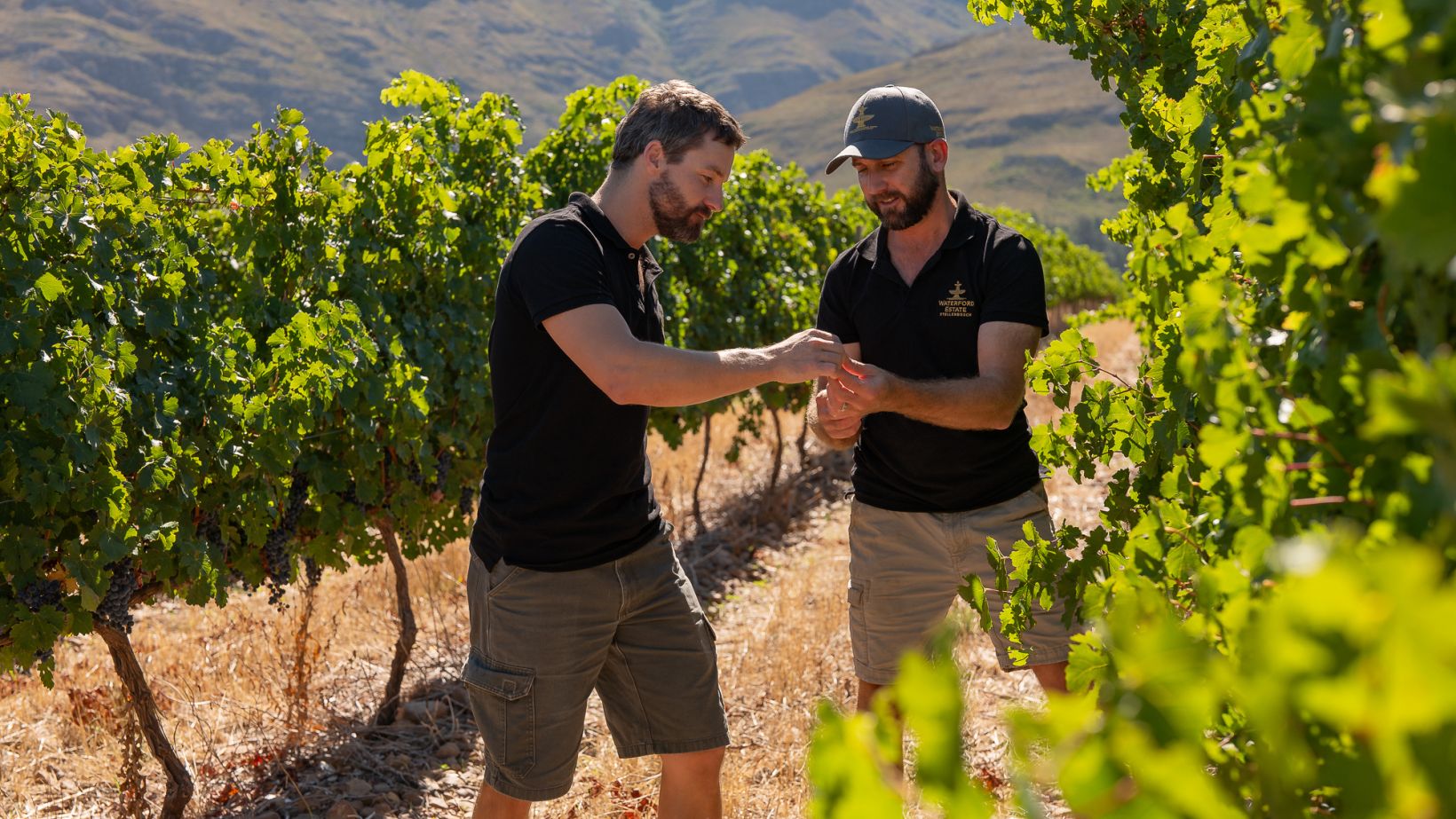
Spring has arrived in Stellenbosch, and with it comes a good time to take stock of where the estate is heading. Some changes are already visible, while others are happening quietly behind the scenes.
So, what does the next season look like at Waterford? We caught up with cellarmaster Mark le Roux and viticulturist David van Schalkwyk to find out.
A few bottles worth watching
If you like your wine with a bit of a backstory, keep an eye on what’s coming out of the Waterford cellar.
The 2023 Estate Single Vineyard Chardonnay is one of the big ones. It will be the first Waterford Estate-grown wine to carry Old Vine Project certification, coming from a vineyard that has now passed the 35-year mark and qualifies as a Heritage Vineyard.
Mark sees the milestone as a reflection of the way the team approaches its vineyards. “It is a testament to our team’s attitude to farming and our commitment to quality,” he says.
The new 2020 vintage of The Jem is also on its way. Every vintage brings its own character, allowing the team to explore how the estate expresses itself in a particular year.
Then there are the Library wines. These bottles have been resting quietly in the cellar and are now reaching the point where the team feels they are ready to share. Waterford Estate’s 10- and 15-year release programme offers wine lovers the chance to taste that evolution rather than simply hear about a wine’s ageing potential.
Rose-Mary is getting a little makeover too, with a new label and bottle joining the range.
The estate is ready for spring
Spring and summer are good excuses to spend a little more time outdoors, and Waterford Estate has plenty of ways to do just that. The vineyards are waking up, the gardens are looking their best and the estate’s outdoor spaces are ready for visitors.
Music in the Gardens will bring local music, wine and the estate’s new gardens together for relaxed evenings.
The Porcupine Trail Wine Walk has also been extended. The longer route takes guests further into the Stellenbosch landscape and offers a closer look at the environment in which Waterford farms.
For those who prefer to stay close to the glass, the Wine & Chocolate experience remains a Waterford favourite, while the Cellar Collection gives visitors the opportunity to taste wines with significant bottle age.
There’s a difference between knowing that Cabernet Sauvignon can age and actually tasting what a decade or more in the bottle does to a wine. The Cellar Collection lets visitors experience that difference for themselves.
The vineyard is preparing for a drier future
While the cellar team is getting wines bottled and making room for what lies ahead, the vineyard team has plenty on its plate too.
David says the estate has experienced a winter that has been both warm and dry, and this has raised new questions regarding how to farm during a dry growing season.
One major focus is a virus-free vineyard, with a substantial replanting programme in the works. Alongside that, Waterford Estate is continuing its regenerative agriculture programme.
Then there are the Dexters. Waterford Estate’s herd is growing, and so is the team’s understanding of what the cattle can contribute to the vineyard. Their grazing is being used to manage weeds and cover crops while adding another piece to the soil health puzzle.
The early results are encouraging. David says the soils are healthier and microbial life is thriving, suggesting the cattle may be doing more than simply keeping the grass down.
Regenerative farming has a bigger job to do
There is no shortage of talk about regenerative agriculture these days, but at Waterford Estate, the thinking goes beyond the latest farming buzzword.
The Dexters play their part by grazing between the vines, helping with weeds and cover crops while naturally adding nutrients back into the soil. The bigger goal is to create a healthier system in which the vines, soil, animals, and insects all have a role to play.
“It is ultimately about much more than farming terminology,” David says. “It is also about preparing the vineyard for what lies ahead.”
The thinking is simple: healthier soil should help the vines cope better with changing conditions, while still allowing the vineyard’s character to come through in the fruit.
That philosophy carries into the cellar too. Mark’s approach is to keep intervention to a minimum and let the fruit do the talking.“The work we are doing outside in the vineyard is influencing the fruit that comes into the cellar,” he says, “and our role is not to mask that expression but to allow it to come through in the glass.”
There is always something being tested
Not every experiment at Waterford Estate makes it onto a release note. Some happen quietly behind the cellar doors.
The team continues to work with different vessels and materials, including concrete eggs and porcelain jars, while also experimenting with different winemaking techniques and cultivars.
The point is not to be different for the sake of being different. It is about understanding the wines better.
“Winemaking is often about making small adjustments,” Mark says, whether that means changing how a wine is handled or testing how it responds to a different environment.
Each experiment adds another piece to the puzzle of how best to express what is already there in the vineyard.
The long game is the important one
There may be new wines, new experiences and a few experiments along the way, but Waterford Estate’s bigger ambition is straightforward – to leave the estate in an even better place for the years ahead.
The estate wants to make wines that genuinely express their sense of place while showcasing what South Africa can achieve when a special site is farmed with knowledge, care and commitment.
That means looking beyond the next vintage.
“We are trying to build something that lasts,” Mark says. “Wines with longevity, vineyards with resilience and a farming system that respects the environment.”
It is a fitting way to look at what’s next for Waterford Estate. There will be new bottles to taste and new corners of the estate to explore, but much of the important work happens over a far longer timeline. Healthy soils, resilient vineyards and a thriving ecosystem are the foundation for wines that can continue to tell the Waterford Estate story for generations to come.

More from
People, community and tourism

Vyf dinge wat jy by SKOP kan leer
Joseph Gertse is ’n kind van die wynbedryf. Sy reis het op L’Ormarins begin, waar sy ouers, Karel en Magda, in die wingerd en kombuis gewerk het.
The Portrait of a South African Winemaker
In James Joyce's A Portrait of the Artist as a Young Man, Stephen Dedalus resolves to express himself "as freely as I can and as wholly as I can". Joyce's hero refuses to be just one thing. That same many-sided energy is increasingly being asked of the modern South African winemaker, who has to adopt different faces for different places.

Who will drink South African wine tomorrow?
Tomorrow’s wine drinker is already here, standing at the braai with a can in one hand and a phone in the other. South African wine still has time to join the occasion, although it may need to loosen its collar first.