
Thiols in red wine (Part 2): Individual thiols and levels
Valeria Panzeri, Gonzalo Garrido-Bañuelos and Astrid Buica
· 6 min read
The split personality of thiols – ‘tropical fruits’, ‘meaty’ or ‘berry jam’? The work presented in this article forms part of series of experiments on the interaction between thiols and red wine matrices as described in Part 1.
Background
A curious fact about chemical compounds is that describing their aroma can be quite elusive, especially because the perception is not linear. In other words, naming the descriptors can be difficult even for experienced tasters, even more so because with increase in concentration, attributes can change (hence the “multiple personalities”).
Consider flavour scientists for a moment. They work constantly at reproducing and mimic Mother Nature’s most appealing aromas. They develop flavours to be used in the food industry with the aim of keeping the consumers happy. They are familiar with the elusive character of those chemicals. Take benzaldehyde as a classic example. It is the base flavouring component of many candies and cough syrups, but while it is mostly described as ‘cherry’, many people agree that it reminds them of almonds and marzipan instead.
In the same way, increasing levels of thiols can vastly change the profile of a white wine. For example, 3MHA in low concentrations is perceived as having ‘guava’ aroma, but once the level increases, the description changes to a not so pleasant ‘sweaty’ character.
There is no right and wrong in either of the descriptions. Science has shown us that, often times, the tipping point between different aromas for a single compound is determined by its concentration. Even more, the matrix (or type of solution) might also change our sensory perception of this specific compound.
Problem statement
While many studies have investigated the sensorial nature of thiols in white wine, the effect of these compounds in red wine is highly unexplored. A study recently conducted at Stellenbosch University confirmed the presence of thiols in certain red South African single cultivar wines1 and these chemical results paved the way to exploring the topic from an organoleptic point of view.
Approach
As a first step, we generated descriptors for three selected individual thiols. We considered 3MH, 3MHA and 4MMP to be representative of the chemical class. Since the concentration influences the way the aroma is described, three levels of each thiol (zero, medium and high) were included in the experimental design. To take into consideration possible changes caused by the matrix, four cultivars were used (Figure 1). The varieties chosen were Pinotage (x1), Cabernet Sauvignon (x2), Shiraz (x1) and Merlot (x1). As base, we decided to have a wine that could be recognise as such, but without any specific or typical aroma. To create this base, the chosen commercial wines were de-aromatised under vacuum to avoid oxidation. Each thiol was evaluated on a different tasting day. Addition of individual thiols was done the day before each evaluation to ensure equilibrium. Practically, the wines were evaluated blind by 15 experienced judges from the sensory panel of the Department of Viticulture and Oenology. Each day 15 wines, plus two blind repeats, were evaluated in duplicate.
The method we chose to capture the results is called Projective Mapping (PM). It allows to assess a large number of samples by giving an idea of how similar or different they are in relation to each other. As an additional information, descriptors of each wine are generated (for more details, see Part 1).
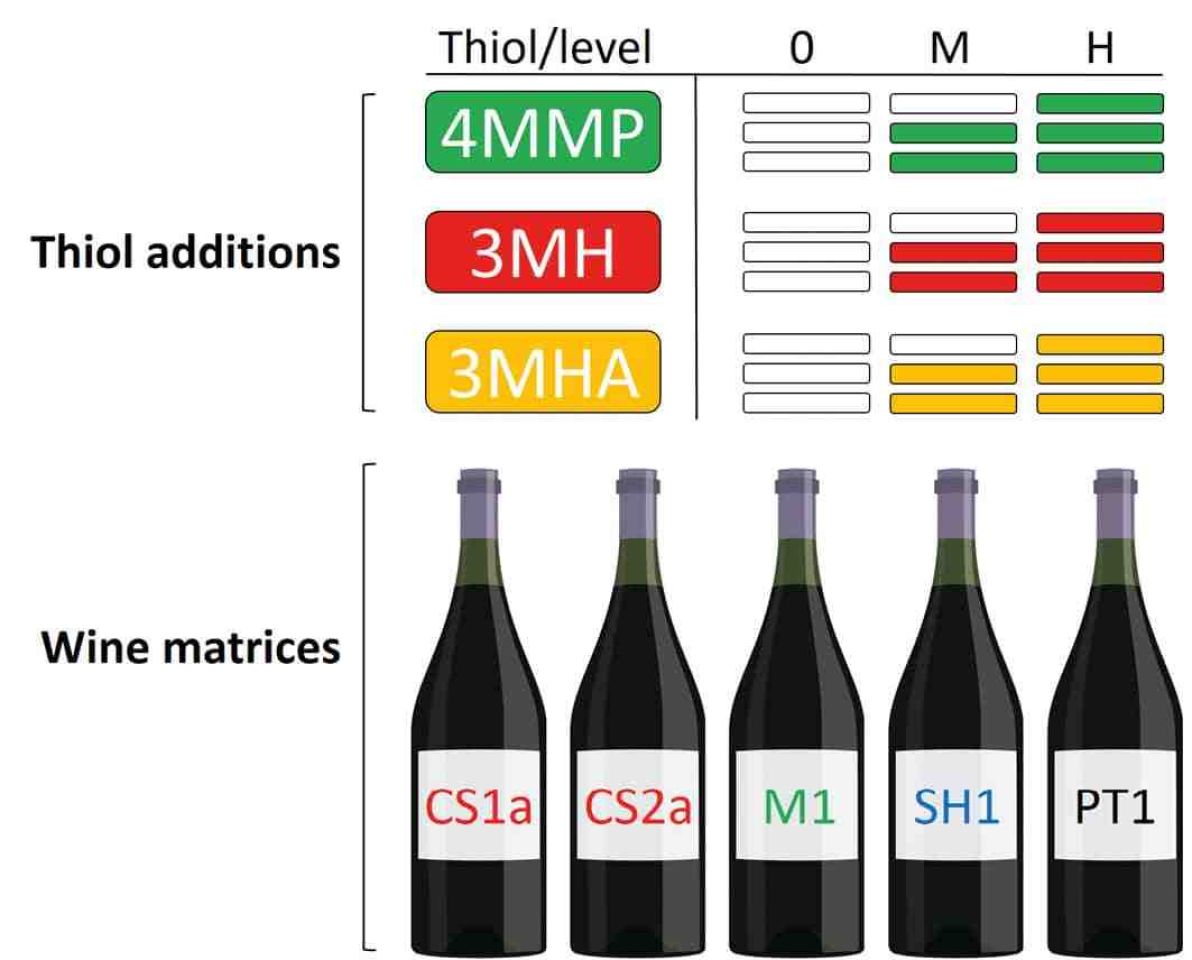
FIGURE 1. Experimental layout showing the project design. Individual thiols at three different concentrations (0 = zero, M = medium and H = high) spiked into five matrices. The wine samples codes are CS1a – Cabernet Sauvignon 1a, CS1b – Cabernet Sauvignon 1b (or blind duplicate), M1 – Merlot, SH1 – Shiraz and PT1 – Pinotage.
Results
The questions we asked were:
- Do increasing levels of thiols in red wine generate different descriptors?
- What role does the matrix (in this case different cultivars) play for each thiol level?
The results point at two types of outcomes.
3MH and 3MHA behaved similarly and have shown that the separation between the wine samples was mainly according to cultivar (Figure 2a and 2b). In this case, the increasing thiol concentrations did not play a role. Nevertheless, with each thiol, the judges used different descriptors for each cultivar. In the case of 3MH spiked samples, Cabernet Sauvignon was described as ‘berry jam’, ‘earthy’, ‘plum’ and ‘soy’; Merlot was associated with ‘toast’ and ‘caramel’; Shiraz with ‘oak’ and ‘smoke’; and Pinotage was characterised by ‘smoke’, ‘spices’ and ‘planky’. When 3MHA was added to the de-aromatised wines, Cabernet samples grouped together and were profiled as ‘raisin’, ‘prune’, ‘animal’ and ‘berry jam’; Shiraz as ‘planky’, ‘coffee’, ‘wood’ and ‘smoke’; and Merlot and Pinotage were clustered, and described as ‘cooked vegetables’, ‘savoury’, ‘herbaceous’ and ‘plum’.
In contrast, spiking of de-aromatised red wine with 4MMP brought a separation of the samples according to increasing concentration, with the cultivars playing a lesser role (Figure 2c). Only the base wines (spiking level zero) allowed for some degree of differentiation. Cabernet Sauvignon had pronounced characteristics of ‘berry jam’, ‘savoury’, ‘soy’, ‘caramel’ and ‘balsamic’. Merlot and Shiraz were quite similar, both sharing ’dark berries’ and ‘prune’ as descriptors; but while the former had ‘caramel’, the latter had wood-related characteristics expressed as ‘oak’ and ‘vanilla’. Lastly, Pinotage in addition to ‘dark berries’ and ‘oak’ (same as Shiraz) had some reductive notes labelled as ‘cooked vegetables’.
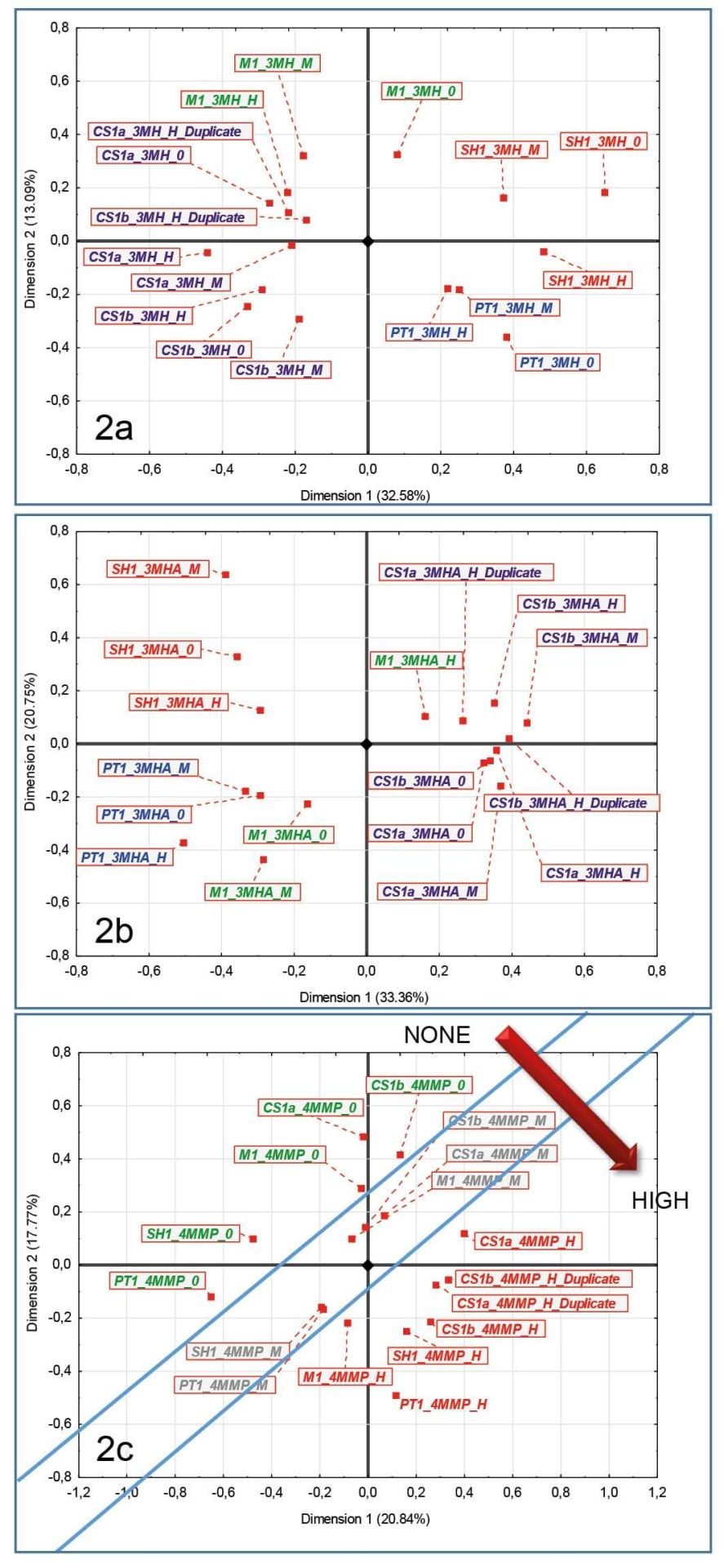
FIGURE 2. CA loading plot for Experiment 1. In Figure 2a (3MH – top); 2b (3MHA – middle), the samples are colour-coded according to cultivar; 2c (4MMP – bottom), the samples are colour-coded according to thiol level.
Once the levels of each thiol were increased, the cultivars lost their individuality and moved to more fruity notes (at medium level) described as berries-like and sweet-associated, to ‘earthy’, ‘green’ and most importantly ‘blackcurrant’ at the highest concentration.
Looking at the large overall number of attributes generated when describing the spiked wines, it becomes clear that the contribution of the matrix plays a significant role. The total number of descriptors generated across sets (thiols x cultivars) was 43 and it could be evidence of the variety of aromas which can be produced already at this relatively simple interaction level.
Take home message
In a real case scenario, one would probably never find a wine containing only one of the thiols at the time. The purpose of this experiment was to lay the foundation for the rest of the project which investigated the impact of thiols in combination with each other (Part 3) and pairwise interaction in five different cultivars (Part 4 of this series of articles). It allowed us to understand the crucial role the non-volatile component has on aromas and how this factor cannot be ignored when studying aromatic compounds and looking at the synergies between them.
Abstract
We discussed the results of Experiment 1 in which we assessed the relevance of individual thiols at different concentration levels in four red wine cultivars. The focus of this part of the project was two-fold to investigate the aromas associated to each compound and the variables the matrix introduces.
Reference
- Mafata, M., Stander, M., Thomachot, B. & Buica, A., 2018. Measuring thiols in single cultivar South African red wines using 4,4-dithiodipyridine (DTDP) derivatization and ultraperformance convergence chromatography-tandem mass spectrometry. Foods 7(9): 138. Doi: 10.3390/foods7090138.
– For more information, contact Valeria Panzeri at [email protected] or Astrid Buica at [email protected].

More from
Innovation and insights

Packaging under pressure: What wine businesses should be watching
From lighter bottles to automated packing lines, packaging decisions are becoming increasingly important to the cost and competitiveness of South African wine.
How vine water stress shapes grape and wine quality
This study formed part of the South Africa Wine programme “Grapevine production with limited water resources”, and aimed to evaluate how spatial and temporal water stress affects vine physiology, fruit composition and wine quality.
Drought tolerance of different scion cultivars (Part 4): Vegetative growth and yield
The study aimed to assess grapevine vegetative and yield responses in an almost worst-case scenario, i.e. grapevines growing under dryland conditions in sandy loam soil in the Swartland region.