
Yeast-derived acidification of red wines
· 7 min read

Acidity is a key quality parameter in wine. It defines not only its taste and style, but also its appearance, microbial stability and ageing potential.1 In warm climates or vintages, grapes at harvest often lack acidity and require acid correction. As global temperatures continue to rise, ripening is increasingly shifted towards the hottest period of the year. High temperatures accelerate malic acid respiration in berries, thereby further exacerbating the acidity loss.
As a result, winemakers increasingly rely on exogenous acidification of grapes, mainly via tartaric acid addition and less so with other organic acids (i.e., lactic, malic, citric and, as of recently, fumaric). However, these practices are tightly regulated and subject to labelling requirements.1 Moreover, tartaric acid is susceptible to instability and precipitation, thereby imposing additional cost implications. As a result, there’s growing interest in approaches that help maintain acidity without relying on costly additives.
The solution
One promising strategy is biological acidification, or bioacidification, which involves the use of acidifying yeast strains during fermentation.2 This includes lactic acid production through the unique sugar metabolism of Lachancea thermotolerans, used either in simultaneous or sequential inoculation with Saccharomyces cerevisiae.3 Another approach is the use of novel S. cerevisiae strains capable of preserving or even producing malic acid during alcoholic fermentation (AF).4 Higher levels of malic acid post-AF translate to increases in lactic acid after malolactic fermentation (MLF), an acid that is both microbially and chemically stable. This article presents results from fermentation trials conducted during the 2023 and 2024 vintages, highlighting the impact of LAFFORT® ZYMAFLORE™ strains on wine acidity, along with other chemical and sensory parameters.
But first, some facts about wine acids
- Six organic acids account for > 95% of organic acids in wine (Table 1). The primary grape-derived acids are tartaric acid and malic acid. Tartaric acid is not metabolised during winemaking, but can be lost due to precipitation with potassium or calcium ions.
- Malic acid can be either consumed or produced by wine microorganisms. Most cerevisiae strains partially consume malic acid (i.e., approximately 15 - 40%) during AF.4 Malic acid is transformed into lactic acid through MLF conducted primarily by Oenococcus oeni.
- Strains of oeni differ in their capacity to degrade citric acid, another grape-derived acid. This can affect both wine acidity and flavour profile, as citric acid is a precursor to several compounds, including diacetyl (buttery aroma).
- In addition to MLF, l-lactic acid can also be produced from grape sugars via lacto-ethanolic fermentation by thermotolerans.
- Absent in grapes, succinic acid is often the third most abundant metabolite formed by fermenting yeast (after ethanol and glycerol). While it has little effect on pH, it contributes significantly to the increase in TA post-AF.
- Acetic acid is the main volatile acid in wines, which can be formed throughout various winemaking stages, via yeasts, lactic acid bacteria (LAB), and acetic acid bacteria (AAB).
- Other organic acids are also present in grapes and/or in wines in various quantities, including pyruvic, fumaric, gluconic, d-lactic acid, amino acids, fatty acids and others.

Putting theory into practice: LAFFORT® yeast trials
Experimental layout
Four yeast treatments were tested in a winemaking trial carried out in two consecutive vintages (2023 and 2024). These included ZYMAFLORE™ yeasts FX10, XAROM, KLIMA and co-inoculation of OMEGALT and KLIMA (Table 2), rehydrated in water at ambient temperature (20°C) with SUPERSTART™ ROUGE (20 g/hL). The O. oeni starter LACTOENOS™ BERRY Direct, capable of preserving citric acid during MLF, was inoculated (1 g/hL) 24 hours after yeast addition. At ⅓ of AF, complex yeast nutrient NUTRISTART™ AROM was added. After seven-day skin contact, coinciding with almost simultaneous AF and MLF completion, the wines were racked of skins and stabilised with SO2 (50 mg/L). Bottling under screw cap occurred three months after vinification, and the final wines underwent detailed chemical and sensory profiling.
Main results
Despite vintage variation, the main oenological parameters of wines obtained from different yeast treatments showed similar trends (Figure 1).
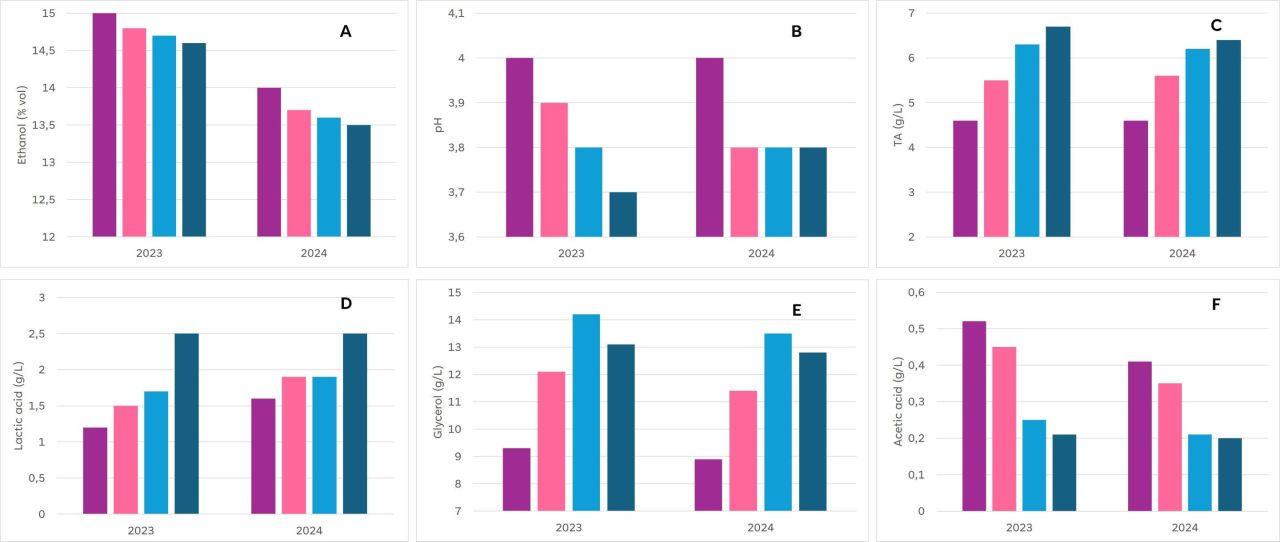
FIGURE 1. Main analytical parameters of the final FX10, XAROM, KLIMA and OMEGA + KLIMAwines (dry wines post-MLF).
The control treatment, FX10, had higher ethanol levels than both XAROM and KLIMA (Figure 1A), while the lowest ethanol content (< 0.5 % vol) was found in OMEGA + KLIMA co-inoculations. FX10 also showed the highest pH across both harvests (4.0), whereas pH values in the other wines were up to 0.2 units lower (Figure 1B). The TA of wines showed inverse trends; the lowest values in FX10, and the highest in OMEGA + KLIMA wines (Figure 1C).
These differences were linked to variations in lactic acid concentration post-MLF (Figure 1D). FX10, representative of most S. cerevisiae strains in terms of ethanol yield and acidity modulation, resulted in the lowest lactic acid levels. In XAROM and KLIMA wines, higher lactic acid was associated with their ability to preserve/produce malic acid during AF, resulting in greater lactic acid levels post-MLF. In these strains, malic acid is produced from grape sugars, contributing to lower ethanol content. In the OMEGA + KLIMA treatment, the additional quantity of lactic acid (0.6 - 0.8 g/L) originated from L. thermotolerans metabolism of sugars, further decreasing ethanol and enhancing bioacidification.
In addition to malic acid, glycerol is another compound produced from sugars that can contribute to lower ethanol content in novel malic acid-producing S. cerevisiae strains.4 Accordingly, glycerol levels were markedly higher in both XAROM and KLIMA wines compared to FX10 (Figure 1E). Elevated glycerol production was maintained in OMEGA + KLIMA co-inoculations, which, like KLIMA alone, also exhibited particularly low acetic acid concentrations (Figure 1F).
What about the sensory profiles of the wines?
Unsurprisingly, upon fermentation, the young wines significantly differed in the number of sensory attributes (data not shown). To determine whether these differences persisted over time, the 2023 wines were re-tasted at 16 months of age. The results confirmed that each wine retained its distinct sensory profile (Figure 2). The FX10 control wine was associated with greater mouthfeel and overall impression; however, its high pH (4.0) without acidification makes microbial stabilisation challenging. Even after 16 months, XAROM was described as intense, with abundant red fruit and fermentative character, and was considered ‘ready to drink’. In contrast, KLIMA and OMEGA + KLIMA were perceived as having greater ageing potential, supported by more pronounced acidity and tannin structure, along with herbal, spicy and dark-fruit notes.
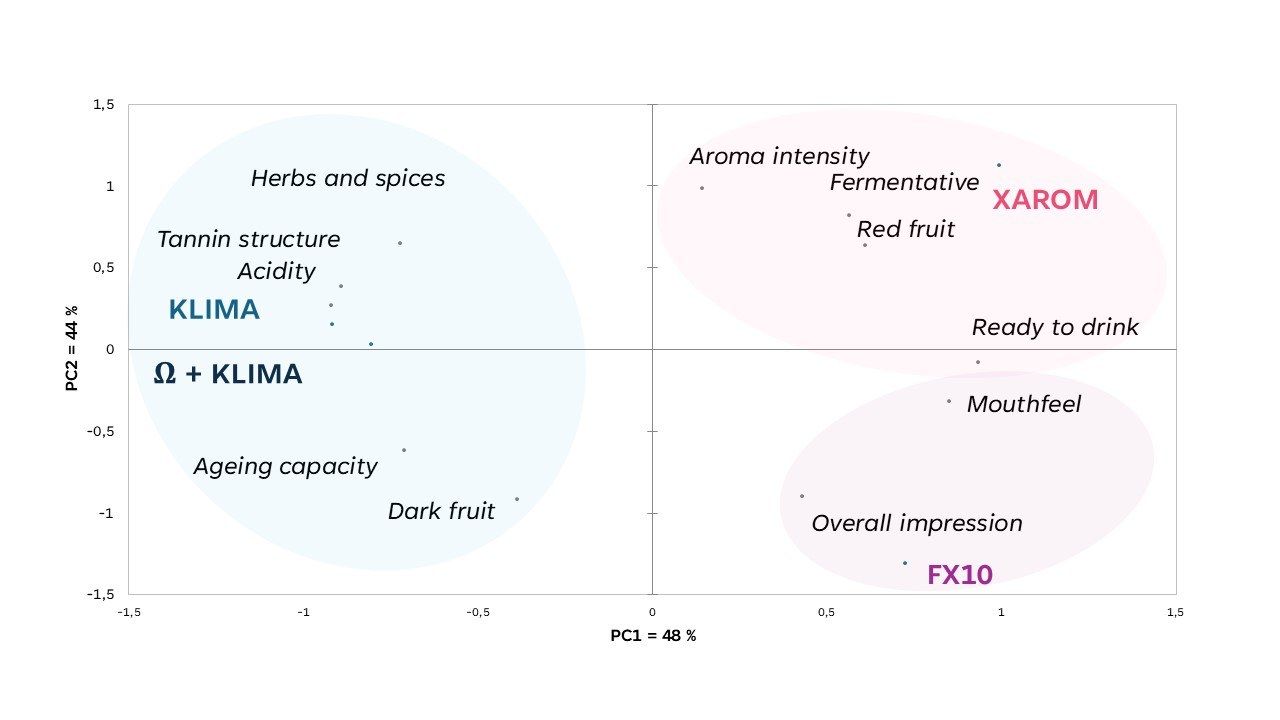
FIGURE 2. Principal component analysis (PCA) biplot of sensory data: The closer a descriptor is to a wine, the more strongly it contributes to that wine’s profile. [Data from a coded, randomised evaluation by nine experts (TASTEL WEB)].
Significance of this information for winemakers
Maintaining freshness in wines is becoming increasingly challenging; however, specific yeast starters can help address this issue. This study highlights the potential of new malic acid-enhancing S. cerevisiae strains, ZYMAFLORE™ XAROM and KLIMA, to manage wine acidity and style. These can be combined with L. thermotolerans OMEGA to further boost this effect through lactic acid production, especially when used in sequential inoculation with S. cerevisiae. In red wines, the contribution of citric acid-preserving O. oeni strains like LACTOENOS™ BERRY Direct, which can favour freshness and fruit character, is of additional importance.
Together, these starters represent valuable tools in the winemaker’s toolkit for preserving the freshness, balance and stability of wines.
Looking ahead
LAFFORT® continues to explore novel yeasts and bacteria that can further stabilise acidity and freshness under increasingly variable climate conditions. Such developments will broaden the winemaker’s toolkit for both red and white wines, ensuring consistency and quality across vintages.
References
- Waterhouse, A.L., Sacks, G.L. & Jeffery, D.W. Acids. In: Understanding Wine Chemistry. Wiley Blackwell; 2016:19-33. doi:10.1002/9781118730720.
- Vion, C., Yeramian, N., Hranilovic, A., Masneuf-Pomarède, I. & Marullo, P. Influence of yeasts on wine acidity: new insights into Saccharomyces cerevisiae. OENO One. 2024; 58(4). doi:10.20870/OENO-ONE.2024.58.4.7877.
- Hranilovic, A., Gambetta, J.M. & Schmidtke, L. et al. Oenological traits of Lachancea thermotolerans show signs of domestication and allopatric differentiation. Sci Rep. 2018; 8(1):1-13. doi:10.1038/S41598-018-33105-7.
- Vion, C., Muro, M. & Bernard, M. et al. New malic acid producer strains of Saccharomyces cerevisiae for preserving wine acidity during alcoholic fermentation. Food Microbiol. 2023; 112:104209. doi:10.1016/J.FM.2022.104209.
For more information, contact Morné Kemp at [email protected].
Click here to get your copy of WineLand Magazine.

More from
Innovation and insights

Packaging under pressure: What wine businesses should be watching
From lighter bottles to automated packing lines, packaging decisions are becoming increasingly important to the cost and competitiveness of South African wine.
How vine water stress shapes grape and wine quality
This study formed part of the South Africa Wine programme “Grapevine production with limited water resources”, and aimed to evaluate how spatial and temporal water stress affects vine physiology, fruit composition and wine quality.
Drought tolerance of different scion cultivars (Part 4): Vegetative growth and yield
The study aimed to assess grapevine vegetative and yield responses in an almost worst-case scenario, i.e. grapevines growing under dryland conditions in sandy loam soil in the Swartland region.