
Getting the most out of applied phosphorus (P) - understanding soil P relations in vineyard soils
· 7 min read
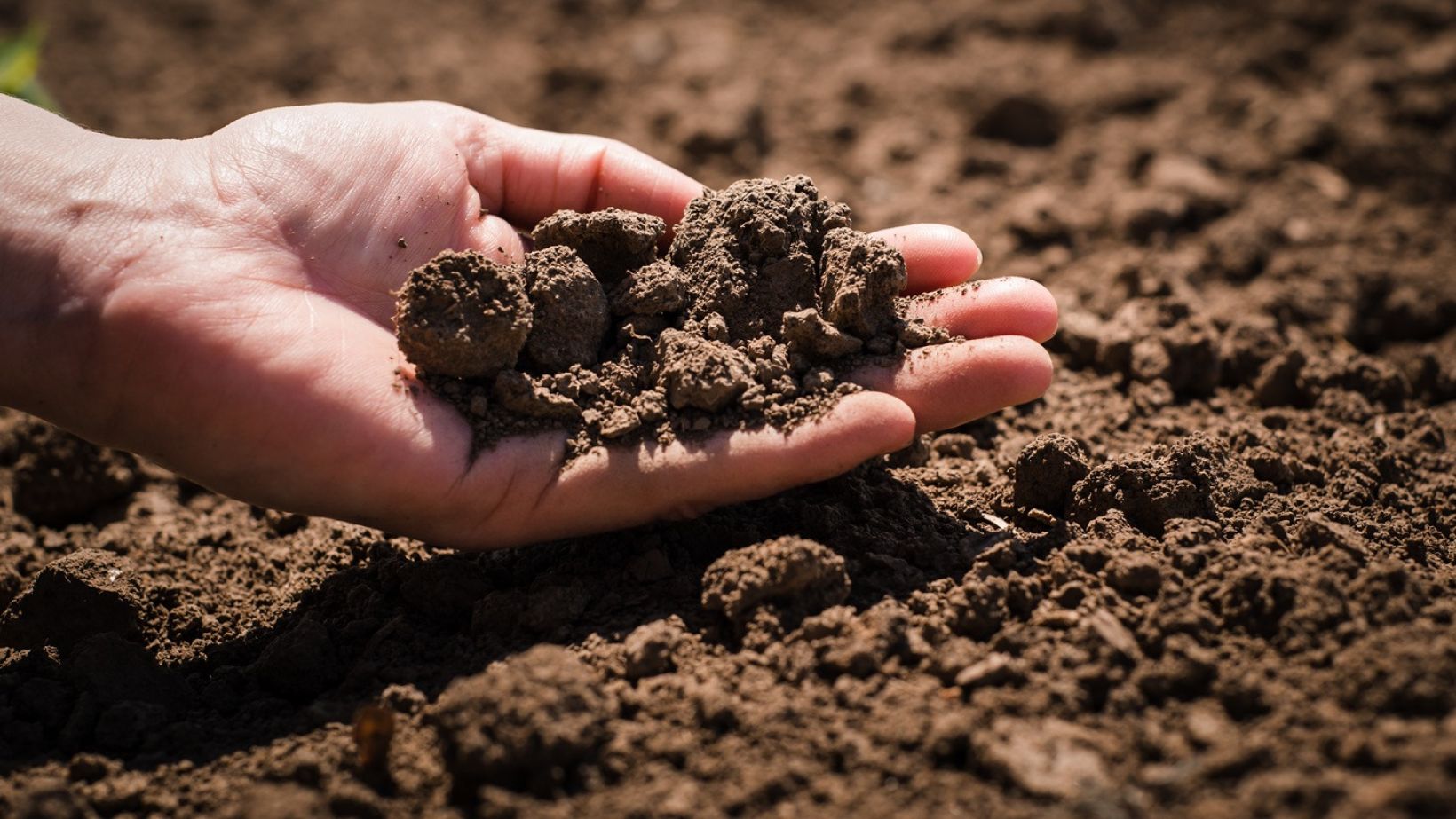
The vineyard industry is evolving rapidly – new soil conditioners, precision tools and AI-driven decisions are becoming commonplace. Yet, as Jean-Baptiste Alphonse Karr famously wrote, “The more things change, the more they stay the same.”
The principles governing nutrient availability have not changed. And when it comes to phosphorus (P), soil chemical and physical properties still determine whether your fertiliser investment pays off – or quietly disappears into the soil. As we approach the maintenance amelioration and pre-plant soil preparation season, it is worth revisiting what really happens to phosphorus in vineyard soils. Phosphorus in the vine is mobile and a key component of phospholipids and nucleic acids (DNA and RNA). Being part of ATP and ADP, P also plays a central role in photosynthesis and is required for cell division and meristematic growth. Adequate P supply is also critical for root and vegetative growth. Phosphorus nutrition should therefore not be neglected.
Note that even when P supply is adequate, conditions favouring uptake should be prioritised. If one creates an oxygen-poor, saturated environment with excessive irrigation/poor drainage, or if the root zone is excessively saline, we greatly limit the vine’s root ability to absorb applied fertiliser, and sufficient supply becomes irrelevant. Statements such as “Bray II P is high, but not plant available” are, however, often voiced without unpacking their meaning. It is worth looking at the destination of applied P in the soil.
What happens to phosphorus after you apply it?
In soil, P exists in three main pools:
- Soil solution P (primarily H₂PO₄⁻) – directly available.
- Reversibly adsorbed P – loosely attached to mineral surfaces, but potentially available.
- Precipitated or occluded P – locked into stable mineral compounds and unavailable.
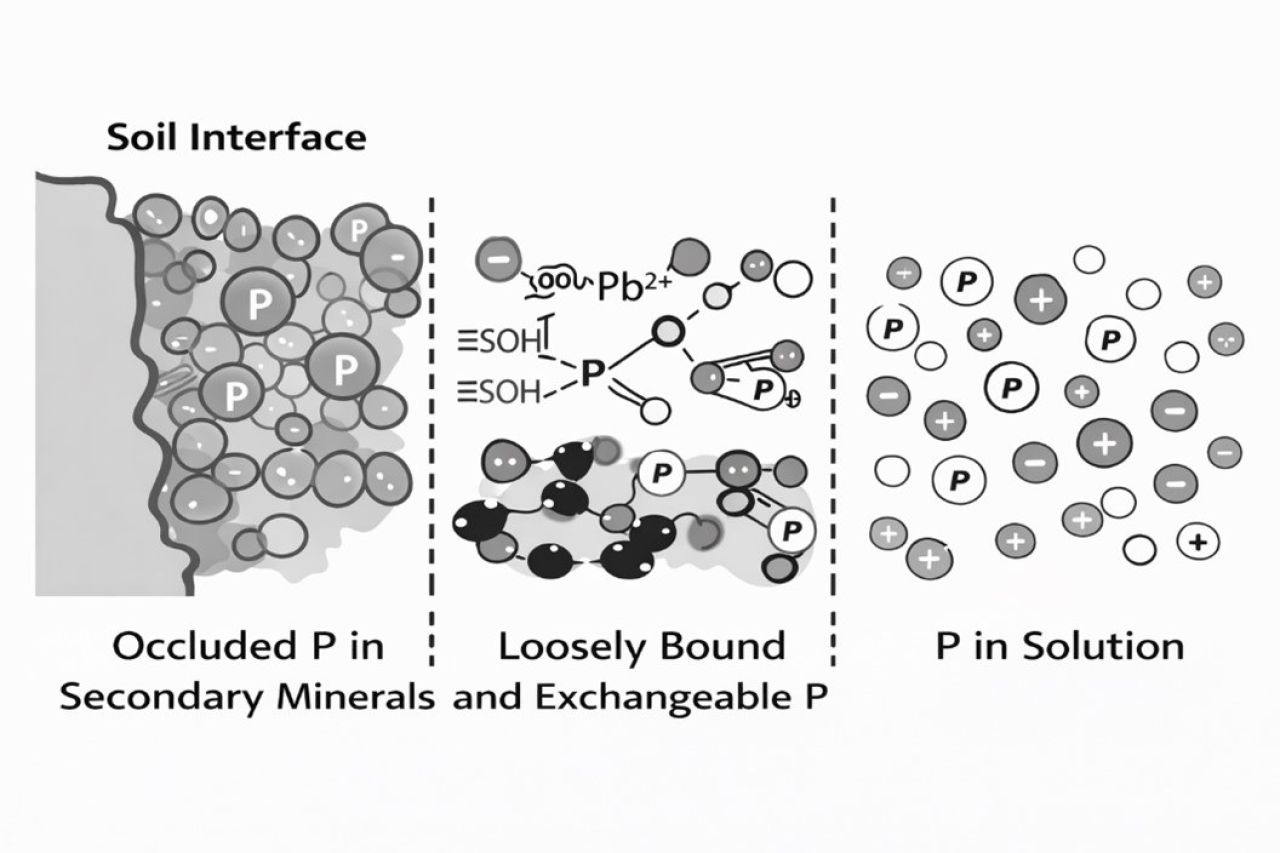
FIGURE 1. Soil phosphorus can exist in one of three pools in the soil.
Isotope studies using P³² show that a fraction of bound P exchanges rapidly with the soil solution; the remainder exchanges slowly or becomes effectively unavailable. Over time, depending on soil pH, clay type, iron (Fe) and aluminium (Al) oxide content and total P concentration, plant-available P declines (Figure 2). Critically, phosphorus availability is strongly influenced by soil pH, with optimal availability near pHKCl of 5.5 - 6.5. Correcting soil acidity should therefore precede major P applications. Soil tests such as Bray I, Bray II, Olsen, Ambic or Mehlich III are designed to reflect plant-available P. What is measured can be assumed to be plant available. It should be noted that these tests vary in their aggressiveness and ability to extract plant-available P. However, soil type strongly influences P behaviour in the medium to long term:
In acidic (pHKCl < 5.5), red soils
Soils rich in iron (Fe) and aluminium (Al) oxides, often recognisable by their deep red colour, have a strong ability to bind phosphorus, especially at lower soil pH values. Common examples include Oakleaf and Hutton soil forms. In these soils, extractable P levels can decline significantly within six months to one year if acidity is not corrected.
In alkaline (pHKCl > 6.5), lime-rich soils
In calcareous soils such as the Augrabies soil form, phosphorus reacts with calcium and can precipitate as tri-calcium phosphate. Again, availability declines over time.
In sandy, granitic soils
In coarse-textured soils typical of parts of Paarl and Stellenbosch, there are fewer binding sites. Phosphorus is not strongly fixed, but this creates another risk: leaching if application rates exceed the soil’s holding capacity.
In both strong-fixing and low-binding soils, large once-off applications are inefficient. Smaller, well-timed applications that match P demand to expected or historical yield are generally more effective.
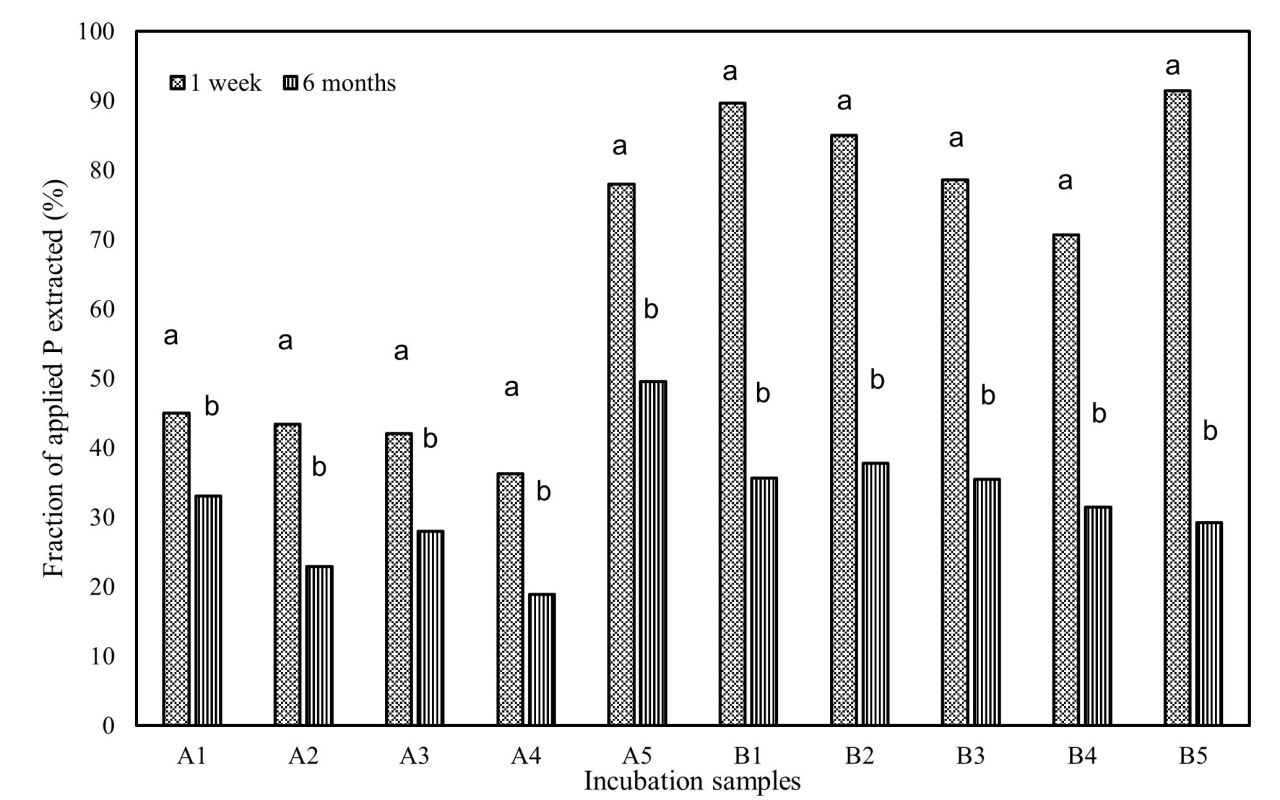
FIGURE 2. Percentage of applied P, extractable by Olsen test after one week and six months. Significant letters applicable to each soil sample only, p < 0.05. A1 - A5 referring to acidic, low P soils and B1 - B5 referring to alkaline, high P soils.
How much P should be applied?
A useful analogy is to view soil as a sponge with a fixed capacity. Apply too little and the sponge holds on fiercely to the little bit of water it has; apply too much, above the sponge’s capacity, and you end up with water dripping out of it.
- In a “large sponge” (high clay, high Fe/Al oxides, low P), more P must be applied to satisfy binding sites, allowing plant-available levels to increase.
- In a “small sponge” (sandy soils or soils already high in P), exceeding binding capacity increases leaching risk.
Research shows that when soil P exceeds a certain concentration (approximately 40 - 60 mg/kg Olsen P or 208 - 375 mg/kg Bray II P), P binding (sorption) declines sharply and leaching risk increases. Beyond established norms, increasing soil P has little effect on leaf P concentration or yield – this means that the law of diminishing returns applies.
A further consideration is the type of extractant used; some extractants are better at reflecting P in solution (i.e., water extract and Olsen), and others are better at reflecting exchangeable and solution P (i.e., Bray I, II, Mehlich III, Ambic I and citric acid). Soil pH also plays a role here; the general notion is that the Olsen extraction is better suited for high pH soils and that Bray II is better suited for acidic soils. In work done by the University of Stellenbosch, it was found that the more aggressive extractants (Bray I, II and Mehlich III) are more effective at a wider pH range. This was validated in field trials on calcareous soils where Olsen P showed deficient levels, while P extracted with Bray II was high, with leaf P concentrations that were optimal. When P was applied to these soils, no response to the applied P was observed in leaf P concentration. This indicates that Bray II P was better correlated to the actual plant available P.
As a general guideline, 4 kg P/ha raises soil P by 1 mg/kg (assuming 1.3 g/cm³ bulk density and 30 cm depth). This can be adjusted for:
- Actual bulk density (texture-based estimates are useful) (Table 1).
- Sampling depth.
- Stone % (non-reactive fraction).
- The P binding characteristics of the soil.
Before establishment, and during maintenance applications done every two to three years, the aim is to increase soil P to a desired minimum norm. During production, applications should focus on replacing the removed P – approximately 0.7 kg P per ton of grapes produced. Since applications close to root flushes (flowering and post-harvest) improve efficiency, timing the fertilisation correctly matters.
TABLE 1. The amount of P required to raise soil P by 1 mg/kg, based on bulk density assumed from texture. Phosphorus sorption is not considered here.
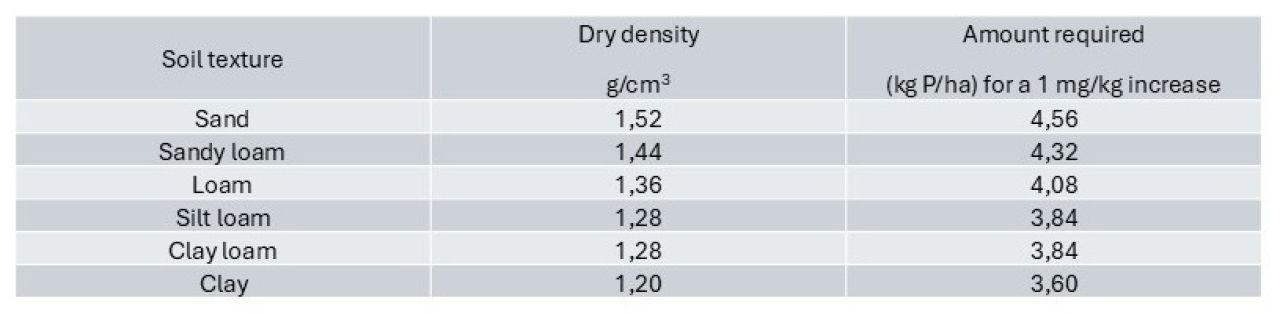
* Dry densities are based on Daniel Hillel’s “Fundamentals in soil physics” (1980).
Armed with the knowledge of your soil’s ability to bind P, we can now decide on the best approach for application:
- In acidic Fe/Al-rich soils, avoid applying P more than a year before planting.
- In alkaline soils, large corrective applications may result in precipitation losses.
- In low-binding sandy soils, avoid excessive maintenance rates to reduce leaching.
Because P is generally immobile in soil, subsoil correction is only possible during soil preparation. Before establishment, broadcast and incorporate it thoroughly up to 60cm. A common question is whether P can be applied with lime. While theoretically tri-calcium phosphate may form, this is rarely problematic under field conditions, because:
- Lime dissolves slowly.
- Superphosphate slightly acidifies upon dissolution.
- Soil CO₂ reacts with water, forming carbonic acid (H2CO3-), and root exudates gradually re-solubilise some Ca-P compounds.
Risk increases when:
- Soil pH (KCl) exceeds 6.5.
- Exchangeable Ca > 6 cmolc/kg.
- Very fine lime is used.
- High topsoil moisture.
- The P is not mixed into the soil quickly.
The best practice is to broadcast both amendments well before establishment, and in established vineyards, before peak P demand. In high-P-binding soils, band-placed P can be considered. However, P should not be mixed in the same tank with calcium (Ca) containing products when applied as fertigation.
Which fertiliser product should be used?
Product choice depends on soil chemistry and timing. Salt index, solubility and nutrient balance should guide decisions rather than price alone.
TABLE 2. Summary of P fertiliser products, price and best use scenario.
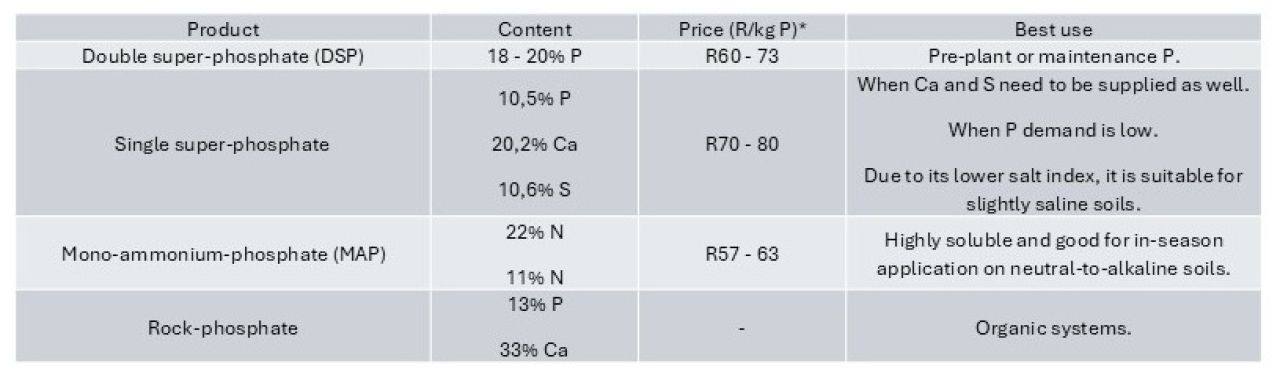
* Rough industry-based prices for 2026 excluding VAT, pre IRAN-US conflict.
For more information regarding phosphorous, other soil chemistry-related queries or assistance with maintenance amelioration recommendations, please feel free to contact:
Vivian White, Vinpro Soil Scientist at [email protected].
Click here to get your copy of WineLand Magazine.

More from
Vineyard, cellar and production
How to understand regenerative farming
Regenerative farming is becoming part of the language of modern viticulture, but what does it actually look like in a vineyard?
JC Smith praat oor wynmaak in die Oos-Vrystaat
JC Smith is ’n derdegeslag-wynmaker. Sy oupa Dassie en pa Flip was albei wynmakers, en hy het tussen wingerde en wynkelders grootgeword. Hy is tans die wynmaker by Blydschap in die Oos-Vrystaat.
Cellar hygiene
Maintaining a spotless wine cellar requires a comprehensive management plan, which includes structural design, equipment sanitation, environmental controls and routine microbial monitoring.