
Rickety Bridge - opportunities for individual development
· 3 min read
Rickety Bridge, located against the Dassenberg near Franschhoek, used to be part of La Provence, a 17th century Huguenot farm. La Provence was subdivided and the portion currently known as Rickety Bridge, was awarded on 13 May 1797 to Paulina de Villiers. Paulina named her farm Paulina’s Drift and one of the Rickety Bridge wines is named after her.
Initially, the main road to Franschhoek was in front of the manor house and cellar, but it was moved to the position of the current main road. Rickety Bridge’s interesting name is derived from an old wooden bridge over the Franschhoek River, which used to provide access to the farm. However, the wooden bridge was not wide enough and therefore trucks and larger vehicles were obliged to access neighbouring farms to reach the farm. This was probably the main reason why the old wooden bridge was rebuilt in 1996 and replaced with a wider concrete bridge.
According to Donovan Ackermann, cellar master, and Mari Kotze, winemaker of Rickety Bridge, cellar assistants often receive information during training and skills development which is not always clear to participants. The use of theoretical terms, without practical examples, can be challenging and consequently interest is lost and a lack of self-confidence, which is often experienced, is further established. Knowledge transfer should preferably include both technical and practical aspects, to ensure that the content is fully understood.
Rickety Bridge offers numerous opportunities for the cellar team to participate in as much training possible and for each team member to reach his full potential. Established informal mentorship relationships are conducive to the development of knowledge and contribute to individual development of the cellar team. Donovan and Mari believe that the knowledge gained by cellar assistants enables them to make informed decisions and to take initiative independently. Consequently, the cellar team is less afraid to ask questions, realising that poor decisions are often made if there is a fear of asking questions. This fear, which is generally prevalent amongst cellar assistants, usually stems from a lack of knowledge, which in turn results in a lack of self-confidence.
Donovan and Mari believe that participating in the Winetech study groups and senior cellar assistant workshops improves participants’ confidence and a greater understanding develops for the different winemaking processes. Participation in the Winetech cellar assistants’ programmes promotes communication in the cellar; cellar assistants develop a greater interest in the product they work with, which results in increased productivity and establishing sound relationships. Consequently, the fear of asking questions diminishes and individual confidence is growing with participation in the Winetech cellar assistant programmes.
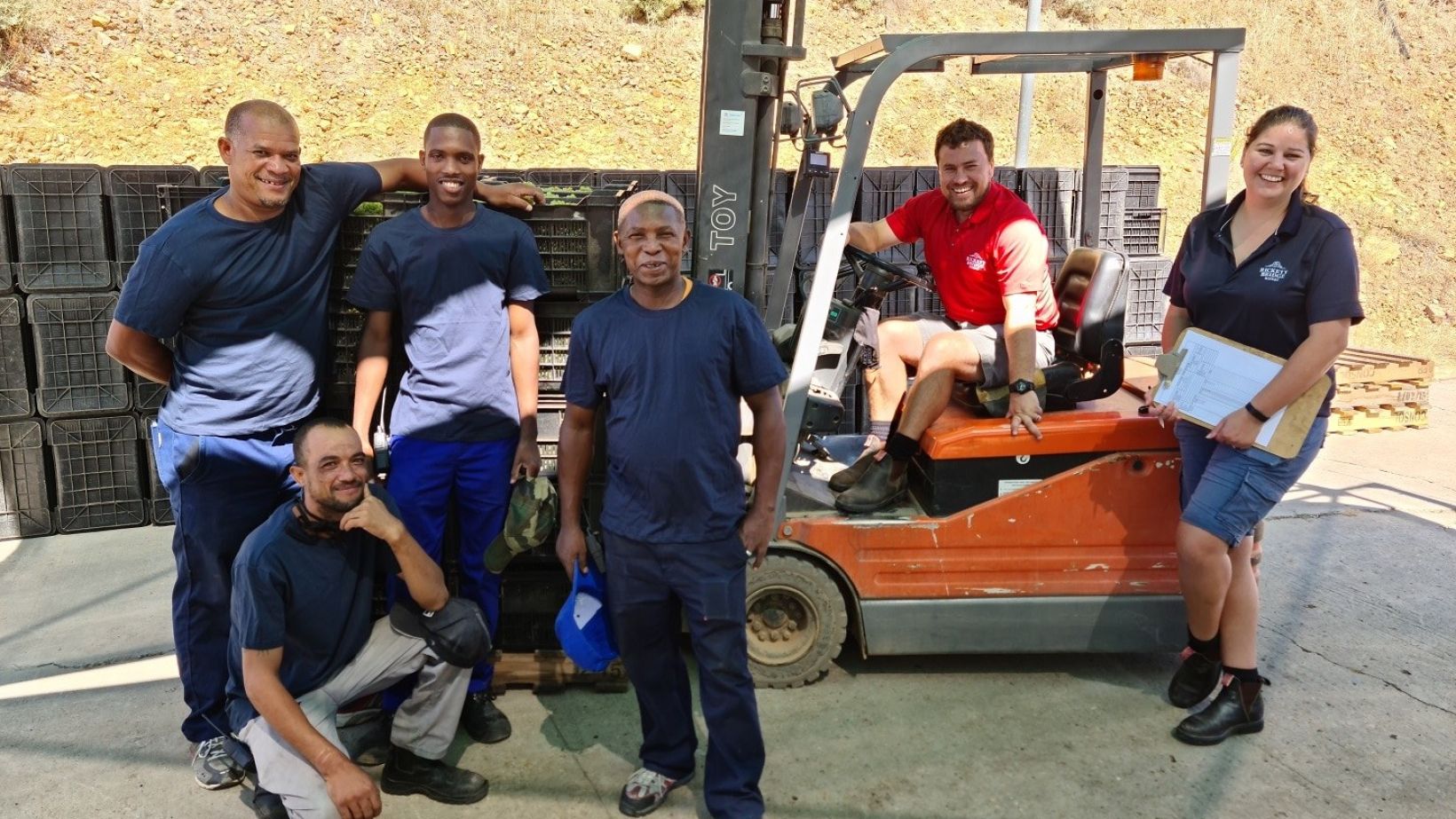
Paul Hoffman, Jonathan McPherson (kneeled in front), Bradley Jacobs, Dirkie Williams, Donovan Ackermann (cellar master) and Mari Kotze (winemaker).

More from
Vineyard, cellar and production

Cellar hygiene
Maintaining a spotless wine cellar requires a comprehensive management plan, which includes structural design, equipment sanitation, environmental controls and routine microbial monitoring.
Making wine in Cape Town's Philadelphia ward
Havana Hills overlooks Table Mountain and the Atlantic Seaboard from its perch atop one of the region’s smallest wards, Philadelphia. Piet Kleinhans recently took over the reins as winemaker.
What's so special about wine globes?
Diemersdal places a strong focus on innovation, and there’s always something new up their sleeve. Wineglobes represent a new way of telling a story that’s centuries old.