
Irrigation strategy and trellis system (Part 1): Vegetative growth of Pinotage grapevines in the Breede River Valley region
The primary objective of the study was to determine during what stage(s) Pinotage vegetative growth is sensitive to water deficits, and the most suitable irrigation strategy when water restrictions are imposed during periodic droughts.
· 15 min read
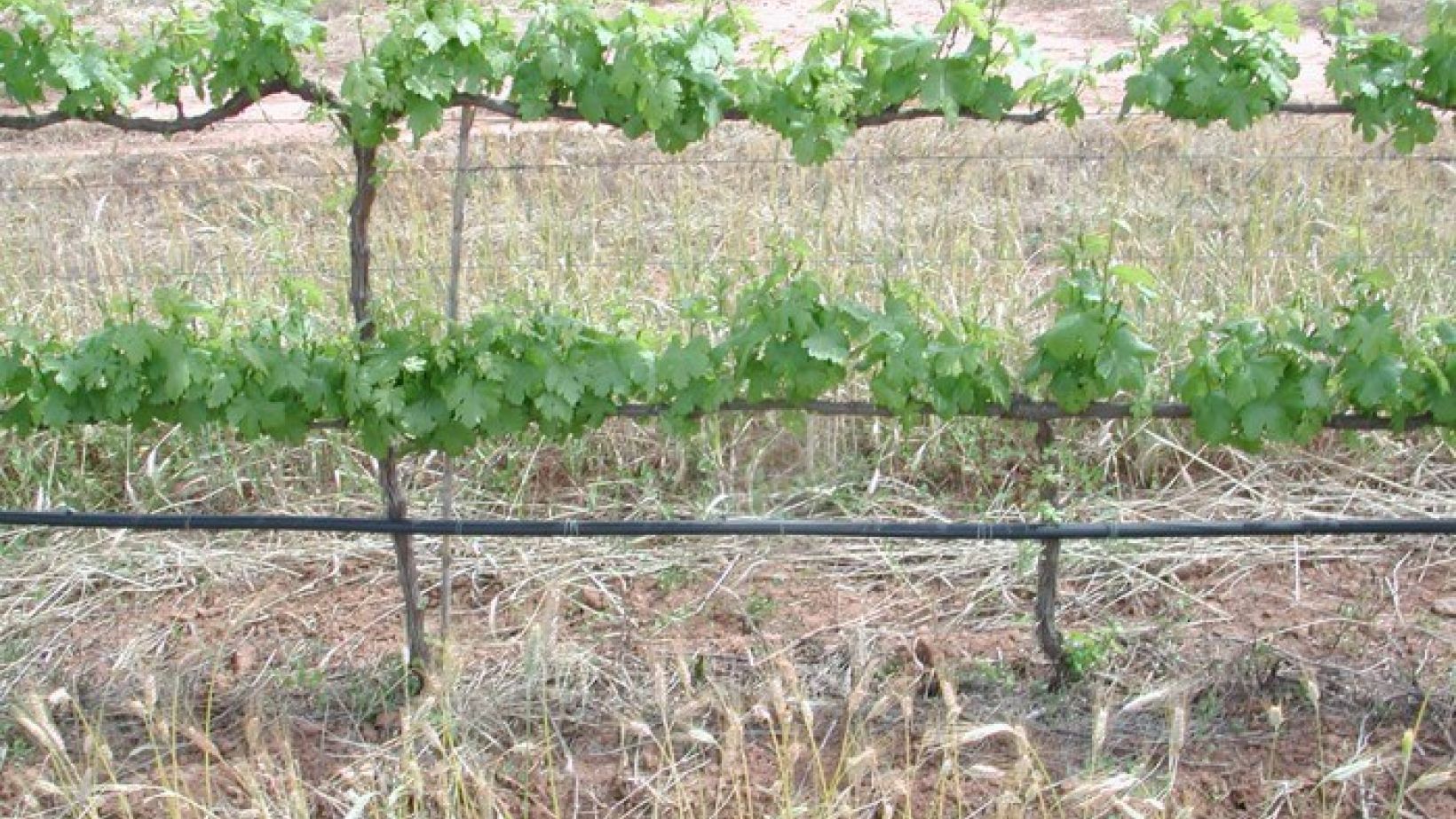
Abstract
Pinotage is a South African-bred red wine cultivar and is second only to Shiraz in terms of the country’s wine exports. Since rainfall in the Breede River Valley region is low, vineyards in this region depend on irrigation. The sensitivity of Pinotage/99R to water deficits and the most suitable irrigation strategy during water restrictions were studied in a field trial from 1998/99 until 2000/01. Irrigation strategies entailed combinations of 50% readily available water (RAW) depletion, 75% RAW depletion and no irrigation between various phenological stages, viz. budbreak, flowering, pea size berries, véraison, 17°B and harvest. Irrigation applied at 50% RAW depletion from budbreak in September until harvest in February was regarded as the control. The possibility to produce more grapes with the same volume of irrigation water was also investigated, and each experimental plot was split into a six-strand vertical hedge and a two-tier vertical trellis. The experimental layout was a split-plot, randomised block design. Cane mass of grapevines on the two-tier trellis was lower compared to the six-strand hedge with shorter cordon arms. Pinotage vegetative growth tended to be reduced by prolonged water deficits from flowering to véraison, as well as where drier soil conditions prevailed from budbreak to véraison or harvest.
Introduction
Irrigation resources are generally limited in the grape-producing regions of South Africa.1 The Breede River Valley production region, which has a Mediterranean climate, receives approximately 116 mm of rainfall in spring and summer, followed by 164 mm in autumn and winter. Therefore, vineyards in this particular region depend entirely on irrigation. Considering the possible effects of climate change on viticulture, the worst-case scenario would be that lower rainfall reduces natural water resources and higher air temperatures increase the vineyard water requirements. Even if climate changes do not affect vineyard evapotranspiration, grape growers still need to use irrigation water more efficiently, but without compromising yield and wine quality.
Pinotage is a South African red wine grape cultivar that was bred locally and yields 10 to 15 t/ha of grapes.2 It is the most widely planted, locally bred cultivar in South Africa. The total area of vineyards planted to Pinotage comprises ca. 7.6% of the total area of South African wine grape vineyards.3 Thirty three percent of the Pinotage vineyards are located in the Breedekloof, Robertson and Worcester areas of the Breede River Valley. In terms of red wine exported from South Africa, Pinotage is second only to Shiraz. Despite the popularity of the cultivar, there is no knowledge on the sensitivity of Pinotage vegetative growth to water constraints if water resources for irrigation are, or become, limited. Vegetative growth may impact directly and/or indirectly on grape yield and wine quality. Less irrigation reduces shoot growth tempo,4 as well as total shoot mass compared to more frequent irrigation.5,6,7,8,9,10,11,12 In drought situations, water restrictions could be imposed, thereby forcing growers to manage the limited available water to obtain maximum benefits. In order for growers to make informed decisions regarding the irrigation of their vineyards if water becomes limited, information is needed on the effect of water constraints during the different phenological stages of the grapevine.
Taking the above-mentioned into consideration, the primary objective of the study was to determine (i) during what stage(s) Pinotage vegetative growth per se is sensitive to water deficits, and (ii) the most suitable irrigation strategy when water restrictions are imposed during periodic droughts.
Methods
Experimental vineyard
The field trial was carried out over three seasons, i.e. from 1998/99 until 2000/01, in a three-year-old Pinotage/99Richter vineyard on the Agricultural Research Council (ARC) Research Farm near Robertson in the Breede River Valley of South Africa. Details have been given previously.13 Briefly, based on the growing degree days (GDD) of 1 497°C from 1 September to 31 March,14 the specific locality is in a class II climatic region that has the potential for the production of good quality red and white table wine.15 The sandy loam soil of the experimental plot was representative of the Hutton and Sterkspruit forms16 and was deep delved to ca. 90 cm before planting. Grapevines were planted at a spacing of 2.75 m × 1.50 m. Irrigation was applied over the total area using 32 L/hour Eintal® micro sprinklers. Standard viticultural management practices were applied in the experimental vineyard. The vineyard was mechanically cultivated only to establish Avena sativa L. cv. Pallinup (oats) as a winter cover crop.17 Full surface chemical control was applied before budbreak.
Experimental layout
To determine the effect of water deficits at various stages, different irrigation strategies were applied. These irrigation strategies consisted of eight different combinations of 50% readily available water (RAW) depletion, 75% RAW depletion and no irrigation between various phenological stages, viz. budbreak, flowering, pea size berries, véraison, 17°B and harvest. Irrigation applied at 50% RAW depletion from budbreak in September until harvest in February was regarded as the control (S1). For the purpose of this study, RAW was defined as the water available between -5 kPa and -100 kPa soil matric potential. The experimental layout was a split-plot, randomised block design. Each experimental plot was split into a six-strand hedge and a two-tier vertical trellis to give a total of 16 irrigation strategy/trellis system combinations, or treatments. Each strategy/trellis system combination was replicated three times.
Grapevines were developed onto the respective trellis systems from establishment onwards. The cordon arms of grapevines on the two-tier trellis were developed to a length of 3 m (Figure 1). The total height of both trellis systems was 1.8 m. Plots consisted of eight experimental grapevines with two border grapevines at each end, as well as two border rows on either side of the experimental row to limit possible overlapping of treatment effects. Each experimental plot covered 247.5 m2.
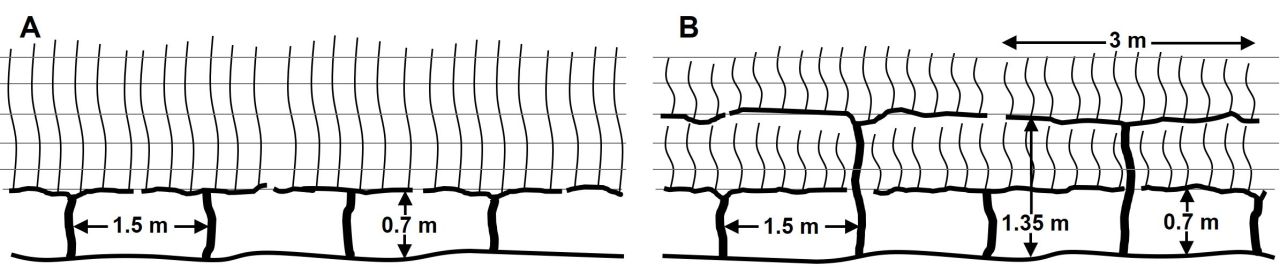
FIGURE 1. Schematic illustration of grapevines trained onto the (A) six-strand hedge and (B) two-tier trellis.
Application of irrigation strategies
Soil water matric potential was measured weekly, as well as before and after irrigations, using tensiometers installed at 30 cm, 60 cm and 90 cm depths. A soil water retention curve was determined for each 30 cm depth increment using undisturbed soil cores and the ceramic pressure plate technique.18 The water retention curves were used to determine RAW between -5 kPa and -100 kPa. The soil water retention curves were comparable for the three depth increments and total RAW amounted to 94 mm/m. Based on the soil water retention curves, 50% and 75% RAW depletion amounted to soil matric potentials of ca. -35 kPa and -65 kPa, respectively. Irrigation volumes of selected irrigation strategies were measured by means of water meters. Grapevines were not irrigated during winter months.
Vegetative growth
To quantify growth vigour, cane mass was measured at pruning in early August. The cane mass of all the experimental grapevines in each plot was determined using a hanging balance. Cane mass per plot (kg) was converted to tons per hectare. Shoots were slightly topped at the beginning of December. Topping of principal shoots was only required where irrigation was applied at 50% RAW depletion before véraison. On the two-tier trellis, shoots were topped on the lower, as well as upper cordons. In July 2001, the number of primary shoots per grapevine were counted and their length was measured using a measuring tape.
Statistical analyses
Raw data was captured and sorted in Microsoft® Excel. The data were subjected to an analysis of variance (ANOVA) by using Statgraphics®. Least significant difference (LSD) values were calculated to facilitate comparison between treatment means. Means which differed at p ≤ 0.05 were considered significantly different.
Results
It must be noted that some of the results of S1 and S7 on the two trellis systems have been summarised previously.1 The results obtained with both the trellis systems and all the irrigation strategies will be discussed in detail below.
Soil water status and irrigation volumes
Grapevines were generally irrigated once a week to maintain 50% RAW depletion during summer. In order to allow 75% RAW depletion, irrigation was applied every 10 to 14 days depending on the weather (Figure 2). On average, 619 mm of water was applied to the control strategy (S1) over the three seasons. Irrigation of grapevines at 75% RAW depletion from budbreak until harvest (S7) required 462 mm of water. Where water deficits were imposed from flowering to véraison (S3), an average of 572 mm of water was applied over the three years of the study. For grapevines irrigated at 75% RAW depletion with 50% RAW from flowering to véraison (S6), 509 mm of water was applied. It must be noted that grapevines on the two trellis systems received the same volume of irrigation water.
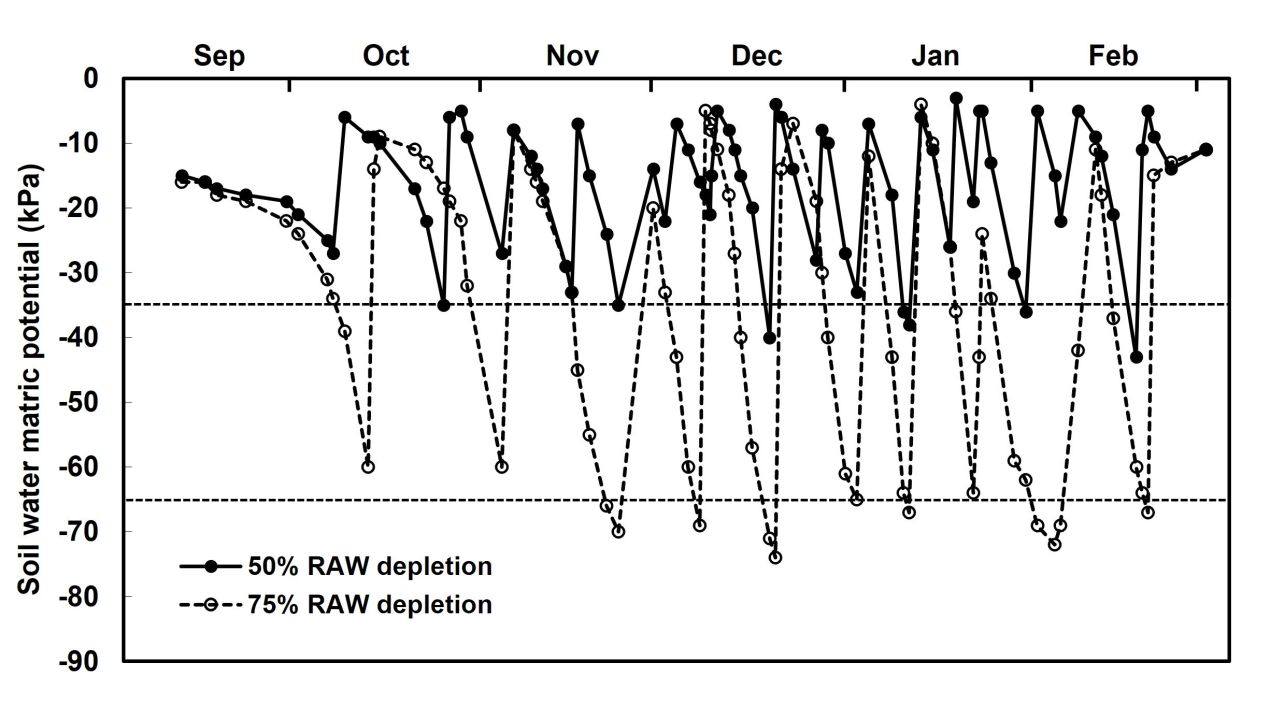
FIGURE 2. Seasonal variation in soil water matric potential (Ψm) where Pinotage grapevines were irrigated at two readily available water (RAW) depletion levels in the 2000/01 season near Robertson (redrawn). Horizontal dashed lines indicate the target Ψm values for 50% and 75% RAW depletion, respectively.
Vegetative growth
Effect of trellis system
Since some cordon arm development was still required in 1998/99, cane mass was lower than in 1999/00 and 2000/01 when the cordon arms were fully developed (Table 1). Although grapevines on the two-tier trellis had double the cordon length, cane mass of grapevines on the two-tier trellis was lower compared to the six-strand hedge. Cane measurements carried out in the 2000/01 season showed that grapevines on the six-strand hedge had less primary shoots per grapevine (Figure 3A), but longer shoots compared to the two-tier trellis (Figure 3B). The distribution of growth potential over the longer cordons reduced the length of single primary shoots on the two-tier trellis. Based on the number of shoots per grapevine, spurs were ca. 14 cm apart on the six-strand hedge, whereas the spacing was ca. 17 cm on the two-tier trellis. However, the total cane length of grapevines on the two-tier trellis was comparable to the six-strand hedge (Figure 4A). Visual observations revealed that the canes of grapevines on the two-tier trellis were thinner compared to those on the six-strand hedge. Cane mass per unit cane length of the two-tier trellis was considerably lower compared to the six-strand hedge (Figure 4B). This suggested that the tendency towards lower cane mass on the two-tier trellis was due to thinner canes compared to the six-strand hedge in all the seasons (Table 1).
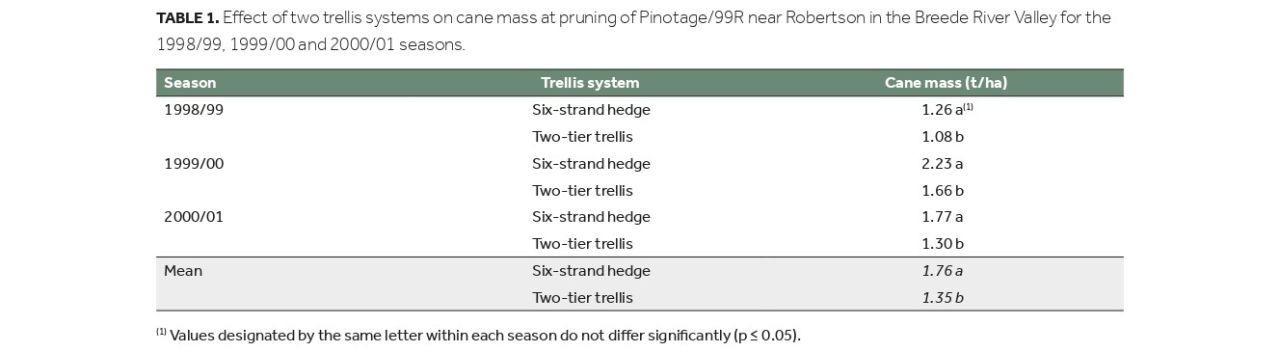
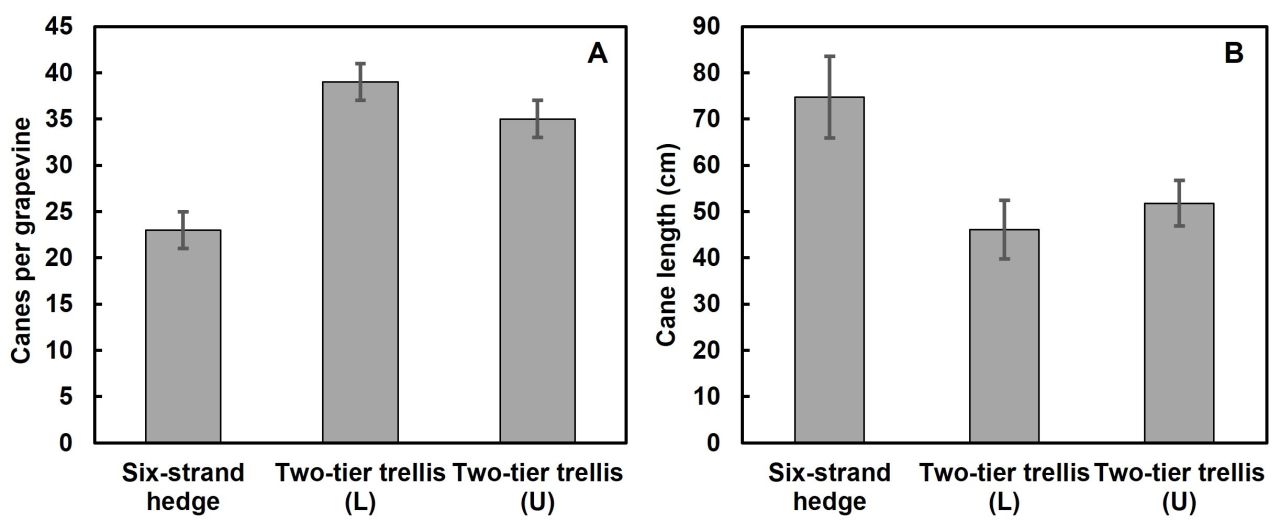
FIGURE 3. Effect of two trellis systems on (A) number of canes per grapevine, and (B) cane length of Pinotage/99R in the 2000/01 season near Robertson. In the case of the two-tier trellis, L and U refer to grapevines on lower and upper cordon wires, respectively. Vertical bars indicate ±1 standard deviation.
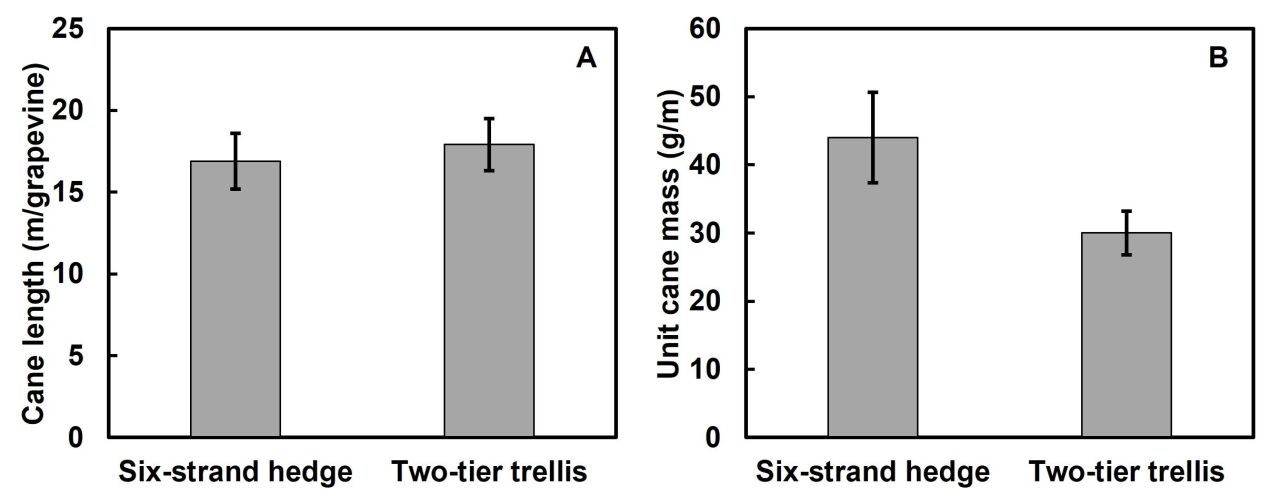
FIGURE 4. Effect of two trellis systems on (A) cane length per grapevine, and (B) unit cane mass of Pinotage/99R in the 2000/01 season near Robertson. Vertical bars indicate ±1 standard deviation.
Effect of irrigation strategies
Irrigation at 75% RAW depletion from budbreak until harvest (S7) tended to reduce cane mass compared to irrigation applied at 50% RAW depletion over the same period (S1) in the 1989/99 and 1999/00 seasons (Table 2). On average, S7 tended to reduce cane mass compared to S1 (Figure 5). The growth reduction where irrigation was applied at higher soil water depletion levels from budbreak to harvest agrees with previous results.4,5,10 Likewise, cane mass of suckered VSP-trained Shiraz grapevines decreased with an increase in the level of PAW depletion.12,19 In contrast, deficit irrigation did not reduce cane mass of Castelão grapevines, whereas no irrigation caused a substantial reduction compared to well-watered grapevines.20 Colombar grapevines irrigated every seven days throughout the season produced higher pruning mass in comparison to those that were irrigated every two, three or four weeks.8 Merlot grapevines subjected to continuous deficit irrigation also produced lower cane mass than those that were irrigated more frequently.21
There was generally no reduction in cane mass of grapevines when water deficits were applied from flowering up to pea-size berries (S2) compared to the control (S1) in the three seasons (Table 2). However, where grapevines were subjected to water deficits over a longer period, i.e. from flowering to véraison (S3), cane mass was lower than that of S1 grapevines in the 1998/99 and 1999/00 seasons. Mean cane mass over three years followed similar trends (Figure 5). Previous studies also showed that vegetative growth was most sensitive to soil water constraints after flowering.4,22
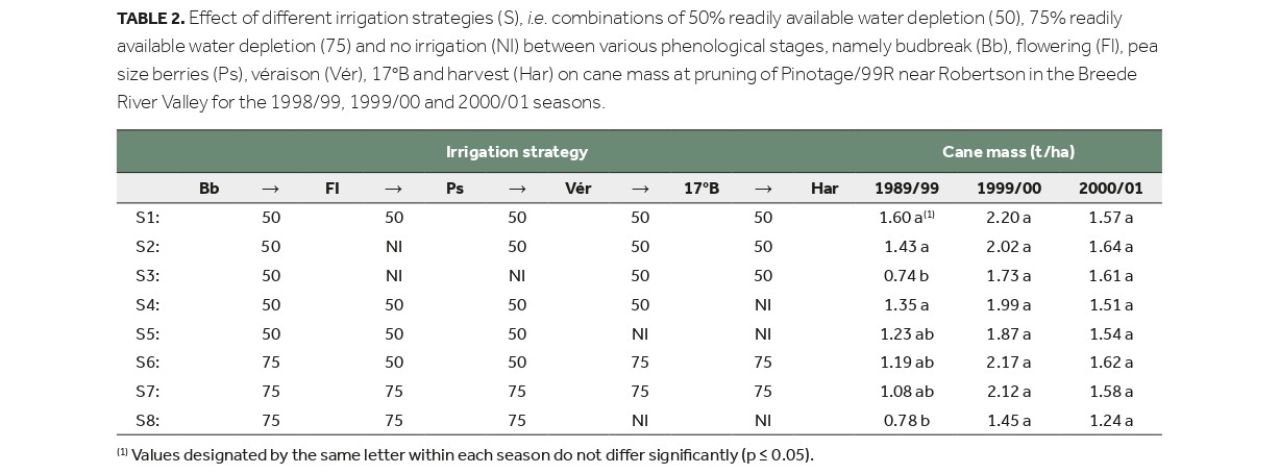
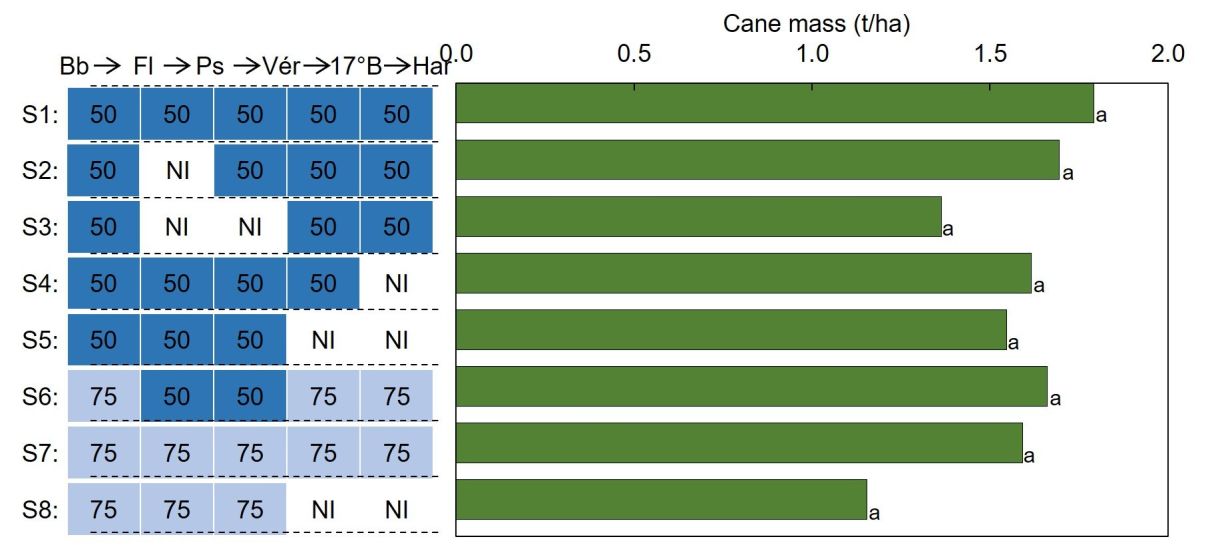
FIGURE 5. Effect of different irrigation strategies (S), i.e. combinations of 50% readily available water depletion (50), 75% readily available water depletion (75), and no irrigation (NI) between various phenological stages, namely budbreak (Bb), flowering (Fl), pea size berries (Ps), véraison (Vér), 17°B and harvest (Har) on cane mass of Pinotage/99R near Robertson in the Breede River Valley. Data are means for three years. Columns designated by the same letters do not differ (p ≤ 0.05).
Grapevines tended to have lower cane mass where they were irrigated at 50% RAW depletion, which was terminated at 17°B (S4) or véraison (S5) compared to the control strategy (Table 2). Where irrigation at 75% RAW depletion was terminated at véraison (S8), cane mass tended to be substantially lower compared to that of grapevines that were irrigated at 75% RAW depletion from budbreak until harvest for all of the seasons (S7) (Table 2). Mean cane mass over three years showed similar trends (Figure 5). This agrees with previous findings where grapevine cane mass was reduced by post-véraison deficits compared to a fully irrigated control.22 In general, excessive shading due to vigorous vegetative growth can be detrimental to wine colour.23 In the current study, visual observations revealed that water deficits tended to terminate shoot elongation. Termination of shoot growth could impact positively on red grape cultivars.24
Conclusions
This was the first study where Pinotage vegetative growth responses to water deficits and trellis systems were determined. The distribution of growth vigour over longer cordons on the two-tier trellis reduced the primary shoot thickness. Consequently, cane mass of grapevines on the two-tier trellis was lower compared to the six-strand hedge with shorter cordon arms. Pinotage vegetative growth tended to be reduced by prolonged water deficits from flowering to véraison, as well as where drier soil conditions prevailed from budbreak to véraison or harvest. Yield responses will be presented in the next article.
Acknowledgements
- The Agricultural Research Council (ARC) and Winetech for funding the project.
- ARC for infrastructure and resources.
- Staff of the Soil and Water Science division at ARC Infruitec-Nietvoorbij for their assistance, and in particular Mr. T. Harris for his dedicated technical support.
- Staff at ARC Robertson Research Farm.
References
- Myburgh, P.A., 2018. Handbook for irrigation of wine grapes in South Africa. Agricultural Research Council, Pretoria, South Africa.
- Goussard, P., 2008. Grape cultivars for wine production in South Africa. Cheviot Publishing, Cape Town, South Africa.
- SAWIS, 2023. South Africa wine industry statistics, wosa.co.za.
- Van Zyl, J.L., 1984. Interrelationships among soil water regime, irrigation and water stress in the grapevine (Vitisvinifera). Dissertation, Stellenbosch University, Private Bag X1, Matieland 7602, South Africa.
- Myburgh, P.A., 1996. Response of Vitis viniferacv. Barlinka/Ramsey to soil water depletion levels with particular reference to trunk growth parameters. S. Afr. J. Enol. Vitic. 17, 3-14.
- Conradie, W.J. & Myburgh, P.A., 2000. Fertigation of Vitis vinifera cv. Bukettraube/110R on a sandy soil. S. Afr. J. Enol. Vitic. 21, 40-47.
- Myburgh, P.A., 2003. Responses of Vitis viniferacv. Sultanina to level of soil water depletion under semi-arid conditions. S. Afr. J. Enol. Vitic. 24, 16-24.
- Myburgh, P.A., 2007. The effect of irrigation on growth, yield, wine quality and evapotranspiration of Colombar in the Lower Orange River Region. Wineland, Technical Yearbook 2007/08, 59-62.
- Bruwer, R.J., 2010. The edaphic and climatic effects on production and wine quality of Cabernet Sauvignon in the Lower Olifants River region. Thesis, Stellenbosch University, Private Bag X1, Matieland 7602, South Africa.
- Lategan, E.L., 2011. Determining of optimum irrigation schedules for drip irrigated Shiraz vineyards in the Breede River Valley. Thesis, Stellenbosch University, Private Bag X1, 7602 Matieland (Stellenbosch), South Africa.
- Myburgh, P.A., 2011. Response of Vitis viniferacv. Merlot to low frequency irrigation and partial root zone drying in the Western Cape Coastal Region - Part II. Vegetative growth, yield and quality. S. Afr. J. Enol. Vitic. 32, 104-116.
- Lategan, E.L. & Howell, C.L., 2016. Deficit irrigation and canopy management practices to improve water use efficiency and profitability of wine grapes. WRC Report No. 2080/1/16. ISBN 978-1-4312-0816-6.
- Howell, C.L. & Myburgh, P.A., 2024. Response of Vitis viniferacv. Pinotage to irrigation strategy and trellis system in the Breede River Valley Region: Vegetative growth, yield and juice characteristics. S. Afr. J. Enol. Vitic. 45, 92-106.
- Amerine, M.A. & Winkler, A.J., 1944. Composition and quality of musts and wines of California grapes. Hilgard 15, 493-673.
- Le Roux, E.G., 1974. A climate classification for the South Western Cape viticultural areas (in Afrikaans). Thesis, Stellenbosch University, Private Bag X1, 7602 Matieland (Stellenbosch), South Africa.
- Soil Classification Working Group, 1991. Soil Classification - A taxonomic system for South Africa. Memoirs on natural agricultural resources of South Africa No. 15, Dept. of Agric. Develop., Private Bag X144, Pretoria, 0001 South Africa.
- Fourie, J., 2021. Cover crops in South African vineyards. Agricultural Research Council, Pretoria, South Africa.
- Klute, A., 1986. Water retention: laboratory methods. In Klute, A. (ed.). Methods of soil analysis. Part I, Physical and mineralogical methods. No.9, Agronomy series. Madison, Wis.
- Stolk, R.A., 2014. The effect of irrigation and canopy management on selected vegetative growth and reproductive parameters of Vitis vinifera cv. Shiraz in the Breede River Valley. Thesis, Stellenbosch University, Private Bag X1, Matieland 7602, South Africa.
- Santos, T.P., Lopes, C.M., Rodrigues, M.L., De Souza, C.R., Ricardo-da-Silva, J.M., Maroco, J.P., Pereira, J.S. & Chaves, M.M., 2005. Effects of partial root-zone drying irrigation on cluster microclimate and fruit composition of field-grown Castelão grapevines. Vitis 44, 117-125.
- Munitz, S., Netzer, Y. & Schwartz, A., 2017. Sustained and regulated deficit irrigation of field-grown Merlot grapevines. Aust. J. Grape Wine Res. 23, 87-93.
- McCarthy, G., 1997. Effect of timing of water deficit on fruit development and composition on Vitis vinifera cv. Shiraz. Dissertation, University of Adelaide, Waite Campus, PMB 1, Glen Osmond, SA 5064, Australia.
- Smart, R.E., 1982. Vine manipulation to improve wine quality. Proc. Int. Symp. Grapes Wine, Davis, California, 1980, 362-375.
- Williams, L.E., Dokoozlian, N.K. & Wample, R., 1994. Grape. In: Schaffer, B. & Anderson, P.C., (eds). Handbook of environmental physiology of fruit crops, Vol. 1 Temperate Crops. Orlando, CRC Press. pp. 83-133.
For more information, contact Carolyn Howell at [email protected].
Click here to get your copy of WineLand Magazine.

More from
Vineyard, cellar and production
How to understand regenerative farming
Regenerative farming is becoming part of the language of modern viticulture, but what does it actually look like in a vineyard?
JC Smith praat oor wynmaak in die Oos-Vrystaat
JC Smith is ’n derdegeslag-wynmaker. Sy oupa Dassie en pa Flip was albei wynmakers, en hy het tussen wingerde en wynkelders grootgeword. Hy is tans die wynmaker by Blydschap in die Oos-Vrystaat.
Cellar hygiene
Maintaining a spotless wine cellar requires a comprehensive management plan, which includes structural design, equipment sanitation, environmental controls and routine microbial monitoring.