
How to understand regenerative farming
Regenerative farming is becoming part of the language of modern viticulture, but what does it actually look like in a vineyard?

· 8 min read
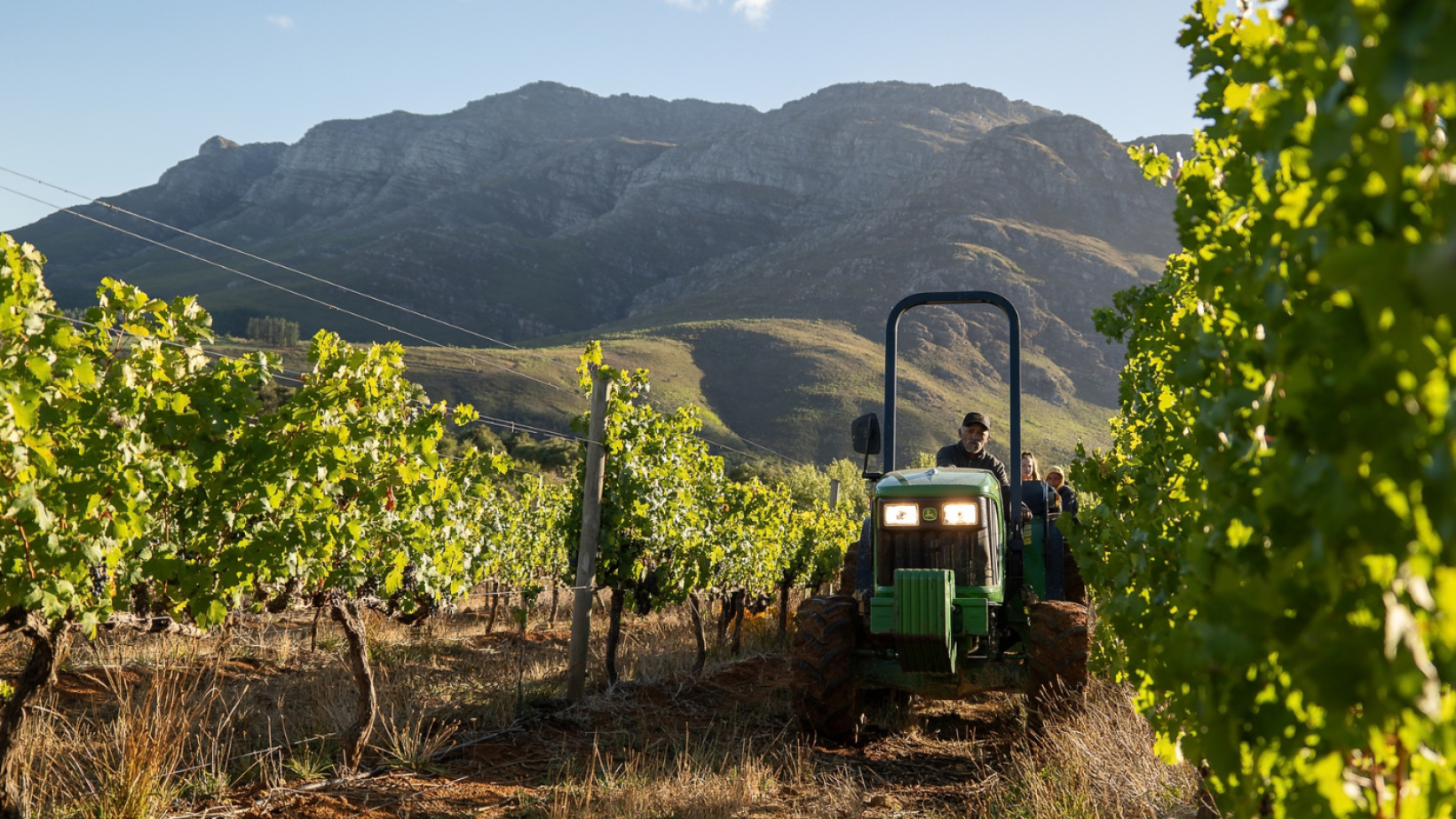
At Waterford Estate, Johané Cilliers and David van Schalkwyk describe regenerative farming as treating the vineyard as an interconnected living system, rather than following a fixed set of practices. Since 2014, the estate has gradually introduced diverse cover crops, cattle, compost, biochar and drone applications, aiming to recycle resources, support soil life and reduce disturbance. Long-term measurements show changes in soil carbon and nitrogen, though the team says these require careful interpretation and continued monitoring; the goal is healthier soil, resilient vines and healthy fruit.
Summary written by AI from this article. The full article is under “Deep dive”.
Listen to this article· 13 min
Passage 1 of 13
Read aloud by an AI voice. The words are the article’s own, nothing is summarised or translated.
At Waterford Estate, it is less about following a prescribed set of practices and more about understanding the vineyard as a living system. Johané Cilliers, assistant farm manager, and David van Schalkwyk, viticulturist at Waterford Estate, unpack some of the principles behind regenerative farming and how they are putting them into practice.
Regenerative farming is not something that happens overnight. Nor is it simply a matter of introducing cattle into a vineyard, planting a cover crop or making compost. At its heart is a swing in how the farm is viewed: not as a collection of individual components, but as a living system in which soil, plants, animals, microorganisms and farming practices are interconnected. And at Waterford Estate, there is a simple way to describe it.
“Ultimately, it is about completing the circle of life,” explain David van Schalkwyk. “Taking what we have available, putting it back into the system and using it to restore the soil to its most natural state.”
It is a useful starting point for understanding what regenerative farming means in practice.
1. Start with what you already have
One of the principles behind regenerative farming is making better use of resources already available on the farm.
At Waterford, clearing alien vegetation and removing trees, for example, creates green material that can become a source of organic matter and carbon for compost or be used to produce biochar.
Waste from elsewhere on the estate also finds its way back into the system. Kitchen waste, coffee grounds, and biodegradable packaging are used in the vermicompost. The resulting vermicast is then used to brew compost tea, which is applied to the vines twice a year to provide nutrients and support soil biology.
This, in essence, means that materials traditionally regarded as waste can become valuable inputs for farming.
Importantly, regenerative farming has not simply added another long list of jobs to the vineyard team’s workload. Many of the practices have become part of everyday farm management. Cattle are moved daily, or as conditions require. Compost temperatures are monitored weekly to ensure the composting process is cycling properly and drone applications are used when required.
The idea is not necessarily to do more, but to think differently about what is already being done.
2. Build the system gradually
Waterford’s regenerative journey illustrates another important point: farms do not have to change everything at once.
The estate began implementing regenerative practices in 2014, initially focusing on optimising cover crop diversity. Different plants have distinct root systems, helping maintain soil cover and providing a more diverse food source for soil microorganisms.
In 2020, Waterford introduced drone technology, enabling certain vineyard applications to be carried out with less machinery moving through the vineyards and, consequently, less soil disturbance.
Dexter cattle followed in 2022. Their role extends beyond keeping vegetation under control. Grazing stimulates cover crop regrowth, while manure and urine return nutrients directly to the vineyard.
Between 2023 and 2025, the team increased its focus on compost monitoring, began producing biochar to supplement its compost, started brewing compost tea from vermicast and continued refining precision spraying programmes.
None of these practices operates in isolation; together, they are intended to improve soil, encourage biodiversity, make better use of available resources, and reduce unnecessary external inputs and interventions.
3. Look beneath the vine
If there is one place to begin understanding regenerative farming, it is probably beneath your feet. Soil is far more than the medium that holds a vine upright. It stores water and nutrients, provides an environment for roots and supports an ecosystem of microorganisms and other living organisms. Healthy soil should therefore be alive.
In practical terms, Johané say this means looking for good soil structure and aggregate stability, water infiltration, organic matter, plant residues and biological activity. These characteristics have practical consequences for the vineyard.
Better soil structure can improve water infiltration and storage. Biological activity contributes to the decomposition of organic material and nutrient cycling. Healthy soils can encourage root development, while good ground cover can help reduce erosion.
Rather than focusing only on what is happening above ground, regenerative farming asks growers to pay much closer attention to what is happening below it.
4. Keep the soil covered and encourage diversity
A vineyard may appear to be dominated by one plant, the grapevine, but a healthy vineyard ecosystem consists of considerably more. Vine roots, cover crops, microorganisms, insects, other plants and animals all interact.
Cover cropping is therefore an important part of Waterford’s approach. Apart from protecting the soil surface, cover crops provide organic matter and nutrients and create habitat for different organisms. Cattle add another dimension. As they graze, they help manage weeds and stimulate regrowth, while returning nutrients to the soil. Biodiversity can further support these natural interactions, while reducing unnecessary intervention gives the system greater opportunity to function without continual disruption.
The objective is not an immaculate vineyard floor, it’s a functioning one.
5. Measure what is changing
Regenerative farming requires patience. A vineyard is influenced by rainfall, temperature, soil type, season and countless other variables, which means the success of a farming practice cannot necessarily be judged after one growing season. Therefore, Johané has used the data collected at Waterford over several years to investigate long-term changes and identify emerging patterns.
Soil organic matter, structure, water infiltration, and biological activity can all indicate how the soil is responding. Changes can also be seen above ground through plant diversity, insect activity and the quality of ground cover.
The estate’s soil carbon measurements provide an interesting example. In one vineyard block that forms part of Waterford’s cattle grazing trial, soil carbon measured 1.44% in 2018. By 2026, carbon had increased to 1.90% in the non-grazed control area and 2.20% in the grazed area.
The result requires careful interpretation. Carbon increased in both areas, so grazing cannot simply be presented as the sole reason for the improvement. However, the higher carbon percentage now measured in the grazed area suggests that grazing may be contributing to the change.
The team is seeing another interesting difference in soil nitrogen. Ammonium levels are similar between the grazed and non-grazed areas, while nitrate levels in the grazed area are almost twice those measured in the ungrazed area. This suggests that grazing may be influencing nitrogen cycling. But continued monitoring will be important in understanding exactly what these changes mean.
There are visual indicators too. Over the years David has seen improved ground cover and changes in the plants growing between the vines. Some of the pioneer species previously present are disappearing and being replaced by what the team describes as “softer weeds” and more useful plant species. This has contributed to a reduced reliance on chemical weed control. The team is also observing greater biological activity in the soil, including beneficial microorganisms.
The lesson is an important one: measure progress over years, not weeks.
6. Build resilience rather than search for a quick fix
The potential role of regenerative farming becomes particularly relevant as vineyards face drought, heat and increasingly variable weather. But here too, it is important not to overstate what individual practices can achieve.
Waterford’s team believes more work is needed to understand how regenerative practices affect vineyards under different environmental conditions. What they can do is build characteristics that may contribute to resilience.
Ground cover is a good example. Keeping soil covered can help protect it from erosion, support biological activity and potentially improve water infiltration and storage. It may also influence the vineyard microclimate. Covered and bare soils interact differently with solar energy, meaning ground cover could potentially help reduce some of the heat reaching grape bunches. In a warming climate, the cumulative effect of healthier soil, better water retention, stronger soil structure and healthier vines may become increasingly important.
7. Follow the connection all the way to the wine
Ultimately, regenerative viticulture must still serve the vineyard and the fruit it produces. How soil is managed influences root development, water storage, nutrient cycling and the vine’s ability to respond to its environment. Those processes, in turn, influence the grapes arriving at the cellar.
For Waterford, the objective is not only healthier soil for its own sake, but also about creating a vineyard that produces healthy fruit year after year while preserving the land’s character and potential.
Regenerative farming is therefore perhaps best understood not as a single technique or certification, but as a way of thinking. Observe the system. Protect the soil. Keep living roots in the ground. Encourage diversity. Recycle what the farm already produces. Intervene more carefully. Measure what changes and then give the vineyard time to respond.
At Waterford Estate, completing that circle has taken more than a decade.
Regenerative farming at a glance
Think in systems: Consider how soil, vines, plants, animals and microorganisms interact rather than managing each element in isolation.
Feed the soil: Use compost, vermicast, organic material and other appropriate resources to support a living soil ecosystem.
Keep it covered: Cover crops protect the soil while contributing roots, organic matter, nutrients and habitat.
Bring in biodiversity: Greater diversity above and below ground can contribute to a more balanced vineyard ecosystem.
Reduce unnecessary disturbance: Technologies such as drones and more precise applications can help limit intervention and soil disturbance.
Use what the farm produces: Organic waste, vegetation and other materials can potentially be returned to the farming system rather than discarded.
Measure over time: Monitor soil properties, structure, water behaviour, biological activity, plant diversity and vine performance over several seasons.
Build for resilience: Focus on creating healthy soils and vines that are better equipped to respond to environmental stress.
Remember the end goal: Regenerative farming ultimately needs to support healthy vines, quality grapes and the long-term potential of the vineyard, as well as better wine.

More from
Vineyard, cellar and production
JC Smith praat oor wynmaak in die Oos-Vrystaat
JC Smith is ’n derdegeslag-wynmaker. Sy oupa Dassie en pa Flip was albei wynmakers, en hy het tussen wingerde en wynkelders grootgeword. Hy is tans die wynmaker by Blydschap in die Oos-Vrystaat.
Cellar hygiene
Maintaining a spotless wine cellar requires a comprehensive management plan, which includes structural design, equipment sanitation, environmental controls and routine microbial monitoring.
Making wine in Cape Town's Philadelphia ward
Havana Hills overlooks Table Mountain and the Atlantic Seaboard from its perch atop one of the region’s smallest wards, Philadelphia. Piet Kleinhans recently took over the reins as winemaker.