
Winery wastewater irrigation (Part 6): Effect on soil phosphorus
The objective of this study was to determine the effects of irrigation with diluted winery wastewater on soil P of four soils varying in parent material and clay content.
Reckson Mulidzi and Carolyn Howell
· 13 min read
Abstract
Due to environmental legislation, the wine industry requires solutions for wastewater treatment or its reuse. The feasibility of reusing diluted winery wastewater (WWW) was assessed in a pot experiment under a rain shelter over four simulated irrigation seasons. Four soils varying in parent material and clay content were irrigated with WWW diluted to 3 000 mg/L chemical oxygen demand (COD), whereas the control received municipal water. Irrigation with diluted WWW raised the level of phosphorus (P) in shale and granite-derived soils into the optimum pH(KCl) range for P availability. Although pH(KCl) in the aeolic sand was initially above the optimum range, relatively high sodium (Na+) levels also caused available P to increase as the pH(KCl) increased. The pH(KCl) in the alluvial sand increased out of the optimum range, thereby causing a reduction in the available P. This indicated that irrigation with diluted WWW may only enhance P absorption if the pH(KCl) shift is towards the optimum. It is worth noting that the results represent a worst-case scenario, i.e. in the absence of rainfall or crops.
Introduction
Most previous studies and reports have focused on the detrimental effects of irrigation with winery wastewater (WWW) on the soil’s physical and chemical status.1,2,3,4,5,6,7 However, reusing stillage for irrigation and as a fertiliser had positive effects on soil, such as increases in pH, improved water and mineral salt retention, as well as restoration and maintenance of soil micro-flora.8 It was also proposed that reusing potassium-rich wastewater could enhance soil fertility.5 In this regard, P (phosphorus) applied via WWW irrigation could contribute to the nutrient requirements of agricultural crops.
Solubility of phosphate (PO43-) compounds, or P availability to plants, strongly depends on the soil pH.9,10,11 In acidic soils, particularly where pH < 5.5, aluminium (Al3+) and iron (Fe3+) will react with PO43- to form amorphous phosphates.11 The amorphous Al3+ and Fe3+ phosphates gradually change to insoluble PO43- compounds that are unavailable to plants. Phosphate becomes more insoluble if the soil pH(KCl) exceeds 7.10,11 In alkaline soils, i.e. pH > 7, calcium (Ca2+) is the dominant cation that will react with PO43- to form a general sequence of calcium phosphates.11 The formation of these compounds decreases the solubility of phosphate. On the other hand, PO43- solubility9 can also increase in alkaline soils when exchangeable sodium (Na+) releases inorganic PO43-. When Na+ replaces exchangeable Ca2+, magnesium (Mg2+) and Al3+, the negative potential of the surface increases, which results in desorption12 of PO43-. It was also reported that water-soluble PO43- increases as Na+ saturation increases in alkaline soils.13 Similar to the effect of exchangeable Na+, soluble P increased above pH 7 when a silty clay soil was alkalinised with potassium hydroxide. A number of field and laboratory studies have shown that irrigation with WWW increases soil pH, particularly if the water contains high levels of potassium (K+) and Na+.8,14,15,16,17,18 However, it was also reported that the opposite effect on soil pH is possible.19 Therefore, the extent to which the P applied via WWW can be absorbed by plants will indirectly depend on the impact of the WWW irrigation on the soil pH.
Taking the above-mentioned into consideration, the objective of this study was to determine the effects of irrigation with diluted WWW on soil P of four soils varying in parent material and clay content.
Materials and methods
Experimental layout
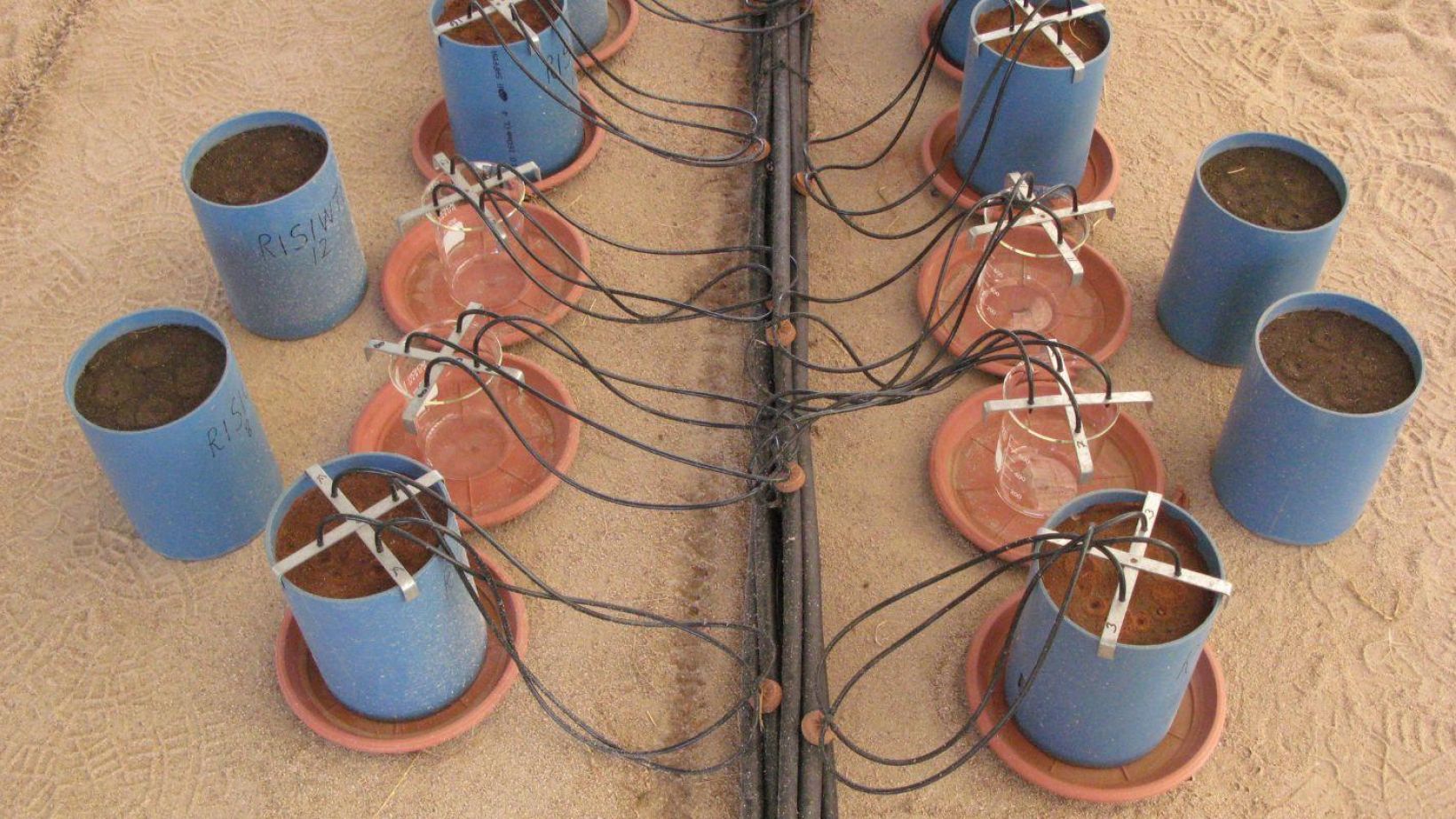
Details of the pot experiment were given previously.20 In brief, a pot experiment was carried out under a 20 m x 40 m translucent fibreglass rain shelter at ARC Infruitec-Nietvoorbij. Four different soils, namely a Rawsonville sand, Lutzville sand, Stellenbosch shale and Stellenbosch granite, were included in the pot experiment. The control treatment soils were irrigated with municipal water. For the wastewater treatments, WWW was diluted to a chemical oxygen demand (COD) level of 3 000 mg/L.
Analyses
Water samples were collected prior to each irrigation. Due to a misunderstanding, P was not determined in the irrigation waters. The P and pH(KCl were determined by a commercial laboratory according to methods described previously.
Results
During the period of the pot experiment, the P levels in WWW obtained from the same winery near Rawsonville and also diluted to 3 000 mg/L COD for a field experiment, were 4.8±1.6 mg/L.7,21 The amount of P applied when the grapevines growing in the sandy soil of the field experiment were irrigated with the diluted WWW was 1.3±0.4 kg P per hectare per irrigation. Based on these results, the annual application would amount to 9.4±2.6 kg P per hectare per year if six diluted WWW irrigations were applied. This indicated that the annual amount of P applied was relatively small and that it varied between seasons.
The initial P contents were 217 mg/kg, 6 mg/kg, 8 mg/kg and 15 mg/kg, respectively, in the Rawsonville sand, Lutzville sand, Stellenbosch shale and Stellenbosch granite soils. With the exception of the Rawsonville sand, P contents in the four soils were in line with values expected for vineyard soils.10 The initial P content in the Rawsonville sand was substantially higher than 114-153 mg/kg reported for the vineyard where the bulk soil was collected.7 This suggested that the bulk soil was probably collected where a fertiliser spill had occurred. The initial P levels in the Rawsonville sand were substantially higher than the maximum of 20 mg/kg recommended for grapevines growing in soils containing less than 6% clay.10
Irrigation with municipal water had almost no effect on the P content in any of the soils (data not shown). The P content in the 10-20 cm layer of the Rawsonville sand tended to be higher compared to the top layer following the third diluted WWW irrigation, thereby indicating that attenuation of P did not occur in the top layer (Figure 1A). In contrast, irrigation with diluted WWW increased soil P substantially more in the 0-10 cm layer compared to the 10-20 cm layer of the Lutzville sand and Stellenbosch granite soil over the four simulated seasons (Figures 1B & 1D). This trend indicated that P attenuation occurred in the top layer of these soils. Although the P content in the 10-20 cm layer of the Stellenbosch shale tended to be lower after the first irrigation, it inclined at the same rate over time as in the 0-10 cm layer (Figure 1C). This indicated that no P attenuation occurred from the second irrigation onwards.
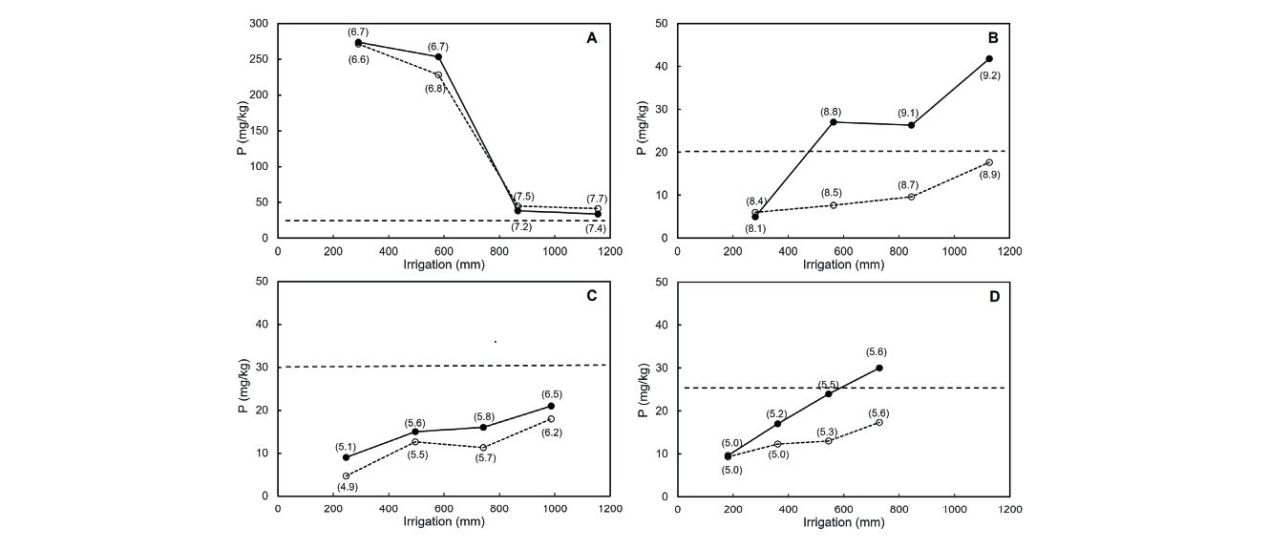
FIGURE 1. Effect of irrigation with diluted winery wastewater on P (Bray 2) in the 0-10 cm layer (solid circles) and 10-20 cm layer (open circles) in (A) Rawsonville sand, (B) Lutzville sand, (C) Stellenbosch shale, and (D) Stellenbosch granite soils over four simulated seasons. Values in brackets indicate the soil pH(KCl). Dashed lines indicate the P (Bray 2) thresholds for grapevines based on clay content.10
The drastic decline of available P in the Rawsonville sand following the third WWW irrigation was probably due to fixation by Ca2+ when the pH(KCl) exceeded 7 (Figure 1A). The P could also have formed soluble complexes with the constituents in the WWW that were either leached out or susceptible to breakdown and P release by the Bray II reagent.22 However, since no leaching occurred when irrigation was applied,18 it could not have contributed to the decline in available P. In contrast to the Rawsonville sand, available P in the Lutzville sand increased as the pH(KCl) increased well above 7, where the diluted WWW was applied (Figure 1B). This trend suggested that the increasing amounts of sodium applied via the WWW increased the soluble PO3-. In the case of the initially acidic Stellenbosch shale and granite soils (Figures 1C and 1D), the amorphous Fe3+ and Al3+ phosphates became more soluble as the pH(KCl) increased towards the optimum, as proposed previously.11 Since P was not determined in the irrigation water, models to estimate the effect of irrigation with diluted WWW on soil P based on the amounts applied could not be created. However, the general variation in available P for the four soils could be illustrated with a plot of relative P, as calculated for each soil and layer, against pH(KCl) (Figure 2).
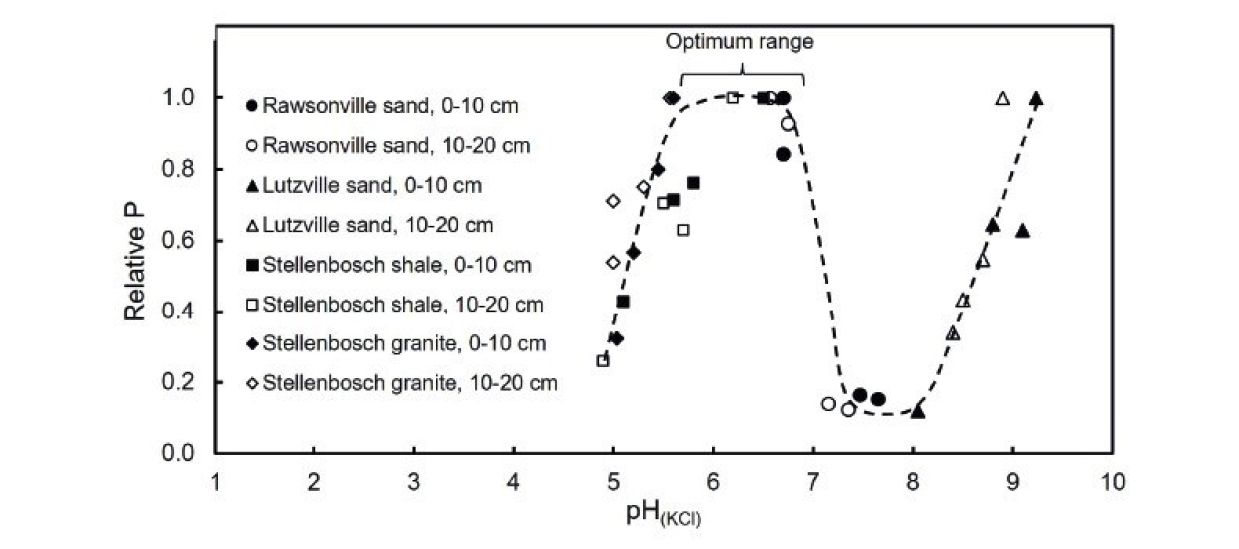
FIGURE 2. Variation in relative available P (Bray 2) content with soil pH(KCl) in four different soils that were irrigated with diluted winery wastewater over four simulated seasons. The dashed line was fitted by eye.
After the fourth season, available P in the Rawsonville sand was still well above the norm of 20 mg/kg proposed for grapevines10 in sandy soils (Figure 1A). However, this must be regarded as an atypical situation due to the initially high levels. In the more realistic scenario, P in the Lutzville sand only narrowly exceeded 20 mg/kg after the fourth simulated season (Figure 1B). After the fourth season, P in the Stellenbosch shale soil (Figure 1C) was well below the norm of 30 mg/kg for grapevines in soils containing more than 15% clay.10 Likewise, P in the Stellenbosch granite soil (Figure 1D) was less than the lower threshold of 25 mg/kg for soils containing 6-15% clay.10 The slow increase in P was probably due to the relatively low amounts of P applied via the diluted WWW.7 Although the minimum thresholds were not reached, this does not rule out the possibility that they could be achieved if diluted WWW is applied over a longer period. However, if grapevines and cover crops absorb the P applied via WWW, the minimum thresholds might not be exceeded to the extent that no fertilisers will be required.
Conclusions
Where diluted WWW was applied, the level of soluble P in the shale and granite soils increased as the pH(KCl) increased towards the optimum range for P availability over the four seasons. Although the initial pH(KCl) in the aeolic sand was higher than the optimum range, the presence of relatively high levels of Na+extr caused available P to increase as the pH(KCl) increased. In the case of the alluvial sand containing unusually high initial levels of P, the pH(KCl) increased out of the optimum range, thereby causing a substantial reduction in the level of available P. These results indicated that irrigation with diluted WWW will only promote P absorption by grapevines if the pH(KCl) shift is towards the optimum. Since the level of P applied via diluted WWW appears to be generally low, application of P fertilisers will still be necessary to ensure adequate uptake by grapevines. It is worth noting that the results represent a worst-case scenario, i.e. in the absence of rainfall or crops.
Effects of irrigation with diluted WWW on the enzyme status of the four soils in the pot study will be presented in the next article.
Acknowledgements
- This article is an output of WRC Project K5/1881, entitled “The impact of wastewater irrigation by wineries on soils, crop growth and product quality”. This solicited project was initiated, funded and managed by the WRC. The project was co-funded by Winetech and ARC.
- Goudini Winery for providing wastewater for the research.
- ARC for infrastructure and resources.
- Staff of the Soil and Water Science division at ARC Infruitec-Nietvoorbij for their assistance, and in particular Mr. F. Baron for his dedicated technical support.
References
- Bond, W.J., 1998. Effluent irrigation - an environmental challenge for soil science. Aust. J. Soil Res. 36, 543-555.
- Arienzo, M., Quayle, W.C., Christen, E. & Jayawardane, N., 2009. Irrigating with winery wastewater? Developing soil stability thresholds and managing total cations. Aust. N.Z. Grapegrow. Winemak. October 86-88.
- Christen, E.W., Quayle, W.C., Marcoux, M.A., Arienzo, M. & Jayawardane, N.S., 2010. Winery wastewater treatment using the land filter technique. J. Environ. Manage. 91, 1665-1673.
- Laurenson, S., Bolan, N.S., Smith, E. & McCarthy, M., 2012. Review: Use of recycled wastewater for irrigating grapevines. Aust. J. Grape Wine Res. 18, 1-10.
- Mosse, K.P.M., Patti, A.F., Christen, E.W. & Cavagnaro, T.R., 2011. Review: Winery wastewater quality and treatment options in Australia. Aust. J. Grape Wine Res. 17, 111-122.
- Arienzo, M., Christen, E.W., Jayawardane, N.S. & Quayle, W.C., 2012. The relative effects of sodium and potassium on soil hydraulic conductivity and implications for winery wastewater management. Geoderma 173-174, 303-310.
- Myburgh, P.A. & Howell, C.L. 2014. Use of winery wastewater as a resource for irrigation of vineyards in different environments. WRC Report No. 1884/1/14. ISBN 978-1-4312-0591-2.
- Papini, A.G., 2000. Land treatment of grape processing effluents near Robertson, Western Cape. M.Sc. thesis, University of Cape Town, Private Bag X3, Rondebosch, 7701.
- Sharpley, A.N., Curtin, D. & Syers, J.K., 1988. Changes in water-extractability of soil inorganic phosphate induced by sodium saturation. Soil Sci. Soc. Am. J. 51, 637-640.
- Conradie, W.J., 1994. Vineyard fertilization. ARC-Fruit, Vine and Wine Research Institute, Private Bag X5026, Stellenbosch, South Africa, 7599.
- Busman, L., Lamb, J., Randall, G., Rehm, G. & Schmidt, M., 2002. The nature of phosphorus in soils. University of Minnesota Extention, St Paul, 5p.
- Naidu, R. & Rengasamy, P., 1993. Ion interaction and constraints to plant nutrition in Australian sodic soils. Aust. J. Soil Res. 31, 801-819.
- Abrol, I.P., Yadav, J.S.P. & Massoud, F.I., 1988. Salt affected soils and their management. FAO Soils Bulletin 39, FAO, Rome, 131p.
- Lieffering, R.E. & McLay, C.D.A., 1996. Effects of high pH solutions with large monovalent cation concentrations on cation exchange properties. Aust. J. Soil Res. 34, 229-242.
- Mulidzi, A.R., 2001. Environmental Impact of winery effluent in the Western and Northern Cape Provinces. M.Sc. dissertation, University of Pretoria, Private Bag X20, Hatfield, 0028.
- Laurenson, S., Bolan, N.S., Smith, E. & McCarthy, M., 2010. Changes in the cation composition of a Barossa chromosol irrigated with wastewaters of contrasting monovalent cation concentrations. Proc. 19th World Congress of Soil Science, Soil solutions for a changing World. 1-6 August, Brisbane, Australia.
- Laurenson, S. & Houlbrooke, D., 2011. Winery wastewater irrigation - the effect of sodium and potassium on soil structure. Report prepared for Marlborough District Council. Agresearch. 1-22.
- Mulidzi, A.R., Clarke, C.E. & Myburgh, P.A., 2016. Design of a pot experiment to study the effect of irrigation with diluted winery wastewater on four differently textured soil. Water SA 2, 20-25.
- Bueno, P.C., Rubi, J.A.M., Gimenez, R.G. & Ballesta, R.J., 2009. Impacts caused by the addition of wine vinasse on some chemical and mineralogical properties of a luvisol and a vertisol in La Mancha (Central Spain). J. Soils Sedim. 9, 121-128.
- Mulidzi, A.R., 2016. The effect of winery wastewater irrigation on the properties of selected soils from the South African wine region. Ph.D. dissertation. Stellenbosch University, Private Bag X1, 7602 Matieland (Stellenbosch), South Africa.
- Howell, C.L., 2016. The effect of winery wastewater irrigation on the properties of selected soils from the South African wine region. Ph.D. dissertation. Stellenbosch University, Private Bag X1, 7602 Matieland (Stellenbosch), South Africa.
- Eloff, J.F. & Laker, M.C., 1978. Phosphorus studies on Vaalharts soil. II. The evaluation of method of extraction by correlation of results with various wheat crop parameters. Agrochemophysica 10, 19-23.
For more information, contact Reckson Mulidzi at [email protected].
Click here to get your copy of WineLand Magazine.

More from
Vineyard, cellar and production
How to understand regenerative farming
Regenerative farming is becoming part of the language of modern viticulture, but what does it actually look like in a vineyard?
JC Smith praat oor wynmaak in die Oos-Vrystaat
JC Smith is ’n derdegeslag-wynmaker. Sy oupa Dassie en pa Flip was albei wynmakers, en hy het tussen wingerde en wynkelders grootgeword. Hy is tans die wynmaker by Blydschap in die Oos-Vrystaat.

Cellar hygiene
Maintaining a spotless wine cellar requires a comprehensive management plan, which includes structural design, equipment sanitation, environmental controls and routine microbial monitoring.